Every day is consumer research: Moving from ad-hoc to always-on brand tracking


Consumer insight is not a one-off exercise; annual dips and ad-hoc agency reports are too slow and too expensive for how marketing works in 2026. Here's a guide of how (and why) to move from thinking of consumer research like a one-off event – and start thinking of it as part of the infrastructure instead.
The modern-day consumer has so much to sift through, all the time: from their morning TikTok scroll as they wake up, to the storefronts and bus-stop ads on their commute, to the piles of newsletters hitting their inbox from the second the sun rises in the east. Awareness, knowledge and perceptions of brands are being formed and reformed constantly; sometimes shifting as frequently as month to month.
So relying on traditional brand research for insights to inform marketing strategy doesn’t make a whole heap of sense – not when the quarterly dip or annual report will often land on your desk months too late to capture a real pulse on how consumers are thinking or feeling. By the time you get the data back, your campaign is over; the competitor has already moved on; and the conversation has shifted. The data housed inside a one-off dip isn’t used to shape the future – it’s simply explaining the past.
Your brand is always-on – it only makes sense that your brand tracker is as well.
Tracksuit Demo Video
The three main reasons brands make the switch 🔁
🔴 “We outgrew our old model.”
Brands that have previously relied on performance marketing but are starting to invest more into brand building (something we highly endorse, obviously) may find that their tracking and attribution models need an update, too.
As Lee Robinson, the Associate Director of Insights and Customer Strategy at telehealth company Ro, opens in new tab says, “Before moving to Tracksuit, we were fielding waves of brand health studies periodically. That approach worked well when most of our marketing investment was focused on direct-response advertising, where success was easy to measure in near-real time.
“As we began investing more intentionally in brand building and awareness, and ramping up our overall media spend, it became clear that periodic studies weren’t giving us the visibility or continuity we needed. We wanted a more agile and consistent way to understand how our brand was evolving, how our efforts were resonating, and where we were winning or lagging in consumer perception.”
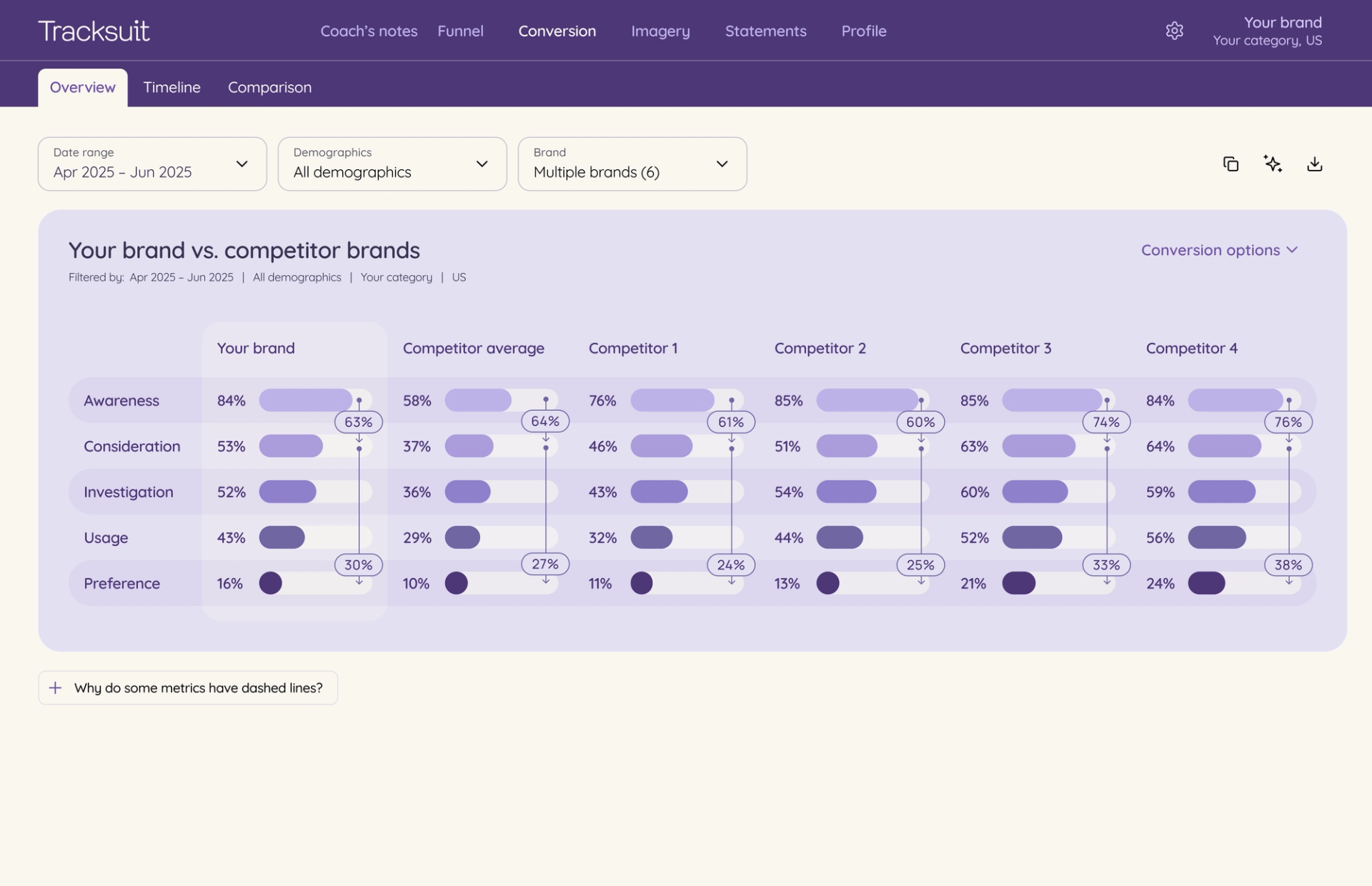
Tracksuit has plenty of features which help brands identify where they’re winning and losing.
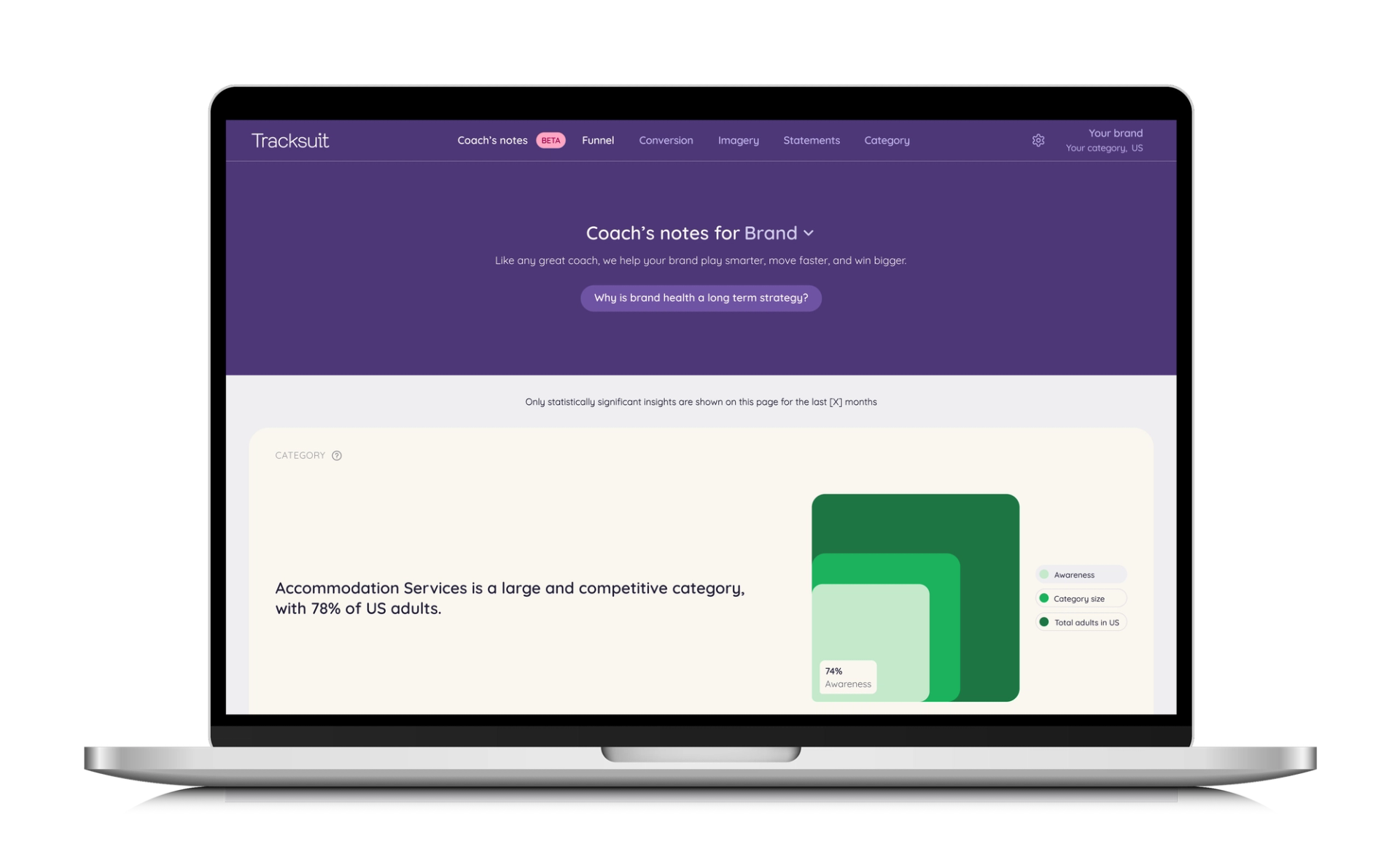
Coach’s Notes helps to surface your brand’s statistically significant shifts within brand and category – so you can make faster, smarter calls. It’ll show you what kind of attributes are driving conversion down the funnel, and also allows you to drill into demographics to see your performance within priority audiences. And, yes, it updates month-to-month.
“As we began investing more intentionally in brand building and awareness, and ramping up our overall media spend, it became clear that periodic studies weren’t giving us the visibility or continuity we needed." - Lee Robinson, Associate Director of Insights and Customer Strategy, Ro
🔴 “We couldn’t trust what we were getting.”
There are countless options, platforms and methods of collection within the market research industry, some of which may be less reliable than others. If you’re making foundational decisions using data, then the quality of that data matters.
David Elster, the Director of Insights & Strategy at Orangetheory, opens in new tab, said, “We moved to Tracksuit because our previous partner consistently fell short. Responses were low-quality and unreliable… on top of that, the solution wasn’t always-on the way Tracksuit is. Collectively, these gaps made us skeptical of the output and pushed us towards a more modern, high-fidelity tracking solution.”
Tracksuit moves at the pace marketers operating in 2026 are expected to move at (that is, quickly). For around the same price (or less, in some instances), Tracksuit’s affordable solution gives you access to high-quality data, with the added value of being always on.
🔴 “We needed to prove what was working, faster.”
Quarterly reports and annual snapshots don’t exactly facilitate quick action – in fact, it makes it very hard to understand what’s actually working and what isn’t. How are you supposed to attribute a tick upwards in a certain demographic to a brand campaign that ended 7 months ago? What do you say to your CEO when they ask about it?
Elster pointed out that being able to attribute specific marketing activity was a crucial decision factor in moving. “One of the biggest value adds is finally being able to understand and control for seasonality, which is a critical factor in our industry. With always-on data, we can isolate the impact of specific awareness campaigns instead of relying on a single end-of-year snapshot. As a bonus, the increased reporting cadence gives us more frequent touchpoints to evaluate brand health shifts and think through their implications.”
Robinson also sees the value of this at Ro. “Having a continuous, reliable source of truth that we can reference against key milestones, campaigns, and initiatives allows us to directly correlate media moments with tangible brand impact.”
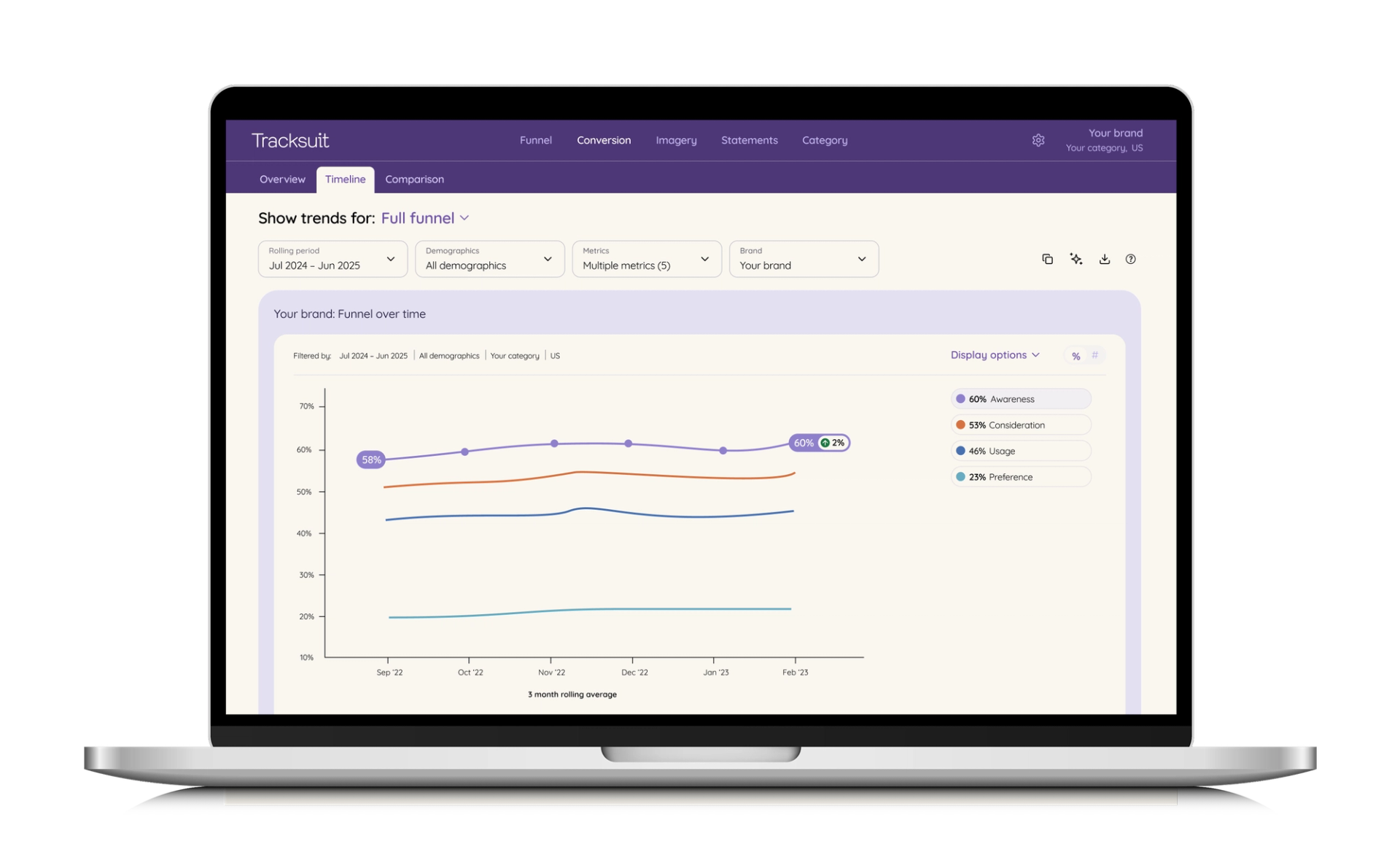
Tracksuit updates monthly, meaning you can see how your brand funnel shifts month by month. That means that, yes, you can spot how things like campaigns, competitor launches or retail pushes are landing, without waiting 6 to 12 months for that research dip.
Robinson also said that Tracksuit was an asset to them internally. “It’s also helped us communicate more effectively internally, bridging the gap between direct-response performance metrics and longer-term brand outcomes. With Tracksuit, our team can visualize how brand and performance work together, which helps us make smarter, more balanced marketing decisions and align the broader organization around shared goals.”
Tracksuit has unlimited seats, meaning everyone in your organization (and even your agencies) can see the same fresh category, brand and consumer data at the same time. This allows you to align teams without an expensive workshop or 50-slide tracker deck – and bridge the gap effectively, just like at Ro.
"With always-on data, we can isolate the impact of specific awareness campaigns instead of relying on a single end-of-year snapshot." - David Elster, Director of Insights & Strategy, Orangetheory
What does the shift from ad hoc to always-on actually look like?
Always-on brand tracking slots right into the other ways in which brands are monitoring their brand health in 2026 – it’s only one part of the picture. You should be building an always-on stack that shifts internal workflows from ad-hoc tools to continuous insight.
Layer 1: What people are saying.
What consumers are saying about you in the big, bad world can paint a fuller picture and help fill in gaps that are otherwise missed through data. Think: qualitative, real-time insights that are gleaned through social media listening tools, community feedback, review sites, and even 1:1 DMs and comments.
Like Ruth McGlynn, then the Head of Brand Strategy at skincare brand BYOMA said in our webinar, ““We see every channel as a chance to connect. We’ve received over a quarter of a million DMs since launch. We use those insights to inform marketing and innovation—every element—because it’s a live sounding board.”
Layer 2: What people are doing.
The second layer to look at is real-time behavorial actions that signal how your work is translating to actions: that’s things like website analytics, sales data, product usage and purchase behavior.
Ensuring you have an always-on approach to evaluating these allows you to track patterns and better understand where, when and why people do the things they do.
Layer 3: What people are thinking.
Tracksuit’s always-on brand tracking forms the third layer: a way of understanding people’s perceptions of your brand, updated monthly.
You can get timely answers to questions like:
🟣 Are people aware of you?
🟣 Do they consider you?
🟣 How do you compare to competitors?
🟣 What actually drives people from awareness to consideration?
Insights should be part of the infrastructure – not a one-off event.
It can be a mind-shift to move towards an always-on mode when it comes to consumer research, especially if you’ve been previously relying on quarterly dips or ad-hoc waves.
However, you don’t have to blow up your current set-up. Step back, look at the gaps, and address the highest priority needs. Plus, piloting brand tracking is a good idea: in the first instance, setting a baseline for your brand health so you actually know where you stand, then using it to guide decision-making, unite internal teams, and ultimately track the long-term brand impact of marketing activity.
Tracksuit gets you started in 30 days – we don’t do the weeks-of-back-and-forth-to-agree-on-a-questionnaire thing.
Book a demo now and see what always-on looks like.