How to Measure Brand Awareness (and Prove It's Working)
Written by


Quick Summary
The best way to measure brand awareness is through structured, always-on, survey-based tracking that measures unaided and aided recall, consideration, usage, and preference across your category. Pair that with demographic segmentation and competitive benchmarking so your data leads to decisions, not just dashboards.
You Can't Prove Brand Is Working Without Measuring It
You're spending real money on brand, campaigns, creators, sponsorships, and out-of-home. But when leadership asks, "Is it working?" most marketers reach for Google Analytics and social listening tools that show behavior, but not brand health.
This guide covers how to measure brand awareness properly using the right metrics and methods, and how always-on tracking makes the whole process affordable and actionable.
What Brand Awareness Actually Means
Brand awareness is the probability that people in your category will think of your brand when it matters. When they're browsing a shelf, searching online, or weighing options against a competitor.
It's the foundation every brand relationship is built on. Without it, consideration and preference never follow.
Awareness breaks down into layers:
- Unaided awareness: Can someone name your brand from memory when asked about your category?
- Aided awareness: Do they recognize your brand when shown the name or logo?
- Mental availability: How readily does your brand surface in a buying situation?
Each layer tells you something different about whether your marketing is building the kind of presence that drives future growth.
Why Most Teams Struggle to Measure Brand Awareness
The tools most marketers have access to weren't built for this job.
Google Analytics shows how many people come to your website. It can't tell you how many category buyers have never heard of you. Social listening captures mentions and sentiment, but only from people already talking about you online.
On the other hand, ad-hoc surveys through SurveyMonkey or Typeform give you a snapshot, but without a consistent methodology, you can't trust the data over time or compare it to anything meaningful.
The result is a collection of proxies that feel like measurements but don't add up to a real picture of brand health. As one brand leader put it, "We're using brand search as a proxy because we don't have brand tracking."
What fills that gap is structured, survey-based tracking with a consistent methodology applied month after month.
Why Measuring Brand Awareness Matters
Investing in a brand without measuring it is a faith-based marketing strategy that doesn’t hold up. You believe it's working, but you can't demonstrate that to anyone holding the budget.
Here's what consistent measurement actually gives you.
Proof of Marketing Impact when Budgets are on the Line
When your CFO asks why you're funding a campaign that won't show up in this quarter's revenue, awareness metrics give you the answer. Growing awareness is a leading indicator. More people know you exist, which means more people will consider buying from you. That's the commercial language finance teams understand.
Visibility Into Campaign Performance
Sales data lags. By the time revenue reflects a brand campaign's impact, you've already moved on. Awareness and consideration metrics show whether a campaign is shifting perceptions while it's still running, or shortly after, so you can adjust before the budget is fully spent.
A View of Where you Stand in Your Category
Your awareness number in isolation doesn't mean much. What matters is where you stand relative to competitors. Are you gaining ground? Holding steady while a new entrant takes share? Without category-level measurement, you have no frame of reference for whether your brand growth is strong, average, or falling behind.
Clarity on how You are Perceived by the Audience
Averages hide the truth. You might have strong awareness among women aged 25-34 and almost none among men aged 45+. Segmented awareness data shows you where to focus media, creative, and distribution so you're spending on audiences who need to hear from you, not ones who already know you.
Shared Language Across Your Team
When marketing, product, agencies, and leadership all work from the same brand health dashboard, decisions get faster, and arguments get shorter. One source of truth means everyone's looking at the same numbers and working toward the same goals.
How to Measure Brand Awareness in 6 Steps
1. Define What You’re Trying to Learn
Before you start, be specific about what you want to learn. "Measure brand awareness" is too vague to be useful.
Start by deciding which layer of awareness you care about most. Unaided awareness tells you whether your brand comes to mind without prompting. Aided awareness tells you whether people recognize you. And further down the funnel, consideration, usage, and preference each reveal a different relationship between your brand and the people in your category.
These metrics connect to different business outcomes. Growing unaided awareness tends to reduce paid acquisition costs over time, while rising consideration correlates with future sales. Strengthening preference signals loyalty and pricing power.
Link your objectives to your marketing funnel. Establish a baseline with whatever data you have today. Decide who sees these numbers, how often, and in what format.
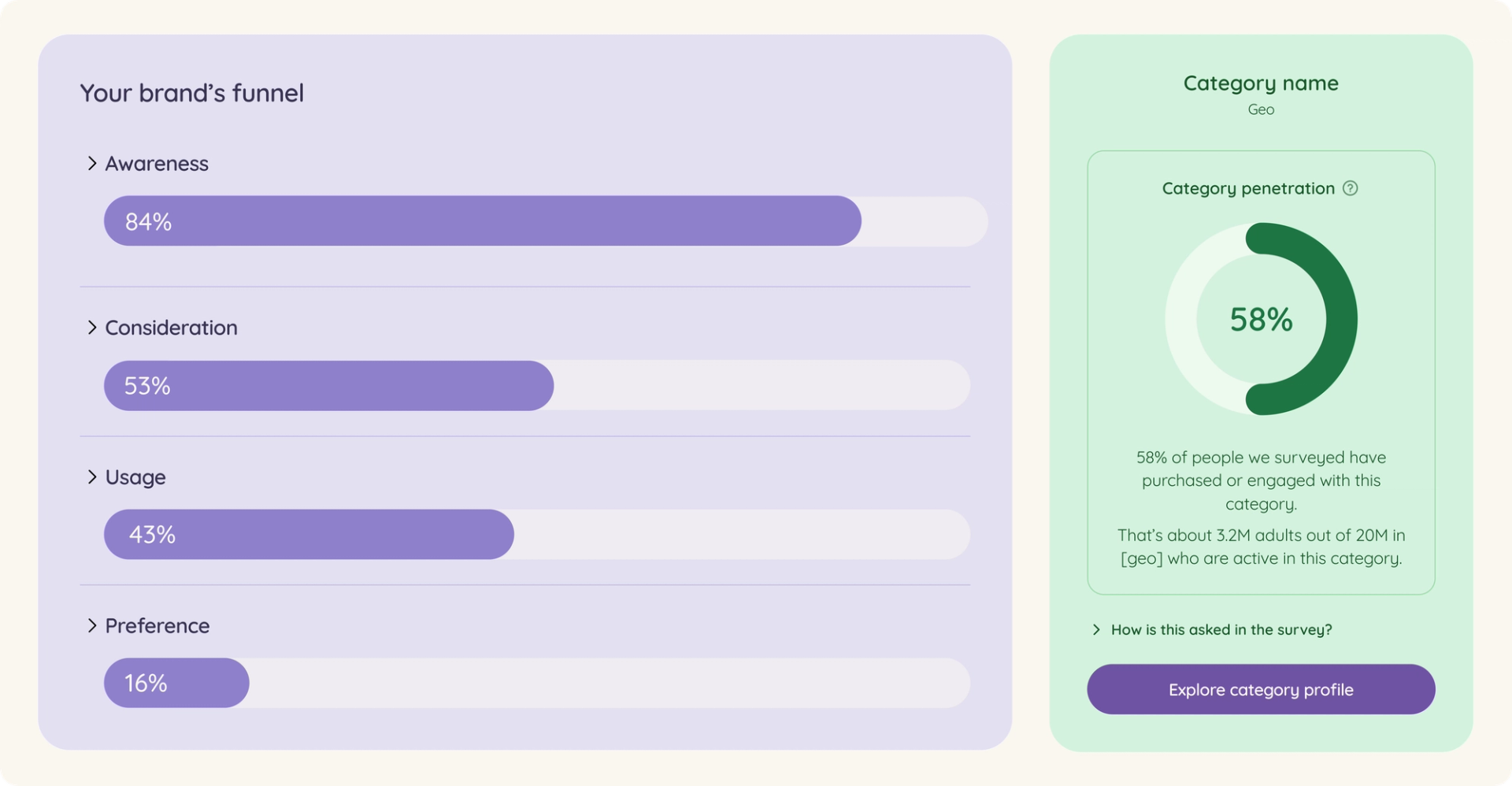
Tracksuit tracks a 5-stage brand funnel: awareness, consideration, investigation, usage, and preference. You set baselines from month one, then track how each metric shifts over time.
2. Pick the Right Method
Different approaches show you different things. The key is matching your method to your objectives, then sticking with it.
- Survey-based brand tracking is the gold standard. It measures what people think, recall, and feel about your brand directly. It's the only method that captures mental availability from consumers who may have never visited your website or mentioned you online. Those people represent your growth opportunity.
- Social listening captures public mentions and sentiment. Useful for buzz and cultural relevance, but limited to people already talking about you.
- Search trend analysis shows when and how often people search for your brand or category. Directional, but not diagnostic.
- Web analytics tracks branded traffic and direct visits. A rough proxy for brand strength, but only among people who already know you well enough to search your name.
None of these tell you how many people in your category could name your brand or whether they'd consider buying it. For that, you need structured survey-based tracking—the same questions, the same sample construction, and the same cadence, every time.
Tracksuit uses census-weighted, nationally representative panels (provided by Dynata and CINT), weighted by age, gender, and region, and tailored to your specific category. Data stays clean and comparable month after month without your team managing panels or designing questionnaires.
3. Track Metrics That Connect to Business Outcomes
Once your methodology is set, focus on the five metrics that map the full buyer journey:
- Unaided awareness: Percentage of category buyers who name your brand unprompted. The clearest signal of mental availability
- Aided awareness: Percentage who recognize your brand when shown it. Tells you how far your marketing has reached
- Consideration: Percentage who would consider buying. One of the strongest leading indicators of future revenue
- Investigation: Percentage who have actively sought out more information about your brand. Bridges the gap between consideration and purchase intent.
- Usage: Percentage who have bought or used your brand. Connects awareness to commercial reality
- Preference: Percentage who would choose you over every other option. The ultimate signal of loyalty and pricing power
Together, these five stages cover the full journey from "I've heard of you" to "you're my first choice." Tracking all five gives you a complete view of brand health rather than a single top-of-funnel number.
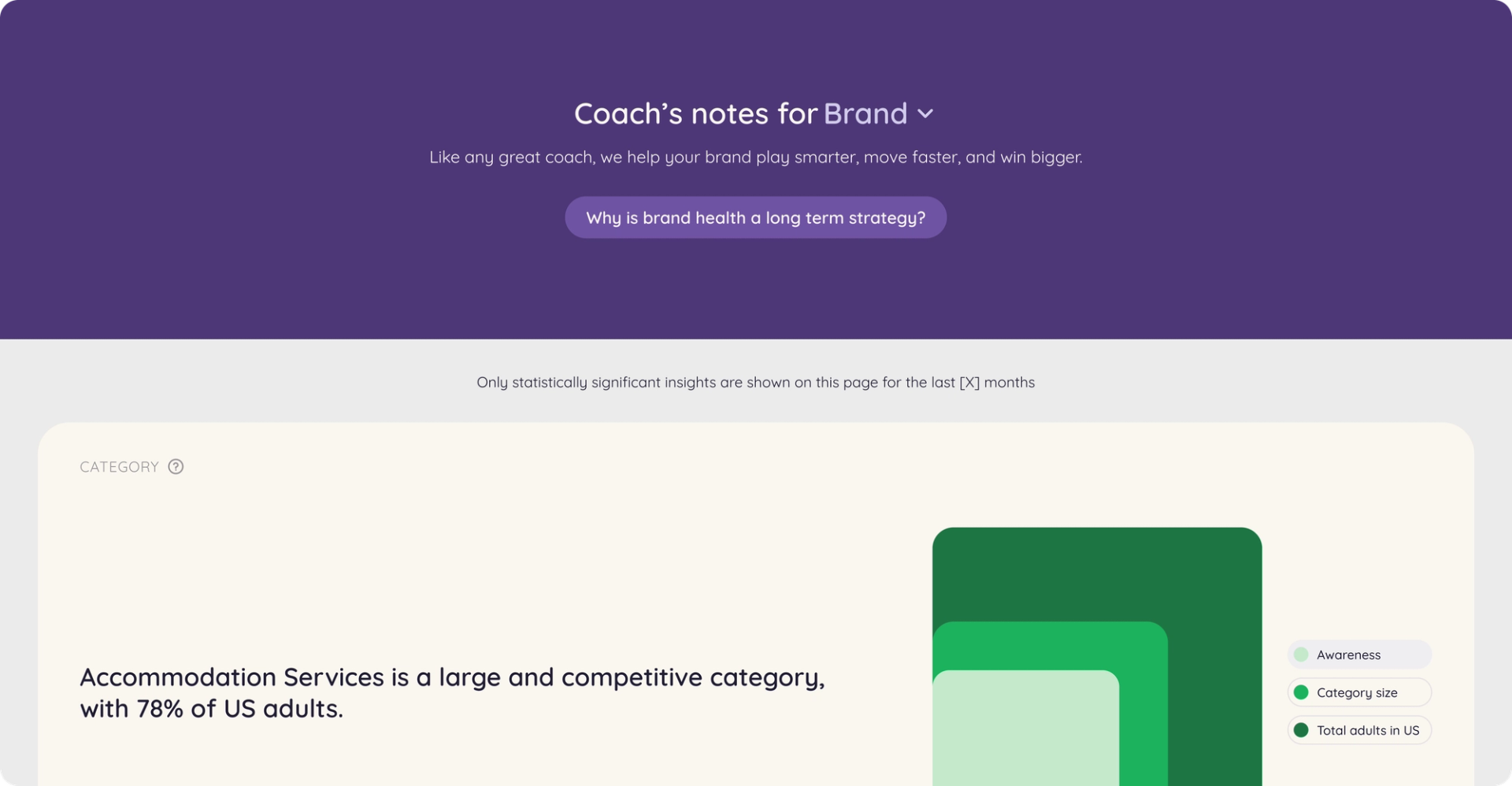
Tracksuit visualizes all five in one dashboard with comparisons across time, competitors, and audience segments. The Coach's Notes feature highlights the most significant changes so you spend less time digging through data.
4. Segment to Find the Real Story
Total-market averages rarely tell you where to act. Breaking data into meaningful segments makes it easier to extract insights.
Filter your metrics by:
- Demographics (age, gender, life stage)
- Geography (markets, regions, cities)
- Customer type (new vs. returning, light vs. heavy category buyers)
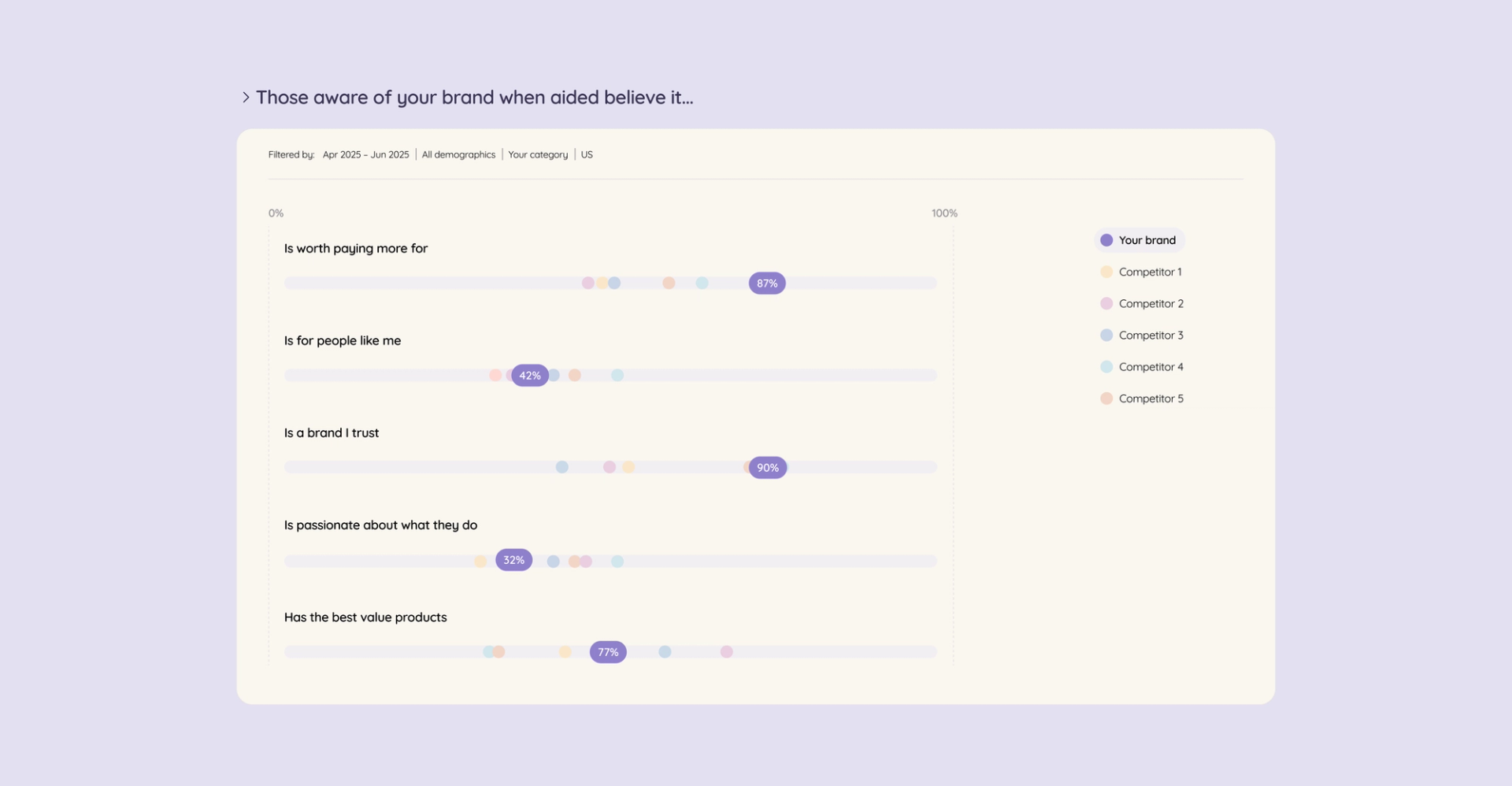
You might discover that Gen Z awareness is climbing fast while 45+ is flat. Or that one region drives most of your consideration growth while another stalls. These patterns shape where you put budget, how you brief creative, and which audiences your media plan prioritizes.
Tracksuit's dashboard supports demographic filtering across every page. The Statements feature shows which brand attributes are most associated with conversion for each segment, so you can see which perceptions are holding specific groups back.
5. Measure Progress Over Time, Not in Snapshots
A one-off brand study tells you where you are today, but it can't tell you whether you're heading in the right direction.
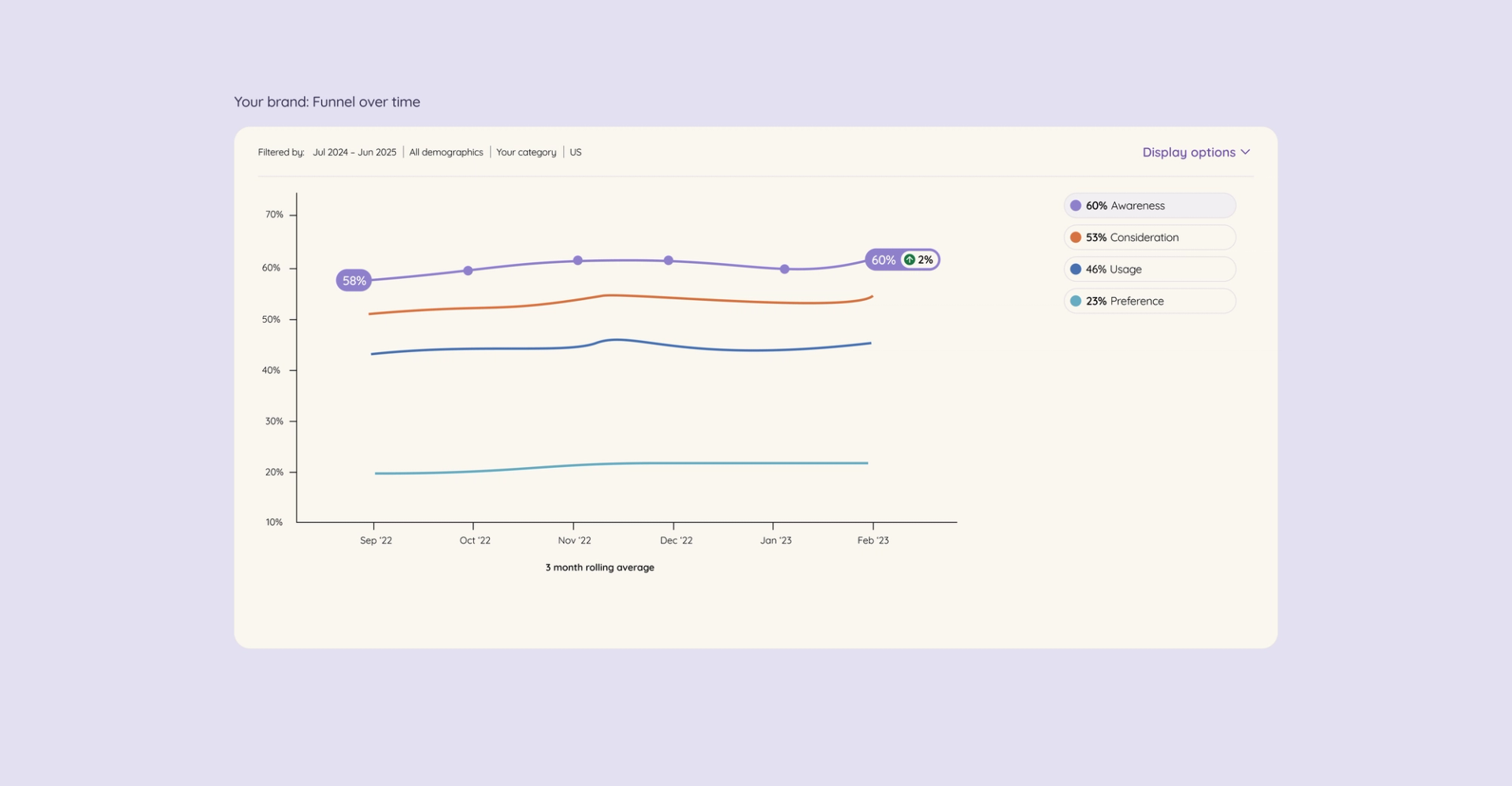
Annual studies are worse. By the time the data arrives, the moment has passed. Continuous tracking answers the questions that actually matter: did awareness rise after your latest OOH campaign? Did consideration dip when a competitor launched? Did preference grow after a brand refresh?
Tracking competitors in parallel adds the context you need. Your numbers in isolation don't mean much. Your growth rate relative to the category is what counts.
Tracksuit updates monthly and supports Milestone tagging. You can mark campaign launches, product drops, and competitor activity directly on your timeline, connecting shifts in brand health to the actions that caused them.
6. Turn Data Into a Story Your Stakeholders Care About
Collecting data is half the job. The other half is presenting it in a way that creates buy-in.
Instead of showing a chart and hoping people draw the right conclusion, frame your data as a narrative. "Our latest campaign lifted unaided awareness by 8 points among 25-34-year-olds in our target market. That's the highest single-month shift we've seen." That ties marketing activity to a measurable brand outcome, in language anyone at the table can follow.
Position awareness as a leading indicator, not vanity data. Growing awareness means a larger pool of potential customers. Rising consideration means more people are warm enough for performance channels to convert. Strengthening preference means better retention and pricing power.
Tracksuit's dashboards are built for this: export-ready charts, visual reporting that doesn't need a data scientist to interpret, and team-wide access so everyone from your agencies to your board sees the same numbers.
Best Practices for Measuring Brand Awareness
Set a baseline before you launch anything. You can't prove a campaign worked without knowing where you started. Tracksuit can have your first benchmark ready in 30 days.
Focus on trends, not individual data points. One month's number doesn't tell you much. Build reporting around trend lines over months and quarters. Resist the temptation to overreact to short-term fluctuations.
Always benchmark against competitors. Growing 3 points while your main competitor grows 10 is a very different situation than growing 3 points while they're flat. Category context gives your numbers meaning.
Make data easy to share. If your brand data lives in a 200-page PDF that only your insights team can interpret, it won't influence decisions. Choose tools and formats that make brand health visual and intuitive to everyone who needs it.
Separate activity metrics from brand metrics. Impressions, reach, and social mentions tell you what you did. Awareness, consideration, and preference tell you whether it worked. One is input, the other is outcome.
Be consistent above all. Same methodology, same questions, same audience definitions, same cadence. That's how you build a dataset you can trust and a story you can tell with confidence.
Brand Awareness Measurement Doesn’t Have to Be Slow or Expensive
Brand measurement has carried a reputation for years: expensive, slow, academic, and disconnected from the decisions marketers actually make.
Annual trackers that cost six figures and deliver 200-page PDFs months too late. DIY surveys with inconsistent methodology and no competitive context. Proxy metrics stitched together from tools that were never designed for the job.
Always-on brand tracking solves this. It launches in 30 days, updates monthly, costs a fraction of legacy alternatives, and lives in a dashboard your whole team can access.
That's what Tracksuit was built for—brand tracking that helps marketing teams see and prove the impact of brand building. When you can show that your work is growing awareness, driving consideration, and building preference, you stop defending brand investment and start leading the conversation about where to invest next.
See how your brand is really performing. Request a demo.