7 Best Brand Management Tools for Tracking and Growing Your Brand
Written by


Quick Summary
The right brand management tools depend on what you're managing. Tracksuit tracks consumer perception through always-on surveys. Quantilope automates advanced research methodologies. Qualtrics offers brand tracking inside a broader enterprise platform. Meltwater and Brandwatch cover media monitoring and social listening. Frontify centralizes brand assets and guidelines. Sprinklr unifies social media management at scale.
Need the Right Tools to Grow Your Brand?
"Brand management tools" could mean five different things depending on who's typing it. A brand marketer tracking awareness and perception needs a completely different platform than a design team organizing logos, guidelines, and templates. Both are valid answers to the same search.
This guide covers 7 of the top brand management tools across the categories that matter most: brand tracking and perception, media monitoring, social listening, brand asset management, and social media management. We've organized them by function, so you can get right to the tools that solve your specific problem.
Why Listen to Us?
Tracksuit works with over 1,000 brands, including Athletic Brewing Company, Turo, Steve Madden, and The RealReal. We help marketing teams benchmark brand health against competitors and connect perception data to commercial outcomes. That hands-on experience gives us a clear view of where different brand management tools fit and where they fall short.
What Are Brand Management Tools?
Brand management tools are platforms that help you build, monitor, and protect how your brand is perceived in the market. The category covers everything from tracking consumer awareness to managing your visual identity across teams.
At a high level, they fall into four distinct types:
- Brand tracking tools measure how consumers perceive your brand. Awareness, consideration, preference. This is the strategic layer: understanding whether your marketing is actually shifting how people think about you relative to competitors.
- Media monitoring and social listening tools track what's being said about your brand across news, social media, blogs, forums, and reviews. This is the reputation layer: knowing when your brand is mentioned and catching sentiment shifts before they escalate.
- Brand asset management tools help teams organize, distribute, and maintain consistency across logos, guidelines, templates, and imagery. This is the operational layer: keeping every touchpoint on-brand as teams and markets scale.
- Social media brand management tools bring publishing, engagement, listening, and analytics together. This is the presence layer: making sure your brand's social footprint is consistent, strategic, and measurable.
Most brands need some combination of all four. The right mix depends on your size, stage, and priorities.
Why Brand Management Tools Matter
Without structured tools, brand management tends to happen reactively. You notice a campaign isn't landing, or a competitor is eating into your consideration share, or your assets are inconsistent across channels. Then you scramble.
Brand management tools shift you from reactive to proactive.
- Visibility into brand health. Are more people aware of your brand than last quarter? Would they consider buying from you? Brand tracking platforms answer these questions with data, not guesswork.
- Reputation awareness. What are people saying about your brand online? Is sentiment shifting? Monitoring tools make sure you're not the last to know when the conversation changes.
- Brand consistency at scale. As teams grow and campaigns multiply across markets, keeping your brand consistent gets harder. Asset management tools give everyone access to the right materials.
- Evidence for leadership. Brand management tools turn "we think the brand is doing well" into specific metrics you can present with confidence. Whether it's awareness growth, sentiment trends, or share of voice, data makes the case for continued brand investment far more effectively than gut feel.
7 Best Brand Management Tools by Category
1. Tracksuit
Category: Brand tracking and perception
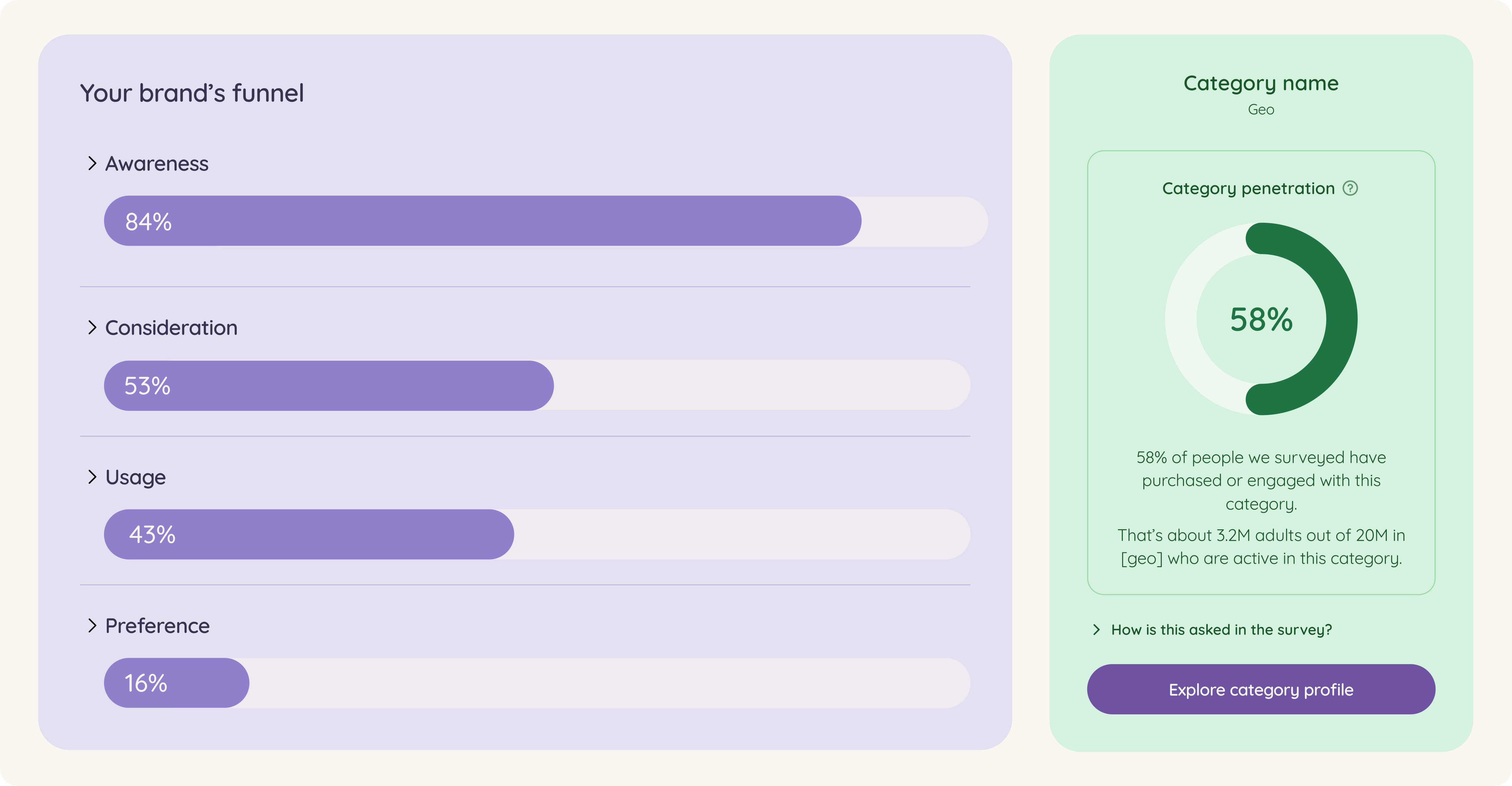
Tracksuit is an always-on brand tracking platform that measures how consumers in your category perceive your brand through continuous, census-weighted surveys. It tracks a 5-stage brand funnel (awareness, consideration, investigation, usage, and preference) and delivers monthly updates through an intuitive dashboard designed for marketing teams.
Where many brand management tools focus on what's being said online, Tracksuit measures what a representative sample of category buyers actually think. That includes people who've never visited your website, left a review, or interacted with your brand at all, i.e., the broader market that represents your biggest growth opportunity.
Key Features
- Consumer funnel tracking: Tracks awareness, consideration, investigation, usage, and preference with monthly updates, so you can see how perceptions shift as campaigns run
- Brand perception measurement: Measures perceptions through Imagery (spontaneous associations) and Statements (attribute ratings), the closest thing to hearing what your market thinks at scale
- Competitive benchmarking: Shows where you're gaining or losing in consumers' minds relative to competitors in your category
- AI-generated Coach's Notes: Surfaces the most significant changes in your data automatically, so you spend less time digging through dashboards
- Conversion Drivers analysis: Reveals which brand perceptions most strongly predict consumers moving through the funnel, so you know which associations are worth strengthening
Pricing
Plans start at $19,500/year for one brand category, your brand plus 5 competitors, with over 4,000 consumers surveyed. Add-ons available for extra competitors, markets, and brand perception statements.
Pros
- Segments by demographics, geography, and target audience for granular insights
- Unlimited seats, so marketing, agencies, and leadership share the same data
- Launches in roughly 30 days with minimal setup effort
- Affordable compared to traditional brand tracking, which often costs $100K+ annually
- Dashboard is intuitive enough for marketers to use without research training
Cons
- Designed for consumer brands, making it less applicable for B2B companies.
- Global market coverage is still expanding
2. Quantilope
Category: Brand tracking and perception
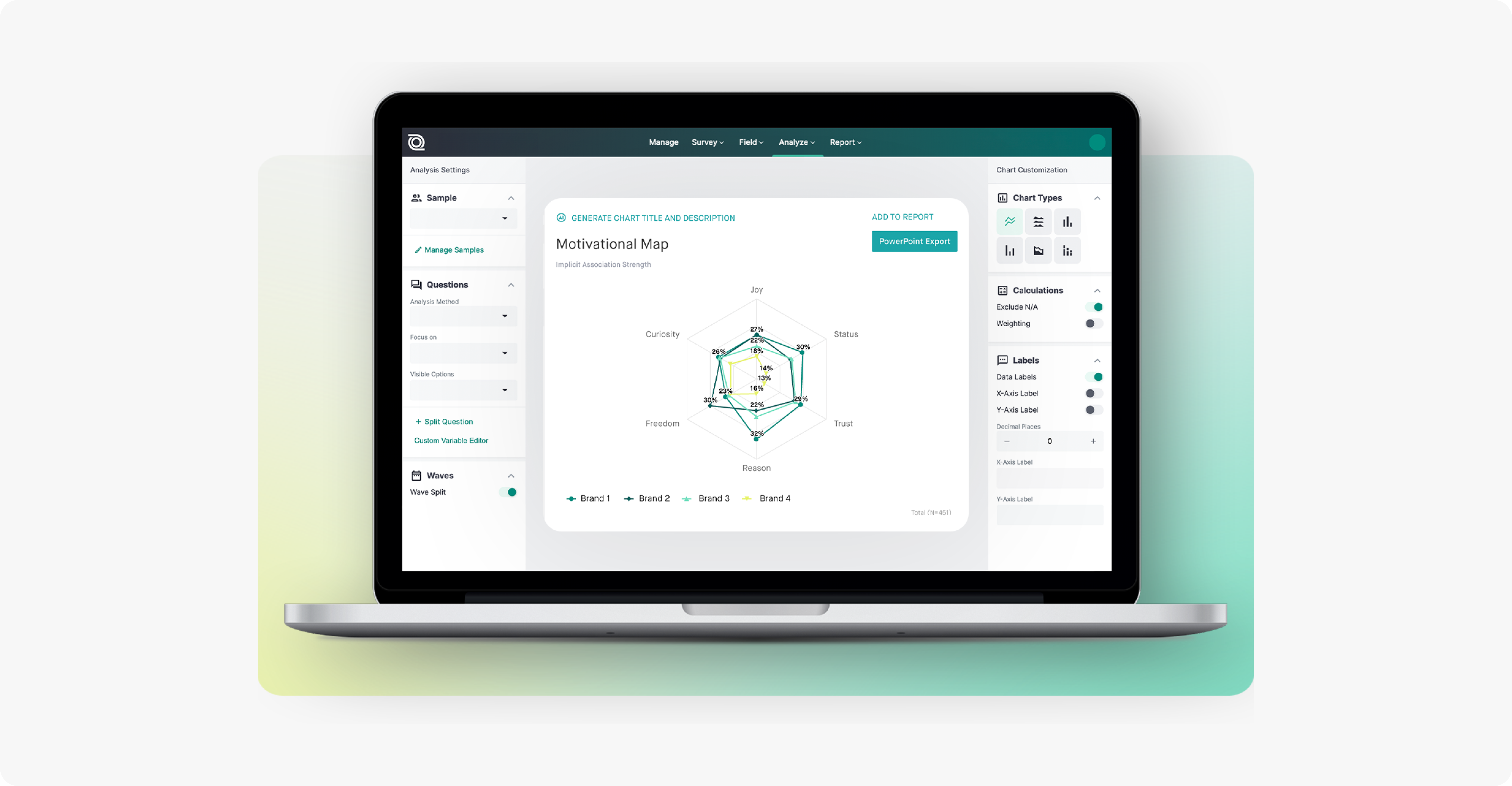
Quantilope is a consumer intelligence platform that automates brand tracking alongside 15+ advanced research methodologies. Its Better Brand Health Tracking (BBHT) approach incorporates Category Entry Points and Mental Availability analysis, grounded in Ehrenberg-Bass thinking. Research teams who want rigorous methodology with faster turnaround than traditional agencies will find this platform useful.
Key Features
- Automated brand tracking: Dashboards update as survey responses come in, giving near-real-time visibility into brand health metrics
- Advanced research methods: 15+ automated methodologies (MaxDiff, conjoint, implicit segmentation, and more) that condense weeks of work into days
- AI-driven analysis: The platform's AI co-pilot, quinn, identifies patterns, generates chart headlines, and summarizes dashboards for stakeholders
Pricing
Custom quote. Contact Quantilope for a demo.
Pros
- Competitive benchmarking across key brand health metrics
- Interactive, shareable dashboards for distributing findings across teams
- Multi-language study support for international research
Cons
- Steeper learning curve for teams without a research background
- Platform subscription means you may pay for capabilities you don't use
- Enterprise pricing for full methodology access isn't publicly available
3. Qualtrics
Category: Brand tracking and perception
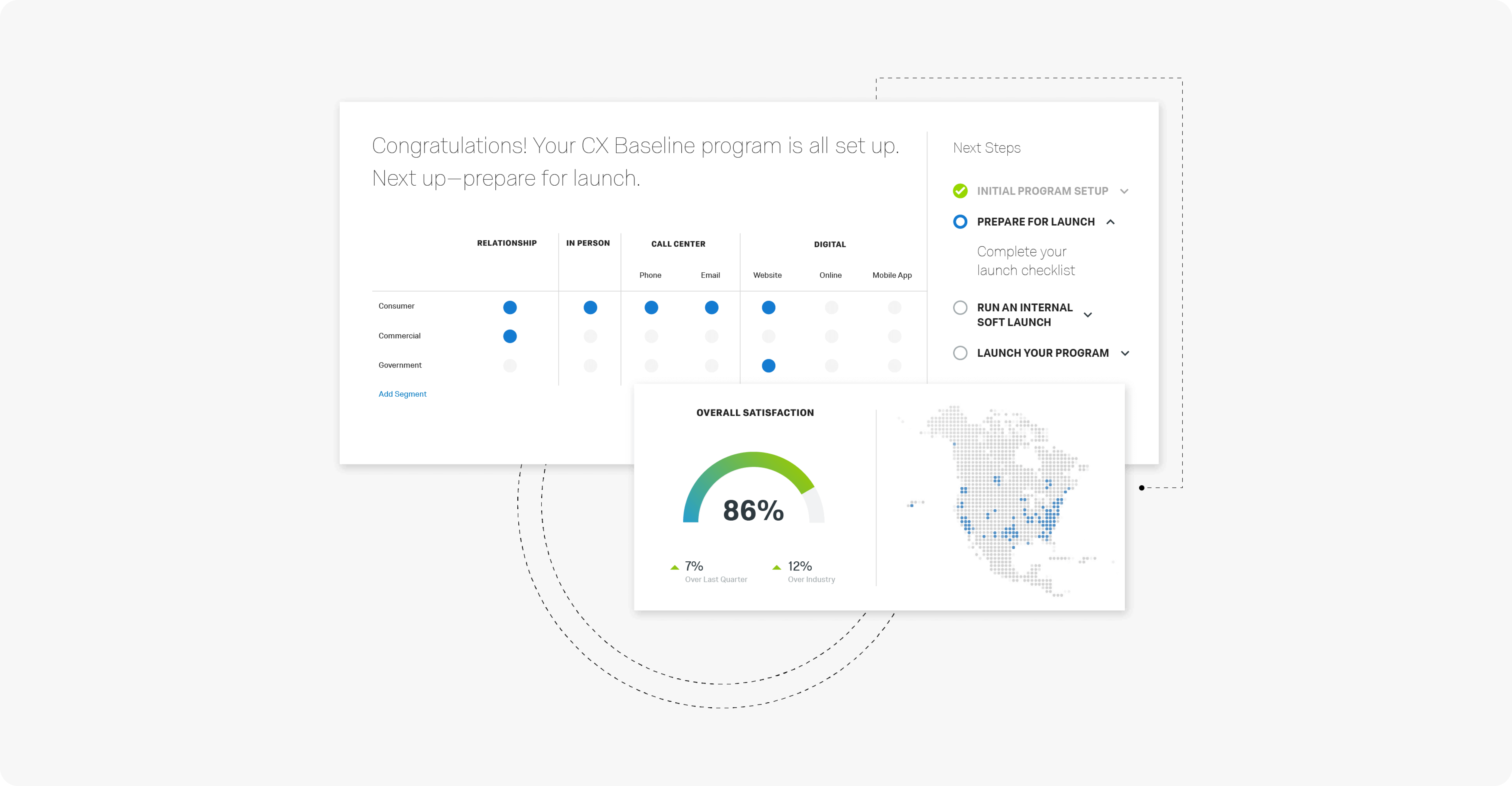
Qualtrics is a broad experience management platform with dedicated modules for brand tracking, customer experience, product research, and employee experience. For brand management specifically, it offers tools to monitor brand health, track perceptions, and measure marketing impact on brand equity. It's a fit for enterprise teams that want brand tracking as part of a broader experience management program rather than a standalone tool.
Key Features
- Brand health tracking: Monitors awareness, perception, and loyalty through automated surveys and dynamic dashboards
- AI-powered sentiment analysis: Processes unstructured feedback from surveys, social media, and reviews to surface how customers feel about your brand
- Competitive benchmarking: Tracks share of voice, sentiment, and brand perception relative to competitors
Pricing
Enterprise pricing, custom-quoted. Contact Qualtrics for a tailored proposal.
Pros
- Integrates brand tracking with customer experience and product research on a single platform
- Real-time crisis monitoring that flags sentiment shifts and mention spikes
- Robust data collection connecting survey, social, and behavioral data
Cons
- Enterprise pricing and implementation complexity put it out of reach for smaller teams
- Brand tracking is one module among many, not the platform's primary focus
- Requires more setup and expertise than purpose-built tracking tools
4. Meltwater
Category: Media monitoring and social intelligence
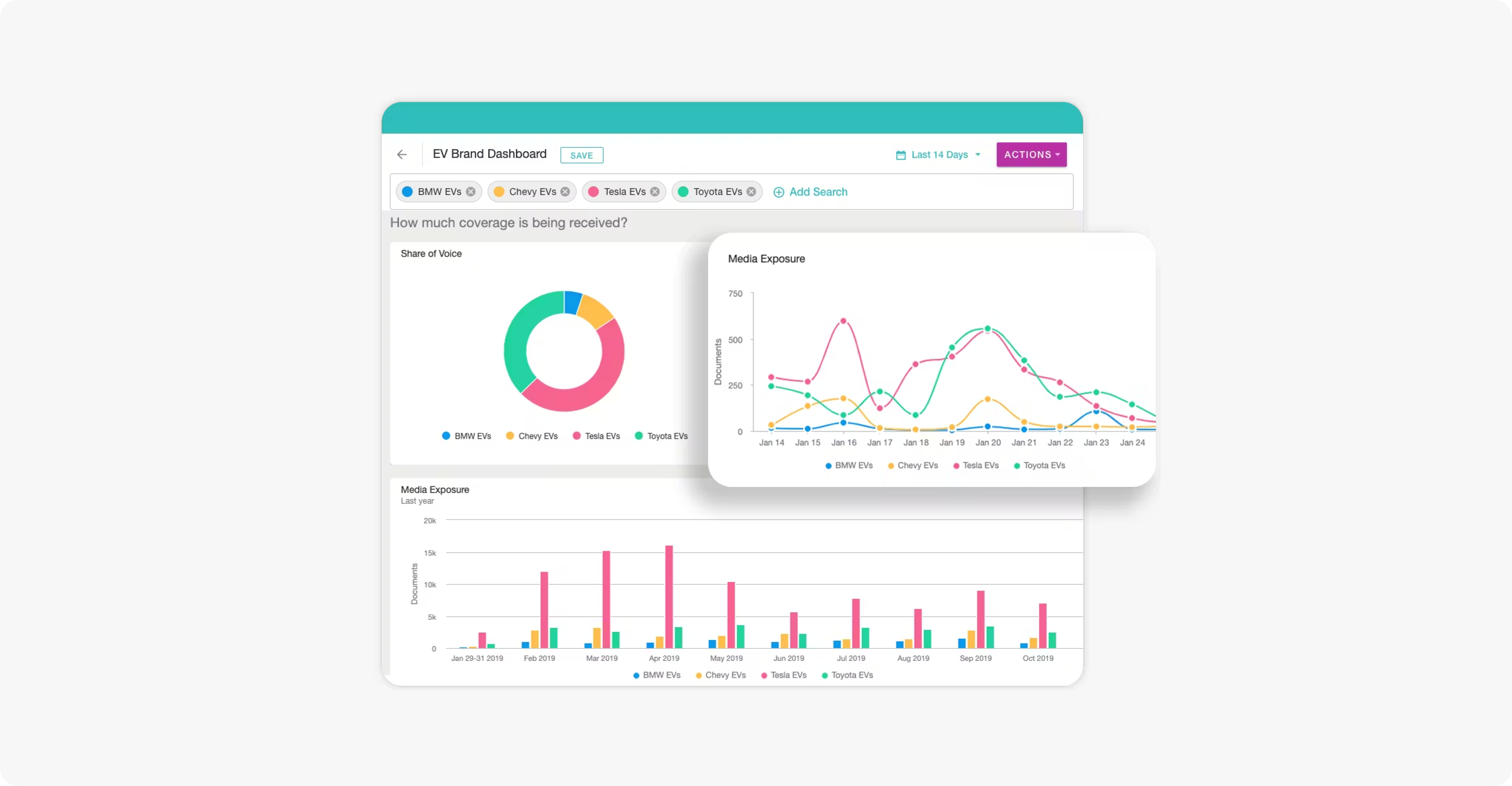
Meltwater is a media intelligence platform that monitors brand mentions across news, social media, blogs, podcasts, and print media worldwide. PR, communications, and marketing teams use it to track how their brand is being discussed publicly and how that conversation compares to competitors. It covers the reputation layer of brand management, rather than the perception layer survey-based tools address.
Key Features
- Global media monitoring: Covers 270,000+ news sources, social platforms, podcasts, and print media across multiple regions
- AI-powered analytics: Measures share of voice, explains sentiment trends, and generates natural-language summaries
- Real-time alerts: Flags mention spikes and sentiment shifts for crisis detection and rapid response
Pricing
Package-based pricing that scales from core tools for smaller teams to fully integrated solutions for global organizations. Custom-quoted.
Pros
- Global coverage with multilingual support across regions and languages
- Customizable dashboards and reporting for measuring campaign and media impact
- Monitors traditional media alongside social and digital channels
Cons
- Doesn't measure consumer brand perception through surveys
- Reporting customization can feel limited relative to the platform's breadth
- Pricing isn't publicly available, and contracts require annual commitment
5. Brandwatch
Category: Media monitoring and social intelligence
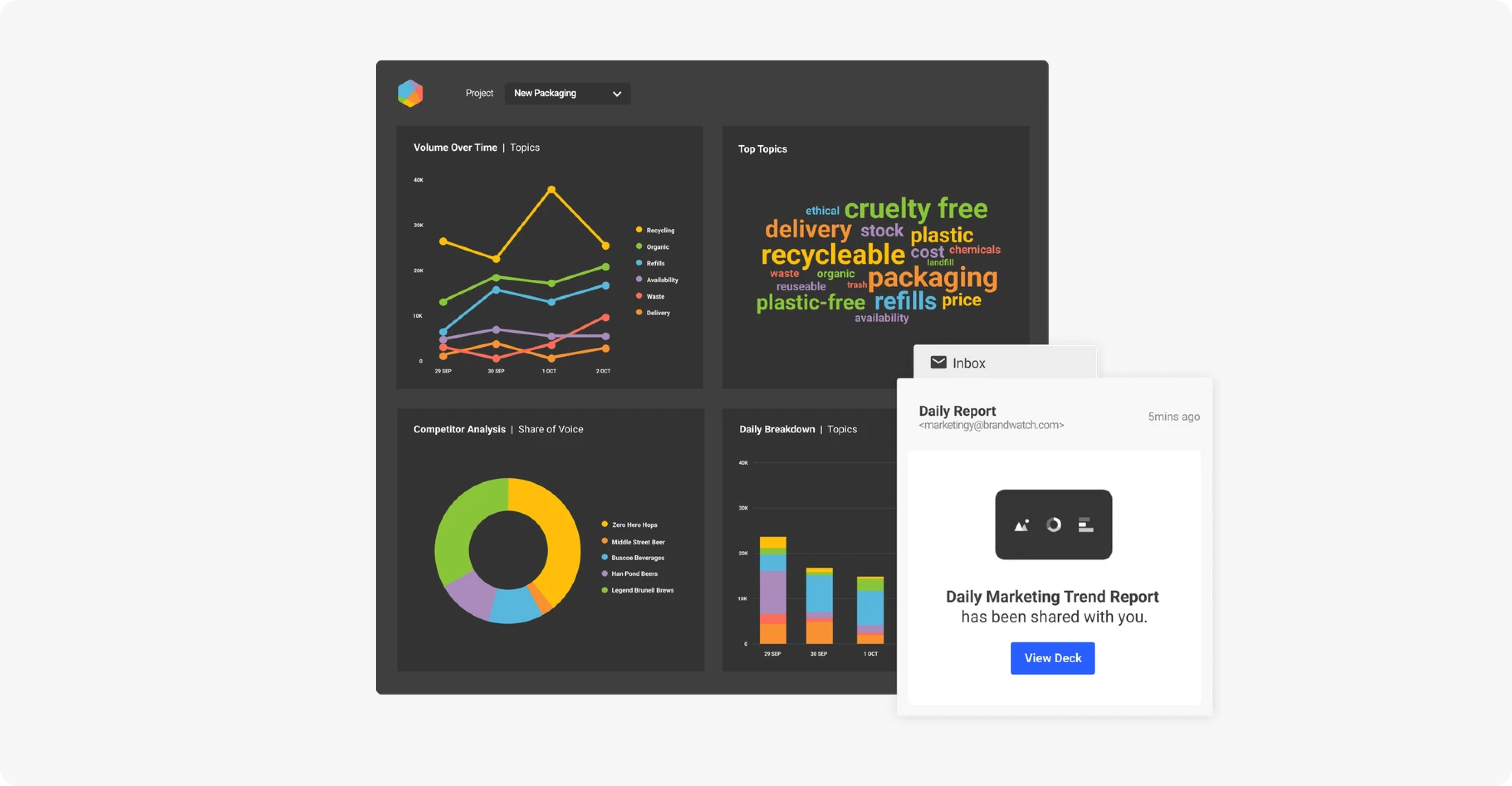
Brandwatch is a social intelligence platform that goes deeper than basic mention tracking. It combines social listening, consumer research, and trend analysis, using AI to analyze conversations at scale and surface insights about audience behavior, sentiment, and emerging cultural trends. Marketing and insights teams that want to go beyond counting mentions will appreciate the analytical depth here.
Key Features
- Social listening: Monitors social media, forums, blogs, reviews, and news with advanced filtering and Boolean search
- AI-powered consumer intelligence: Analyzes millions of online conversations to identify trends, sentiment shifts, and emerging topics
- Image recognition: Identifies brand logos in photos and videos, catching visual mentions that text-based tools miss
Pricing
Custom-quoted based on data volume and feature requirements.
Pros
- Historical data access going back years for long-term trend analysis
- Audience analysis showing demographics, interests, and behaviors of people discussing your brand
- Strong cultural trend identification beyond standard brand monitoring
Cons
- No survey-based tracking, so it can't measure broader market perception
- Steep learning curve given the breadth of features
- Enterprise pricing that isn't publicly available
6. Frontify
Category: Brand asset management
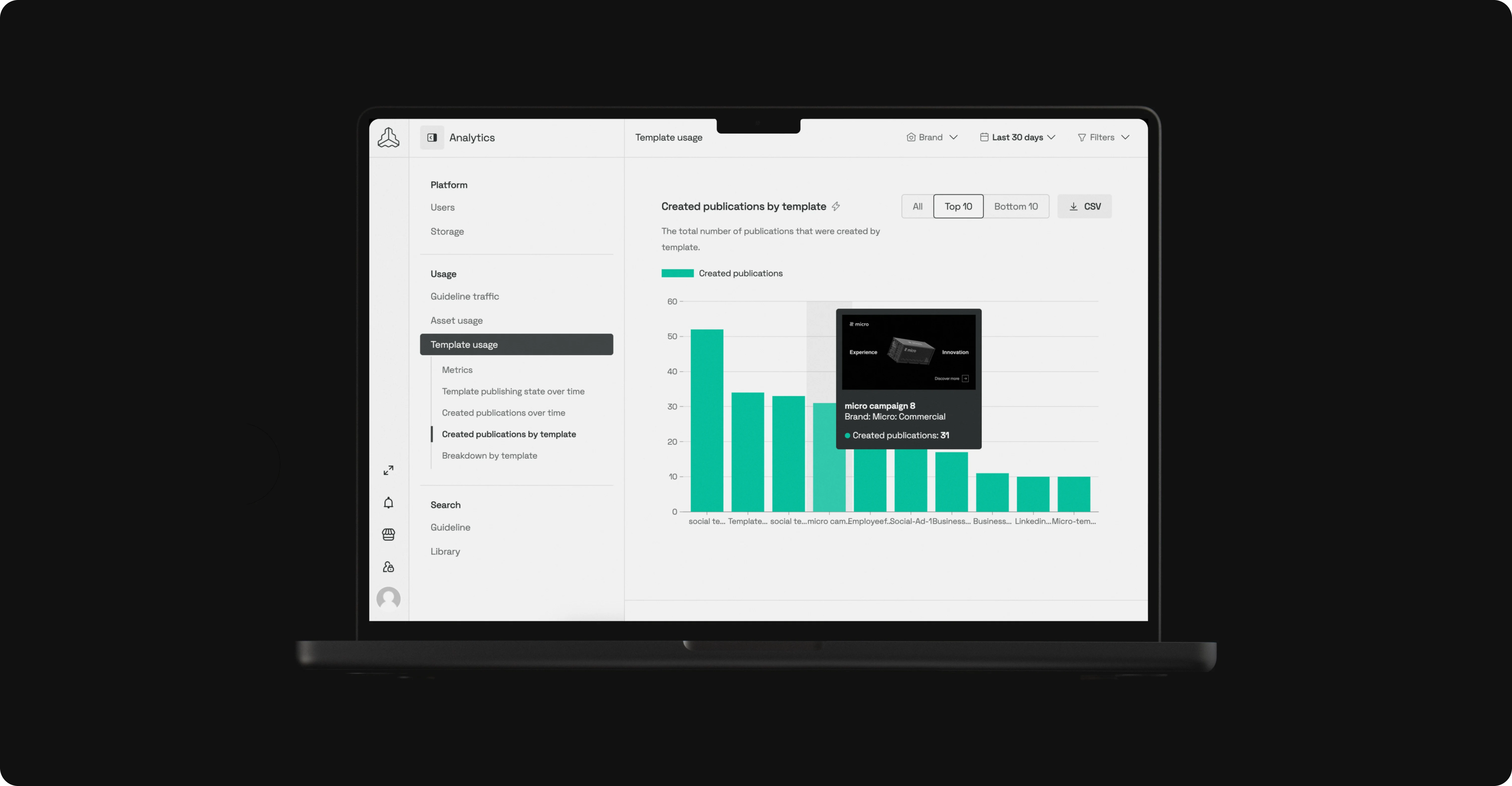
Frontify is a brand management platform focused on the operational side of brand building. It helps teams create, manage, and distribute brand guidelines, digital assets, and templates from a single hub. If brand tracking tools tell you how your brand is perceived, Frontify helps you control how your brand is presented across every touchpoint.
Key Features
- Digital brand guidelines: Interactive, always up-to-date guidelines accessible to in-house teams and external agencies
- Digital asset management: Organizes, tags, and distributes logos, images, videos, and other brand assets with version control
- Creative templates: Non-designers can produce on-brand content without starting from scratch or waiting for the design team
Pricing
Frontify uses value-based pricing calculated by Monthly Active Users (MAUs). Plans scale from a free tier for basic brand guidelines to paid tiers based on users, storage, and features. Contact Frontify for a quote.
Pros
- Integrates with Adobe Creative Cloud, Figma, Sketch, and marketing platforms
- Creative collaboration workflows with clear review and approval accountability
- Scales well for organizations managing brand assets across multiple teams and markets
Cons
- Performance can slow when managing very large asset libraries
- Advanced customization options for templates are limited
- Paid plans require custom quotes, making cost comparison harder upfront
7. Sprinklr
Category: Social media brand management
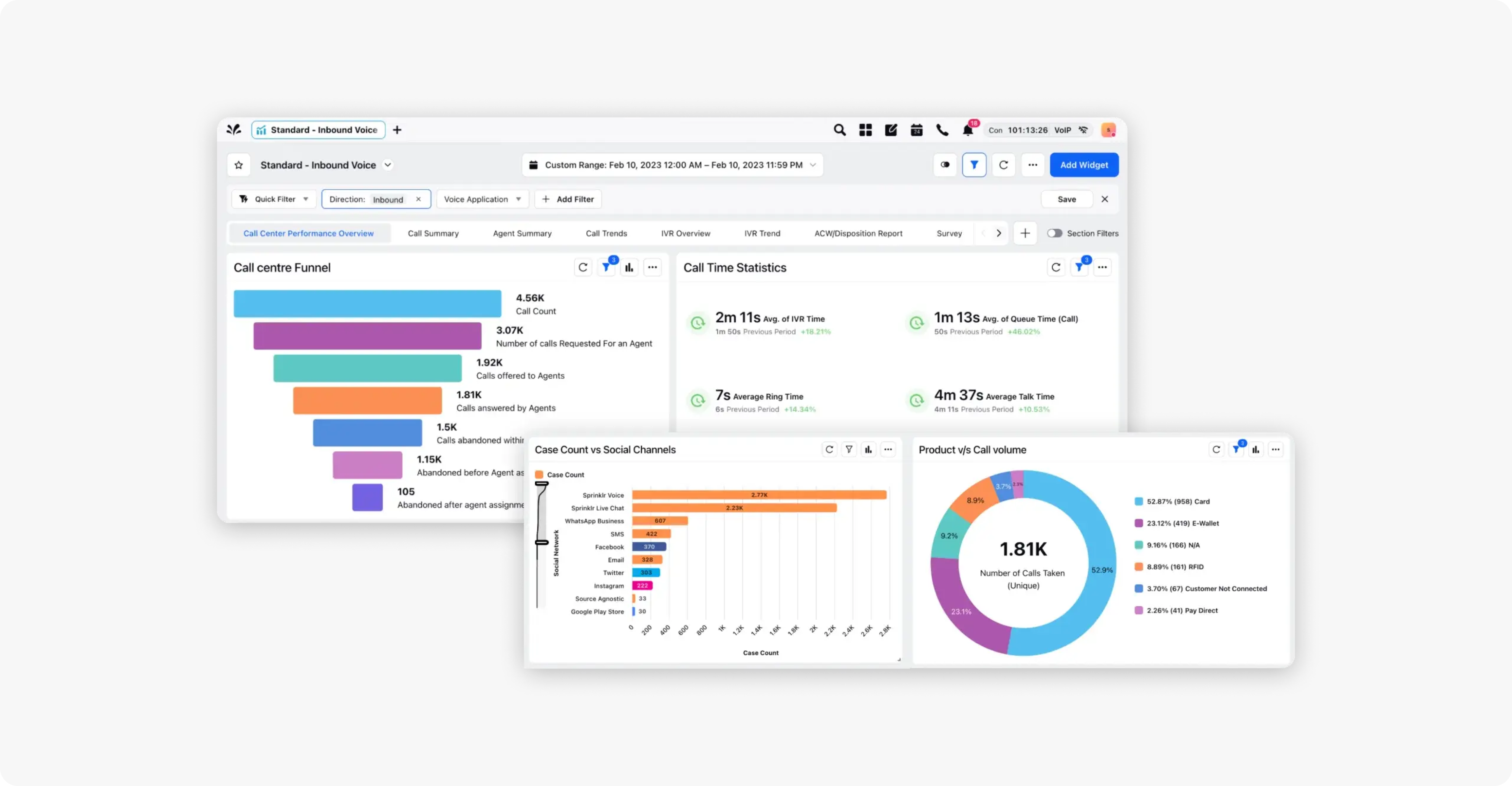
Sprinklr is a unified customer experience management platform with strong social media brand management capabilities. It brings social listening, publishing, engagement, and analytics together in one place, supporting 30+ channels. Enterprise brands managing their presence across multiple social platforms and markets simultaneously will find the governance and scale features particularly valuable.
Key Features
- Unified social management: Publishing, scheduling, and engagement across 30+ channels from a single platform
- Governance and approval workflows: Enforces brand guidelines and compliance across distributed teams, useful for regional or franchise structures
- AI-powered content optimization: Recommendations for timing, format, and audience targeting to improve social performance
Pricing
Enterprise pricing, custom-quoted. Sprinklr also offers a more affordable Social suite for mid-market teams. Contact Sprinklr for details.
Pros
- Covers publishing, engagement, listening, and analytics in one unified platform
- Advanced analytics connecting social performance to broader business outcomes
- Built for multi-brand, multi-market governance at enterprise scale
Cons
- Enterprise pricing and complexity make it overkill for smaller teams
- Significant implementation and onboarding investment required
- Platform breadth means a steeper learning curve than purpose-built social tools
How to Choose the Right Brand Management Tools
Brand management covers a lot of ground, so start by asking what you actually need to know.
Understanding Market Perception
If the goal is understanding whether your marketing is shifting how people think about your brand, you're looking at survey-based tracking. Tracksuit measures awareness, consideration, and preference through always-on consumer surveys. Quantilope layers in advanced research methodologies for teams who want deeper analytical rigor. Qualtrics makes more sense when brand tracking needs to sit alongside customer experience and product research on a single enterprise platform.
Tracking Public Conversation
If the priority is staying on top of what's being said about you publicly, media monitoring is the better fit. Meltwater gives you broad coverage across news, social, and traditional media globally. Brandwatch digs deeper into audience behavior, sentiment patterns, and cultural trends beyond surface-level mentions.
Maintaining Brand Consistency
For teams struggling with scattered assets, outdated logos, and guidelines nobody can find, Frontify centralizes everything in one hub so every touchpoint stays on-brand as you scale.
Managing Social at Scale
When managing your social presence across dozens of channels and markets outgrows your current tools, Sprinklr brings publishing, engagement, listening, and analytics together with the governance controls enterprise teams need.
Most growing brands don't need all seven tools on day one. A common starting point is pairing perception tracking with one operational tool, then expanding as media presence and team complexity grow.
Want to See How Your Market Perceives Your Brand?
Search rankings and social mentions show you what's happening on the surface. Brand perception data shows you whether any of it is actually shifting how consumers think and feel about you.
If you're serious about building a stronger brand, start with consistent, reliable perception data. Tracksuit makes always-on brand tracking accessible, visual, and built for marketing teams who need insights they can act on and share with leadership.
Request a demo and start tracking what actually drives growth.


