How HX Expeditions uses multi-market tracking to compete in seven markets


- If you plan the same brand playbook in seven wildly different markets, that's not strategy – that's just expensive. HX Expeditions used Tracksuit to diagnose the opportunities in different markets.
- Tracksuit’s multi-market tracking revealed that the US needed to focus on awareness, while Germany needed to convert consideration into purchase. Each market tailored its media and positioning as a result.
- By having one source of truth, HX Expeditions were able to connect brand to commercial outcomes and fuel its MMM with always-on data.
Before Tracksuit, HX was running traditional quarterly tracking. Now they use Tracksuit's multi-market tracking to feed their MMM and diagnose funnel gaps monthly, not quarterly.
HX Expeditions isn't your typical cruise line. There aren’t any chandeliers, or butlers – just expedition ships which take curious travellers to Antarctica, the Arctic, and the Galápagos. These are people who'd rather have snow on their boots than champagne on tap.
But here's the thing: until recently, they weren't called HX Expeditions at all. They'd spent years as part of Hurtigruten, a Norwegian coastal ferry service that's a household name in Scandinavia and Germany, but means very little to US or Australian customers. Two years ago, they split the brands and repackaged the expeditions business.
Suddenly, HX had a new identity and new brand challenges to solve. Their legacy markets – Germany, the UK, and the Nordics – knew the brand well. Awareness and consideration were solid. But the big prize was in the US and APAC, where awareness levels were much lower.
The team at HX were staring down a classic multi-market dilemma: wildly different levels of brand maturity, finite marketing resources, and no easy way to diagnose which funnel gaps actually mattered, or where to prioritize budget.
Why multi-market brand tracking mattered
Before Tracksuit, HX was running traditional quarterly tracking. This was fine for a snapshot, but it wasn’t so great for fast-moving strategic decisions. Matthew Parker, HX Brand Director, was up against a classic brand marketer's disadvantage.
"We have an MMM that uses lots of different data points as inputs. Other performance marketing disciplines will say, 'Well, I've got thousands of metrics and they update every hour.' And we're like, 'I've got awareness and it updates every quarter.'"
If your brand metrics only refresh quarterly, you're feeding your MMM less precise data. You can't attribute spikes to specific campaigns as effectively. You're flying blind between dips.
"When the cadence of your brand metrics is quarterly, it's not great for attribution," Matthew explains. "And if you're trying to use an MMM seriously, you need brand data that's more than a slow trickle."
So HX made a call. It put all brand tracking – that’s funnel metrics, perceptions and competitive benchmarking – into Tracksuit. HX decided to keep a traditional research partner for their annual usage and attitudes study, but run Tracksuit as the always-on drumbeat that feeds its MMM. This means HX gets deep dives once a year, but always-on tracking every month. Now that’s what we’d call the best of both worlds.
Diagnosis first, strategy second
HX has a classic matrix structure: local teams in each market, plus a global marketing team that handles brand, creative and channels. Both manage budgets, priorities and objectives, so there needs to be strong collaboration.
Before setting strategy, HX uses Tracksuit to diagnose the business.
"We use it to diagnose the business through the funnel and identify where funnel stages are performing well, and where the opportunities are."
They identify the gaps, rank them by revenue impact, then get ruthlessly focused.
Matthew's approach is about brutal prioritization- focusing on the small number of gaps that represent the lion’s share of the revenue opportunity. And when someone floats a new idea, Matthew can assess it in seconds.
"Someone says, 'What if we did this?' You can really quickly say, 'Great idea, that's not aligned with our objectives.' It keeps everyone - not just the brand person - focused on a common set of parameters."
What the data showed: upper-funnel in the US, lower-funnel in Germany
Tracksuit’s multi-market tracking revealed the real story. Although there were distinct opportunities in each market, each required a completely different approach.
US: Where Awareness was the answer
In the US, HX is an unfamiliar brand in a massive market. But here's the thing: because the US market is so much bigger than HX's other markets, even a small lift in awareness there shifts the global numbers.
"If we increased awareness in the US by just a few percentage points, our global awareness suddenly becomes a totally different story because of the weighted average-that's how disproportionately important the US market is."
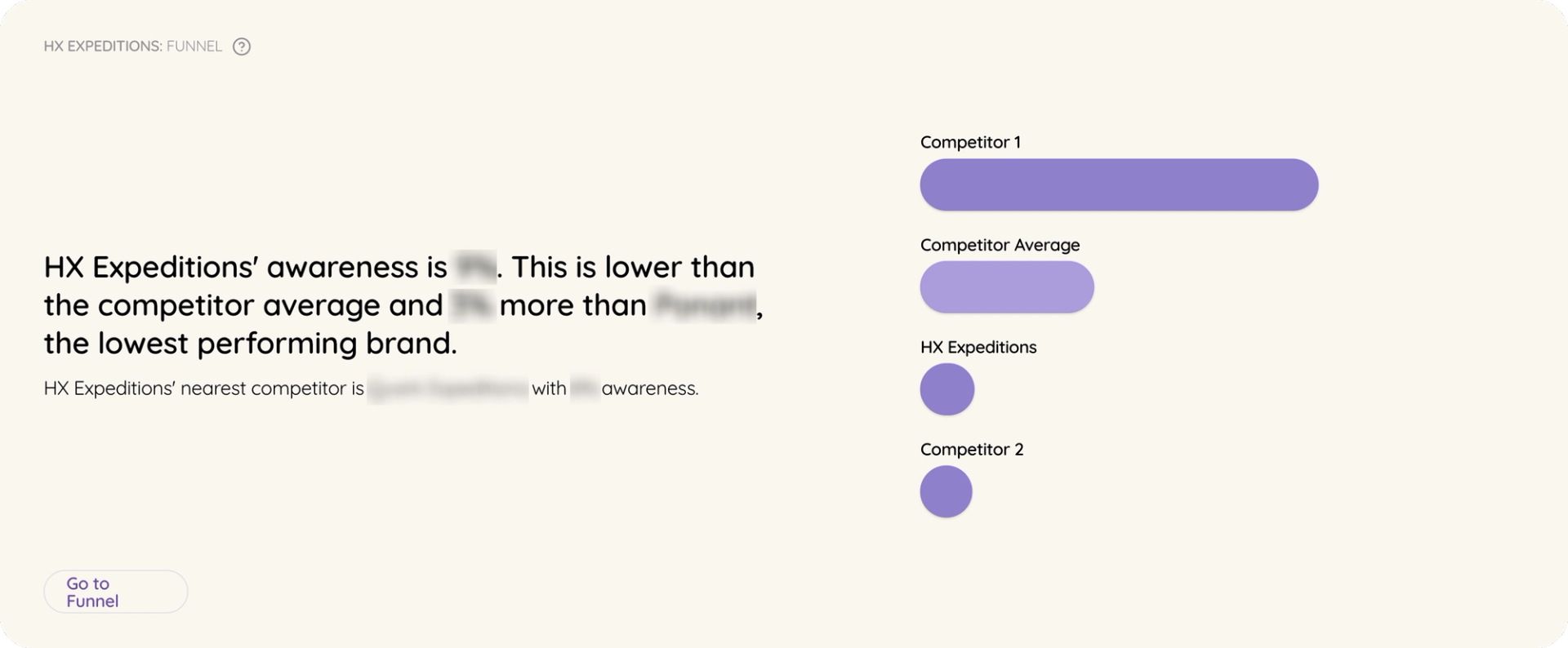
But HX couldn't afford to scatter spend across the entire country. So they shifted to a mixed approach, with pockets of deep dive activity in high opportunity regions, alongside a broader digital strategy.
Using Tracksuit's audience profiling and media consumption data, HX built a hyper-efficient media plan. Think public radio, local TV, and media tailored to their expedition-curious audience.
“We use Tracksuit's media consumption tools to say, 'This is what category buyers are consuming.' We play that back to our media agency: 'Get us better placements on public radio, a better deal on local TV.’ We can tailor a media plan in a pretty efficient way- still broad-reach brand media, just deployed more strategically in one state."
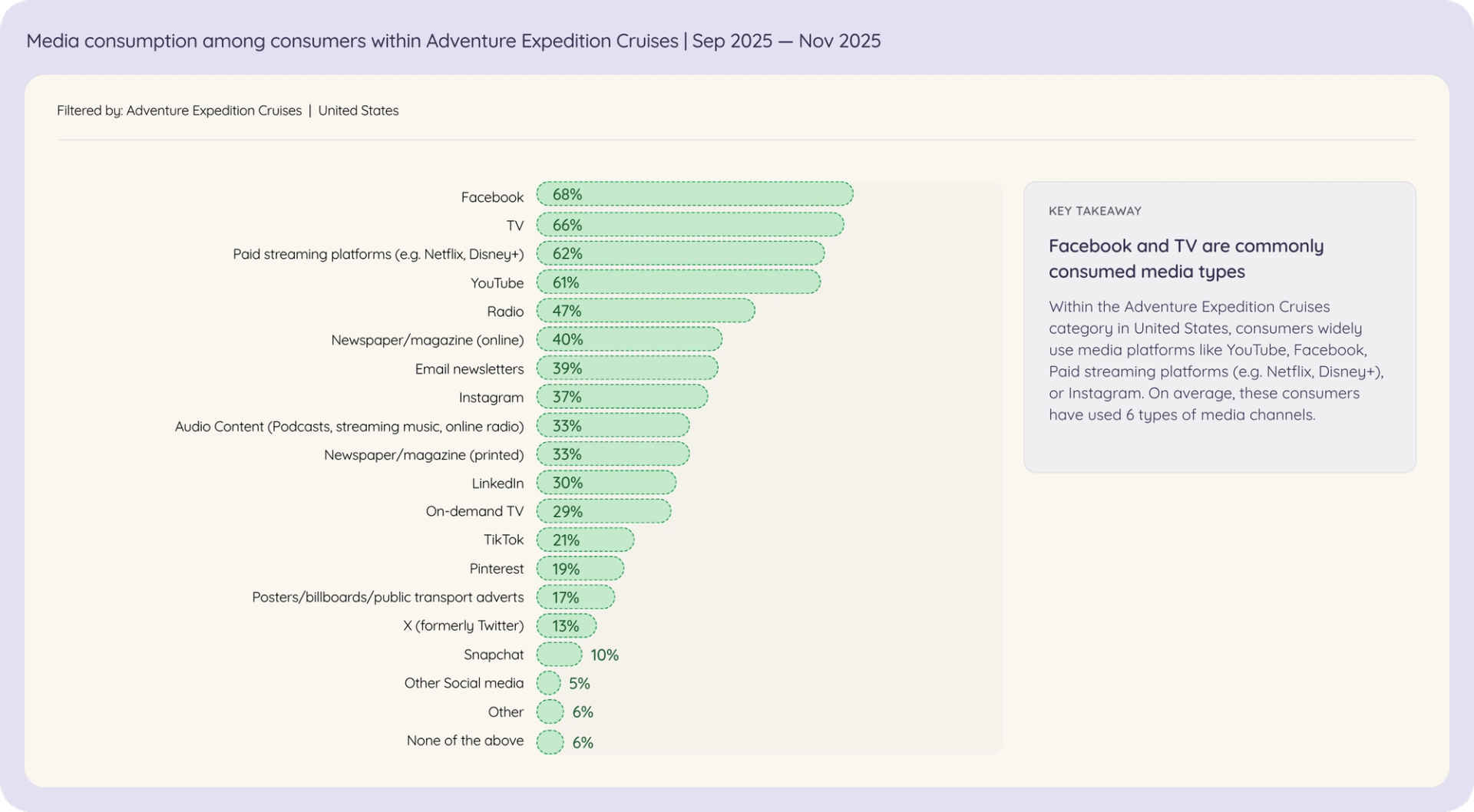
The outcome? A clear, data-backed case for upper-funnel investment in a single priority state rather than wasting budget trying to shift awareness across the entire US.
Germany: Where purchase conversion was the biggest opportunity
Germany tells a different story. Awareness was in line with competitors, but old Hurtigruten associations were getting in the way. This had a knock-on effect lower down the funnel.
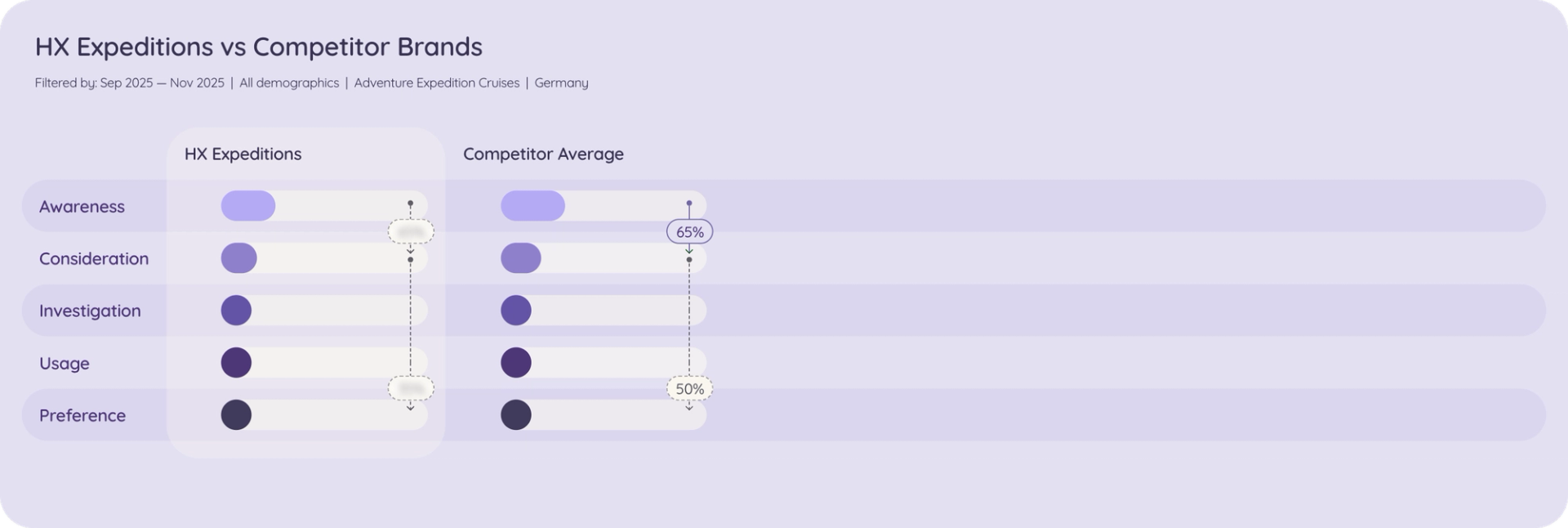
Tracksuit's conversion drivers data showed the issue: the drivers of consideration to usage in Germany include sustainability and long-term reputation. But after HX’s rebrand, those associations hadn’t landed yet - German consumers didn’t see HX as “a brand that’s been around for a long time” or “a more sustainable way to travel.”
HX kept investing at the top of the funnel to protect awareness, while focusing website copy, brochures, and partner communications around trust-building messages.
“Tracksuit’s consideration drivers and brand statements are really useful for our positioning. We leaned hard into our 130-year heritage, hybrid electric ships, no heavy fuel oil usage, and strong customer reviews.”
The outcome: Messaging and positioning built around what actually drives conversion in Germany.
What changed for HX
Multi-market tracking didn't just give HX better data - it changed how the business works.
1. One source of truth, zero data messengers
Now, the global brand team and local marketing managers all log into the same platform, rallying around the same category definitions, funnel data, and competitive set. One shared, global source of truth and no more data gatekeeping.
"I can teach people how to fish. Here's a login, here's how you use filters. It takes four minutes. Usually regional marketers answer their own questions."
HX's CEO even has a Tracksuit login. He doesn't need to fire off questions to the brand team, he just logs in and checks.
"He can log in on a regular basis and see what's going on. At the beginning of the month, I remind everyone that last month's data is available. But people are logging in proactively anyway."
2. Brand metrics took on a commercial legitimacy
Tracksuit helps marketers translate brand metrics into commercial language. Matthew reverse-engineers what funnel shifts actually mean in revenue terms: if awareness goes from 13% to 15%, or conversion from 45% to 50%, what's the prize?"
"If you can say, 'If we increased conversion from this to that, that's a £3 million opportunity'- suddenly you're speaking in the language of the CFO and the CEO. It gives your brand data commercial legitimacy."
3. MMM and Tracksuit work together
HX uses Tracksuit to fuel their MMM with always-on data.
“The MMM tells you what the media mix should be, what brand budget versus performance should look like. But it only plays back what you put in. Without better brand data, it just says, 'Put more money into Facebook, put more money into Google.”
Now, their MMM has monthly brand inputs instead of quarterly so that attribution is sharper and media mix decisions are smarter.
4. Enterprise-quality tracking without the enterprise price tag
By shifting regular funnel tracking to Tracksuit, HX freed up budget. They're now using those savings for deep-dive research as needed – and still have money left over.
Good research shouldn't require enterprise-level costs. Tracksuit gives multi-market brands access to always-on, high-quality tracking without the six-figure price tag.
Multi-market tracking, done right
For HX, Tracksuit turned brand tracking from a quarterly slide deck into a living decision-making tool. Their approach - diagnose first, prioritize ruthlessly, translate metrics into expected revenue - is how global brand strategy should work. It's rare to see companies execute this well.
"Tracksuit allows us to do multi-market brand tracking more efficiently, more cost-effectively, more regularly—and with confidence. It pays for itself quite quickly."