

Every marketer knows this feeling
You’re sitting across from your CFO. The brand campaign landed well: awareness is up, consideration is tracking, the team is proud of the work. And then comes the question:
"What did it actually do for revenue?"
You know the answer. You've read the Binet and Field research. You understand that brand investment compounds over time, that awareness today converts to revenue across the next 18 to 36 months, that cutting upper-funnel spend to hit a short-term number quietly destroys the asset that drives long-term performance.
But knowing the answer and proving it are two very different things. And in most organisations, the tools to bridge that gap simply haven't existed.
That's the problem Mutinex and Tracksuit set out to fix together.
Connor Archbold, CEO at Tracksuit
This is the conversation I’ve had with almost every brand we work with. They have the data. They believe in the investment. But the moment someone upstream asks for a number, the argument falls apart. That’s what makes this partnership feel genuinely different: we’re not just giving marketers better tracking, we’re giving them a number that holds up in a boardroom.
The gap wasn't data. It was methodology.
Here's what's strange about this problem: most brands already have the data they need. Brand tracking tools have been around for decades. Marketers have been measuring awareness, consideration, and recall for years.
The gap was never the data. It was the economic translation layer: the rigorous, quantified pathway from brand metrics to revenue outcomes. That piece of infrastructure has been missing at scale. Until now.
Tracksuit provides always-on brand intelligence: prompted awareness, spontaneous awareness, and purchase consideration, updated continuously and piped directly into Mutinex's GrowthOS platform via API. No manual exports. No quarterly batch uploads. No lag between measurement and analysis.
Mutinex takes that signal and runs it through a Bayesian hierarchical modelling framework (the same class of econometric models used by central banks to model long-run macroeconomic relationships) to produce something genuinely new: a clean separation of short-term media ROI from the compounding financial return of brand equity.
Connor Archbold, CEO at Tracksuit
The thing I keep coming back to is the word ‘continuous.’ Brand tracking has historically been a snapshot: a quarterly read that lands in a slide deck and sits there. The fact that our data now flows directly into a live modelling environment means brand equity is treated as a real-time financial variable, not a soft metric reviewed once a quarter. That shift in framing changes everything.
WHAT THIS INTEGRATION UNLOCKS
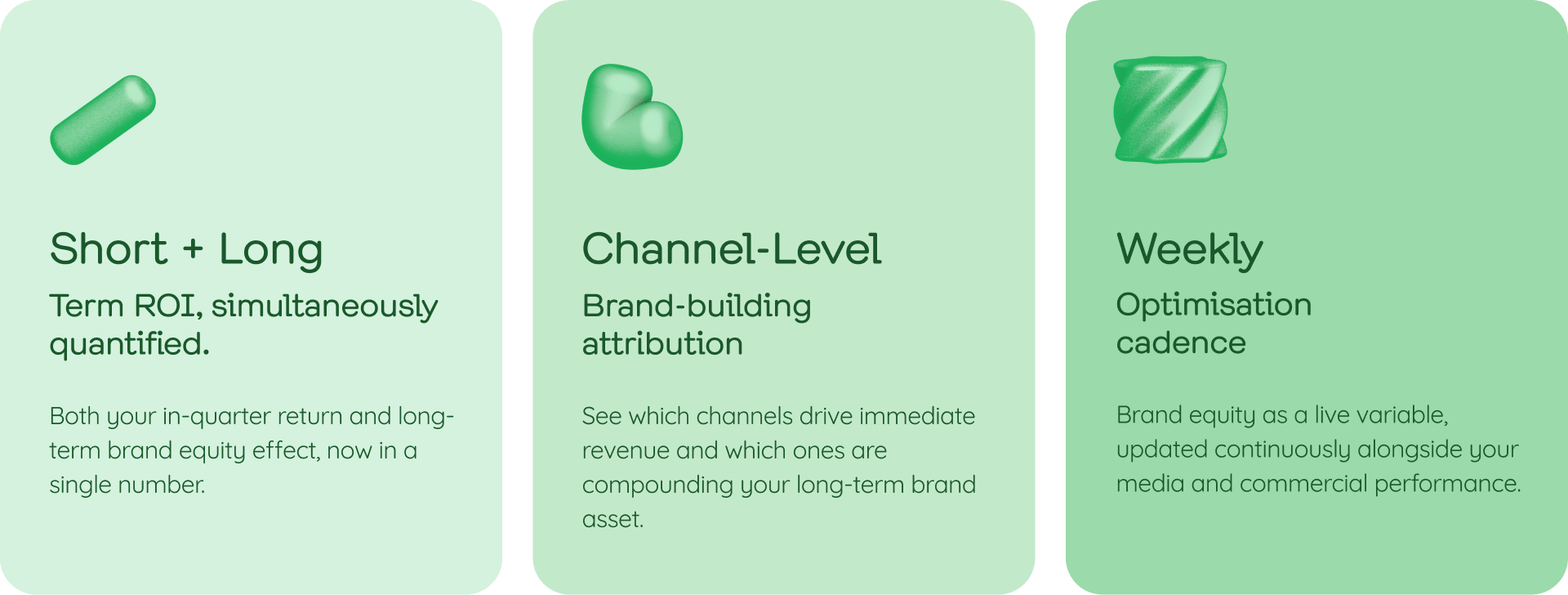
For the first time, marketers operating within Mutinex GrowthOS with Tracksuit brand health data connected can get answers to questions that have historically been unanswerable.
The campaign that was worth far more than anyone knew
A globally recognised household CPG brand with decades of category leadership and deep brand equity built through consistent long-term investment came to Mutinex with a specific challenge.
Their existing marketing mix model was architecturally short-term. It captured the immediate uplift from a campaign and stopped there. The compounding financial value of years of brand investment in awareness and consideration was invisible in their attribution framework. Every time the marketing team argued for maintaining or growing brand spend, they were making an economic case they couldn't fully quantify.
The brief: accurately measure not just short-term media uplift, but the long-run financial impact of brand equity. In a model rigorous enough to hold up under financial scrutiny.
The invisible asset problem
In a traditional model, the baseline (the revenue a brand would generate with no marketing at all) is treated as static within each period. Media and trade effects are measured on top of it.
For a brand with strong equity, this is structurally wrong. A significant portion of what appears as baseline revenue is not organic. It’s the accumulated financial return of years of brand investment. When the model treats this as baseline, it attributes the value to nothing. Media ROI is systematically understated. The case for brand investment weakens every time the model runs.
"For brands with deep equity, a static baseline quietly misattributes their most valuable asset to noise."
The Mutinex approach deploys a time-varying baseline: one that adjusts dynamically with demand conditions, competitive activity, and seasonal patterns. This prevents the misattribution of brand-driven revenue to baseline, and ensures that media and trade effects are credited accurately in each period.
What we found when we looked properly
Powered by years of Tracksuit's continuously updated awareness and consideration data flowing directly into the model via API, we built a clean separation between two distinct components of marketing ROI that legacy models had been blending together.
The short-term media ROI was already above CPG category norms, reflecting the strength of their creative and media execution. That wasn’t the surprise.
The surprise was the long-term brand equity ROI. When properly measured, it represented a multiple of the short-term figure. The majority of the brand's total marketing value had been systematically invisible.
"The majority of this brand's total marketing ROI had been invisible to every prior model they had run."
The model also showed something important for planning: while trade activity plays a vital role in converting demand at peak moments, media investment drives the bulk of total commercial impact, primarily by sustaining and building the long-term brand equity that underpins baseline performance year-round.
Optimising purely for short-term trade efficiency would gradually erode the asset generating the majority of the brand’s financial value. The model made that cost visible and quantifiable for the first time.
Connor Archbold, CEO at Tracksuit
Results like this are why we’re investing in our API infrastructure to support integrations with leading partners like Mutinex. Tracksuit data was always good at telling brands where they stand. What it couldn’t do alone was tell them what that standing is worth in dollars. That translation from brand metric to financial outcome is what this partnership makes possible. Seeing it land for a brand that’s been investing for decades and finally has the proof to show for it? That’s the moment.
What this changes for the CMO-CFO conversation
The implications here go beyond measurement. When brand equity is modelled as a continuously updated financial variable rather than a soft metric in a separate tracking report, it becomes available as an input to financial forecasting.
You can now project the revenue impact of sustaining versus cutting brand investment. You can model the decay curve of equity under different spend scenarios. You can quantify, in dollar terms, the cost of short-termism.
These are the conversations that actually change budget decisions, not because marketing has become better at advocacy, but because marketing has become legible in financial terms.
"The CFO question now has an answer. Not an argument. A number."
The Mutinex x Tracksuit integration is new. Portfolio management, geo-level brand modelling, category dynamics, scenario forecasting: we’re only beginning to map what becomes possible. What’s already clear is that the combination works.
Brand tracking data that once lived in a separate system, read quarterly, disconnected from commercial planning, now flows directly into the engine that answers a marketer's most important questions.