Brand ROI: how to persuade executives to invest in marketing


If there’s one thing marketers can agree on, it’s that getting buy-in for brand building can feel like persuading a skeptic to believe in magic: it’s not always easy.
Brand marketing campaigns can often be a tough sell to executives and stakeholders because success metrics are harder to track than that of a performance marketing campaign. As a long-term play, brand building efforts may take longer to generate ROI for a business, so quicker gains are prioritized instead.
Without having tangible insights to gauge the success of marketing activity, they’re more likely to deny your requests for investment. This is why measuring brand ROI via a brand tracking tool is so important. Brand ROI is presenting consumer research and sentiment to help win over business decision-makers and enables them see the value that brand marketing can bring. Here’s our cheat sheet on how to get more investment 👇
Sign up to Shorts
For fortnightly brand insights, stories and goodness that'll help you win (we promise).
Understanding brand ROI and its implications
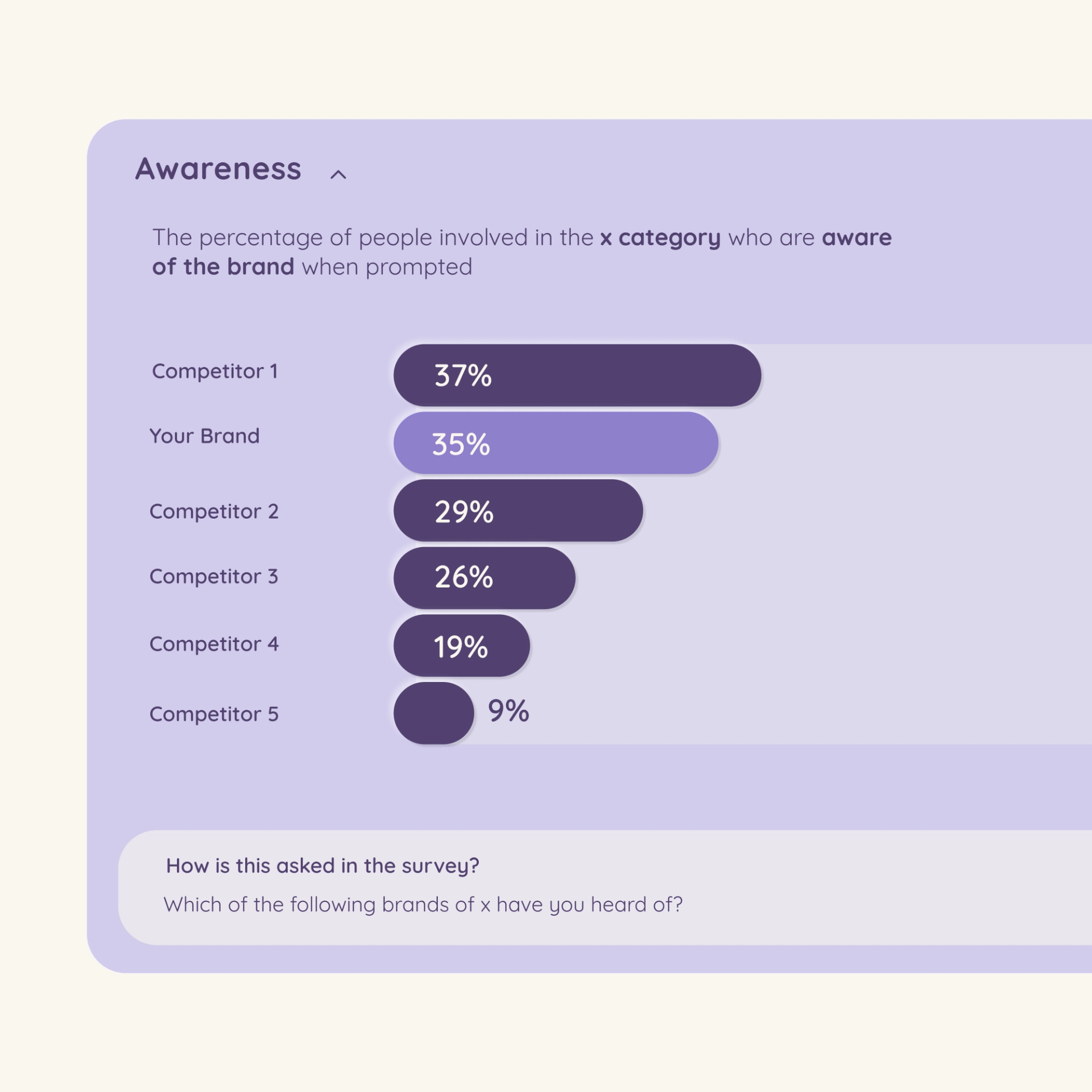
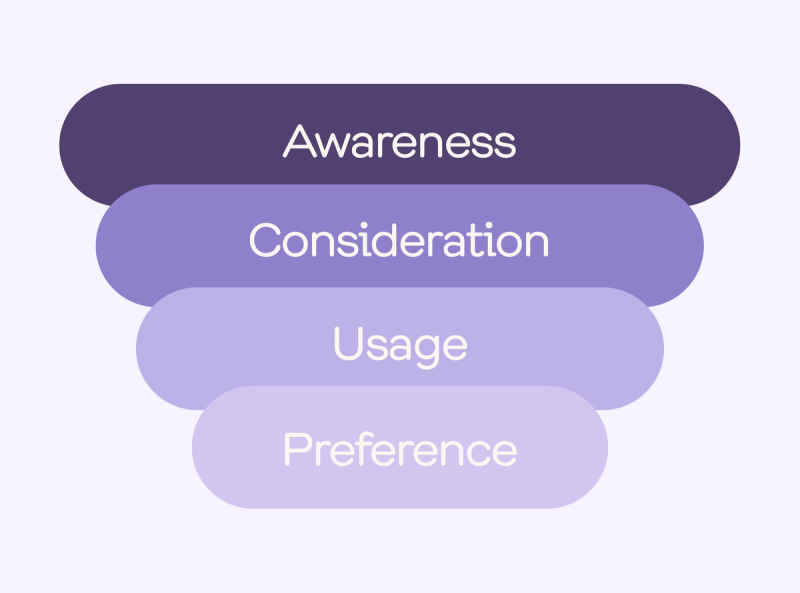
The ROI of branding measures your marketing strategy’s impact on your top-of–funnel health metrics, as well as what people think and feel about your brand.
In simple terms: Brand ROI is the monetary and non-monetary returns you get from your branding efforts. It’s the relationship between your marketing-related outlays (e.g. marketing research, ad campaigns) and what they create (e.g. awareness, consideration, preference).
Having a strong brand brings in benefits that outweigh the expenses. When you nail your branding efforts, you’re able to continue to attract customers without diminishing your brand value. You can even charge more at a lower customer acquisition cost. In fact, 35% of consumers prefer established brands with premium prices over cheaper alternatives.
A brand tracking tool can help marketing teams establish realistic key performance indicators (KPIs) to measure ROI of branding success. These metrics provide insights into the effectiveness of your marketing. After running an ad campaign, for instance, you can use relevant short-term metrics (like conversion and click-through rate) to see how it performed. With brand research, you can use relevant long-term metrics (like brand awareness and consideration) to see the long-term impact of marketing activity, like an out-of-home campaign.
These can help you determine whether your brand is leading its category, or whether there’s an opportunity for growth.
Key stakeholders may be tempted towards immediate revenue spikes and short-term gains. But they can’t say no to top-of-funnel brand growth that translates into bottom-of-funnel sales growth and premium pricing over time — especially if it’s backed up by data.
Research shows that 71% of customers shop from trusted brands.
Measuring the key brand associations of your business and the demographics it’s most strongly resonating with is a long-term play, but it’s definitely a game-changer.
That’s where clear calculations and attribution models come in. To persuade executives, you need to move from abstract benefits to hard numbers — here’s how to calculate brand ROI and prove what’s really driving results.
Brand ROI calculation formulas and attribution methods
Executives rarely sign off on brand marketing budgets without clear proof that the investment will deliver brand ROI. While performance marketing can show quick revenue spikes, brand building requires a longer lens.
The challenge is to translate brand growth into numbers decision-makers understand. That’s where ROI of branding formulas and attribution methods come in.
The core brand ROI formula
At its simplest, ROI (return on investment) can be calculated with a straightforward equation:
ROI = (return – investment) ÷ investment × 100
For example, if a business spends $100,000 on brand initiatives and sees an additional $300,000 in attributable revenue, the brand ROI is 200%.
This formula is easy to grasp but overly simplistic when applied to brand marketing. That’s because brand investments often yield indirect or delayed returns that aren’t captured in immediate sales figures.
Expanding ROI for branding
To reflect both financial outcomes and intangible brand equity, marketers often use a broader formula:
Brand ROI = (incremental revenue + long-term brand equity gains – marketing investment) ÷ marketing investment
This version acknowledges that a brand delivers value beyond sales. Stronger awareness, improved consideration and higher preference all lead to downstream growth. For instance, a business with high brand equity may enjoy:
- Lower customer acquisition costs (CAC)
- Higher customer lifetime value (CLV)
- Ability to charge premium pricing
- Increased customer loyalty and referrals
When these factors are quantified, they provide a fuller picture of brand ROI.
Metrics to use in brand ROI calculations
Several key performance indicators can be built into your ROI of branding calculations:
- Incremental sales: The additional revenue directly linked to brand campaigns.
- Customer lifetime value (CLV): How much revenue a customer generates over their entire relationship with the brand.
- Customer acquisition cost (CAC): How much it costs to acquire each customer, which should decrease as brand strength grows.
- Brand awareness and consideration: Leading indicators that show whether more customers are entering the funnel.
- Price premium: The margin uplift from customers willing to pay more for a trusted brand.
Including both financial and brand health metrics makes the ROI of branding argument more compelling.
Attribution methods for branding
Calculating brand ROI is only half the battle. The next step is attributing results to specific marketing actions. Attribution models help identify which touchpoints influence customer decisions.
1. First-touch attribution
This model credits the first interaction a customer has with the brand. It highlights the value of brand-building activities that generate initial awareness, such as sponsorships, TV ads or social campaigns.
2. Last-touch attribution
This model credits the last interaction before conversion, such as a paid search click or email link. While useful for performance campaigns, it often undervalues the brand-building efforts that created demand in the first place.
3. Multi-touch attribution
This approach distributes credit across multiple touchpoints, showing how brand and performance marketing work together. For example, an awareness ad may contribute 30% of the credit, a retargeting ad 20%, and a final click 50%. Multi-touch models are more complex but better reflect reality.
4. Time-decay attribution
A variation of multi-touch, this method gives more weight to interactions closer to conversion. It balances the influence of brand-building with the immediacy of performance-driven actions.
5. Incrementality testing
Perhaps the most powerful for brand ROI, incrementality testing isolates the impact of marketing by comparing groups exposed to campaigns with those who are not. If exposed audiences show a measurable lift in awareness, preference or sales, marketers can prove the causal effect of branding efforts.
Combining ROI and attribution
The most persuasive business cases use ROI formulas alongside attribution methods. For example, showing executives that a campaign increased consideration by 15%, reduced CAC by 10%, and lifted incremental sales by $500,000 is far more compelling than citing awareness alone.
Best practices for landing brand investment
Here’s the good news: brand investment doesn’t require magic, and getting buy-in for marketing and branding is completely doable.
From data-backed insights to compelling visuals, here’s how to make a persuasive case that leaves no room for doubts.
1. Build a compelling case for marketing investment
Executives need solid proof that marketing strategies will deliver results and brand ROI. Half-baked ideas and wishy-washy claims won’t cut it.
Business leaders love numbers that speak volumes and actionable plans. So ditch the fluff and replace it with data. Instead of only saying that you’ll run ads to increase brand awareness, establish a benchmark for growth that’s realistic for your business and tell them why doing so can increase site traffic by 30% in 3 months. The last bit is what gets managers to sit up and take notice.
But your business case still needs to tick the following boxes to win them over completely:
- Clear goals: specific and measurable objectives you want to achieve through your marketing efforts.
- Data-backed insights: market research analytics and data-driven evidence to back up your claims.
- Cost-benefit analysis: a thorough assessment of costs and benefits in monetary terms to calculate brand ROI potential.
- Risks and mitigation plans: potential challenges associated with your plan and well-thought-out mitigation strategies.
- Long-term impact: a highlight of the marketing investment’s long-term value and sustainability (e.g. the flow-on success you’ve seen from past campaigns).
ROI of branding with clear goals, data-backed insights and long-term impact will leave executives feeling confident in their investment.
Want to know where your brand is sitting right now in the market and where the opportunities for growth are in the top-of-funnel? Consider Tracksuit’s brand tracking platform. Tracksuit surveys real-life consumers to help you monitor brand health, demonstrate return on marketing spend and answer the question, "Is what we're doing working?"
2. Align marketing goals with overall business objectives
Tying marketing goals to the company’s broader objectives fosters a sense of purpose while providing executives with a clear roadmap of branding efforts. Everyone understands what to do, why they do it, and how it drives the company forward.
Review your organisation’s long-term vision and mission. Identify KPIs that align with achieving those — aka your business’ success metrics. Examples include:
- Customer acquisition cost (CAC)
- Customer lifetime value (CLV)
- Net promoter score (NPS)
- Churn rate
- Revenue growth
From there, set marketing goals to achieve these KPIs.
Let’s say the long-term goal is to increase customer loyalty and retention. In that case, your marketing goal might be to reduce the churn rate by 15% in the next year. Specific and measurable goals provide clarity, making it much smoother to justify your proposals.
3. Use industry benchmarks to support investment
Every marketer worth their salt knows you can’t pitch a new marketing campaign without a reference point. With industry benchmarks, you can help execs gain valuable context to assess your proposals more objectively. Rather than have unrealistic expectations, they can compare your strategies against competitors in your category and see how the brand ROI stacks up in the market.
Tracksuit has a free benchmarking tool to help you establish a baseline for comparison. Just put in the required details, choose your industry and you’re good to go. It’s the quickest way to compare if your marketing performance lags behind or exceeds industry standards.
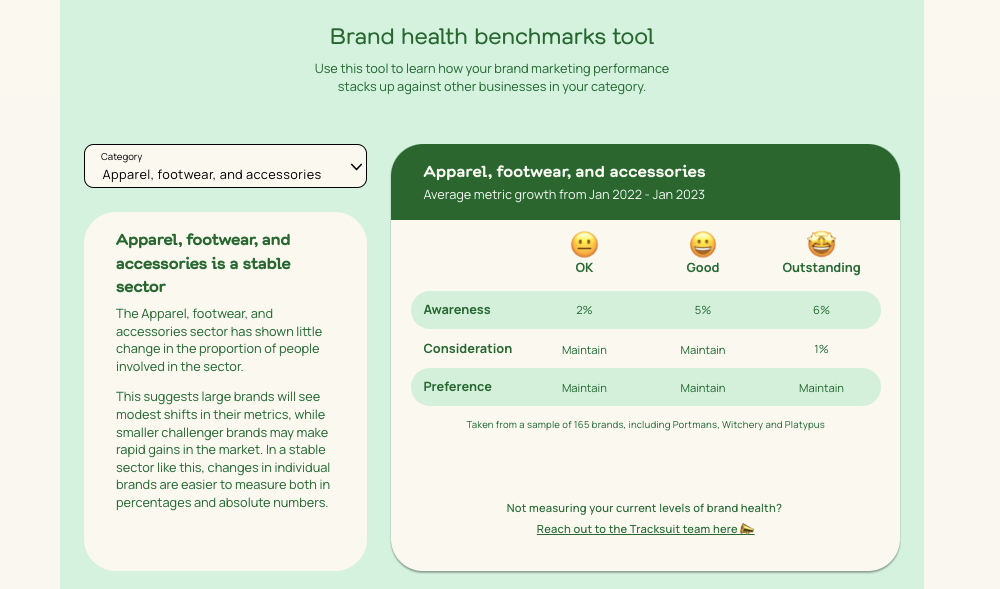
You can also collect data from industry reports, competitors and research on platforms like Statista, Google Trends, and LinkedIn.
Industry benchmarks are the much-needed anchor for successful marketing proposals in a fluctuating business landscape. They offer insights into what works, what doesn’t and where you can stand out where others fall short.
4. Create a culture of open communication and collaborative decision-making
You’re more likely to face resistance and a lack of support when decision makers don’t fully comprehend the proposed branding strategy.
To tackle this, make sure they’re bought into the vision by setting regular meetings with your stakeholders and encourage sharing insights and feedback. For instance, you can brainstorm with them if you’re working on new brand campaigns or product launches.
After the brainstorming session, organise your best ideas into a comprehensive proposal. Remember: it all starts with a compelling business case. Structure it with an executive summary, problem statement, proposed solution, key milestones, KPIs, budget and brand ROI projections.
Share this with the executives for further input and refinement. They can offer perspectives on potential problems and opportunities that can strengthen your initiatives. This inclusive approach builds a unified vision and increases your investment sign-offs.
5. Use beautiful visualisations to convey complex data
Have you ever tried presenting a dense, raw data spreadsheet in a marketing strategy meeting? It’s like watching a foreign film without subtitles 🫣 Luckily, there are better ways of presenting your ROI of branding data.
Tracksuit takes the research that usually lives in complex spreadsheets and distills it into a beautiful dashboard where you can download different visualisations of your data.
This means your team’s eyes won’t glaze over when you present it back to them – instead, they’ll be engaged and easily interpret what the data means. It’s important to know your audience and tailor your visuals to match their preferences.
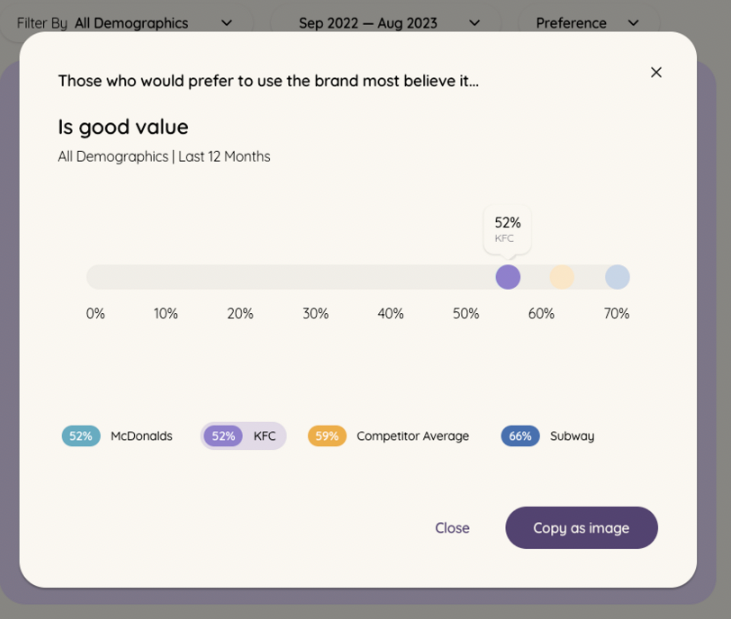
💡 Top tip: On Tracksuit's dashboard, you can select any of the views of your data like the one above and 'Copy as image'. This makes it easy to insert beautiful visualisations of your data into external presentations, like a board report.
CEOs and board members may enjoy seeing your brand data visualised on Tracksuit, while CFOs might need clear-cut but detailed cost analysis presented in clear tables and line graphs.
Catering to their unique info requirements is vital to enhancing communication efficiency and decision-making across the board. Elevate your presentations, strengthen your case, and drive impactful decisions that boost brand ROI.
Handling executive objections and pushback scenarios
Even with strong evidence, marketers often face resistance when pitching brand investment to executives. Pushback usually comes from a place of caution; leaders are accountable for budgets, shareholder expectations and short-term performance targets.
Anticipating these objections and responding with clarity can make the difference between rejection and approval.
Objection 1: “Branding isn’t measurable; we can’t track its impact.”
Executives accustomed to performance dashboards may struggle to see brand marketing as quantifiable. The key is to reframe the conversation around tangible metrics. Brand health can be tracked through awareness, perception, consideration and loyalty scores.
Correlating these metrics with business outcomes, like sales velocity or market share growth, demonstrates that branding is not abstract but measurable and predictive of future performance. Citing long-term studies that link brand equity to profitability helps make the case even stronger.
Objection 2: “We need immediate returns, not long-term investment.”
This is one of the most common concerns, especially in organisations under quarterly revenue pressure. The right response is to show that brand and performance marketing are not mutually exclusive.
Brand campaigns may take longer to show ROI of branding, but they lay the foundation for sustainable competitive advantage, lower acquisition costs, stronger loyalty and the ability to charge premium pricing. Pair this with examples of companies that built enduring market share by committing to consistent brand investment and the argument becomes more persuasive.
Objection 3: “We don’t have the budget for this right now.”
Budget constraints often stop initiatives before they start. Instead of walking away, offer a phased approach. Recommend starting with smaller-scale campaigns or pilot programmes that require modest resources but can generate measurable impact.
By framing brand marketing as what it is - Brand ROI with scalable entry points, and by presenting a cost–benefit analysis showing projected returns, executives are more likely to consider it a manageable commitment rather than an all-or-nothing expense.
Objection 4: “Our competitors are focusing on performance marketing.”
Executives may worry about being left behind if rivals double down on quick wins. This is an opportunity to emphasise balance. Performance marketing captures existing demand, while brand marketing creates new demand.
Without brand-building, performance tactics eventually plateau. Case studies from companies like Apple or Nike illustrate how pairing performance activity with strong branding fuels both short-term wins and long-term dominance.
Objection 5: “We’re not sure this aligns with our company vision.”
Sometimes the resistance is less about money and more about fit. In these cases, connect the ROI of branding directly to the organisation’s mission and values. Explain how branding reinforces differentiation in the market, strengthens culture and builds trust with customers.
By showing that brand investment - and in turn brand ROI - isn’t just marketing spend but a strategic enabler of long-term goals, you help executives see alignment rather than conflict.
Managing expectations for long-term brand ROI
Winning over your executives is only the first step. To ensure their confidence in the marketing team, make sure you’re managing their expectations with these strategies.
1. Set realistic timelines for brand marketing to drive results
Marketing activity doesn’t always create results (and deliver on attribution) overnight. Setting realistic timelines can help manage long-term expectations without overpromising and under-delivering.
Make sure you use specific milestones to track brand ROI progress at various points during the project, not just at completion.
Let’s say you’re setting milestones for a new product rollout’s pre-launch, product launch, and post-launch stages. Each stage should have its own measurable goals and metrics. For example:
- Increased website traffic by 20% during pre-launch
- 500 new leads within the first month of the product launch
- Customer retention rate of 30% post-launch.
By doing all this, you can keep your branding initiatives on track to deliver the expected return on investment.
2. Emphasise the cumulative impact of ROI of branding efforts over time
Your executive team could underestimate the value of branding when they don’t have visible results, leading to budget cuts for your department.
It’s especially risky if you only do an annual dip into your brand metrics, like awareness, consideration, preference and consumer perceptions. You won’t know if you’re on track or if your marketing activity isn't having the projected effect until next year’s assessment, which is a little too late.
Highlight how consistent messaging and brand identity contribute to the bottom line over time.
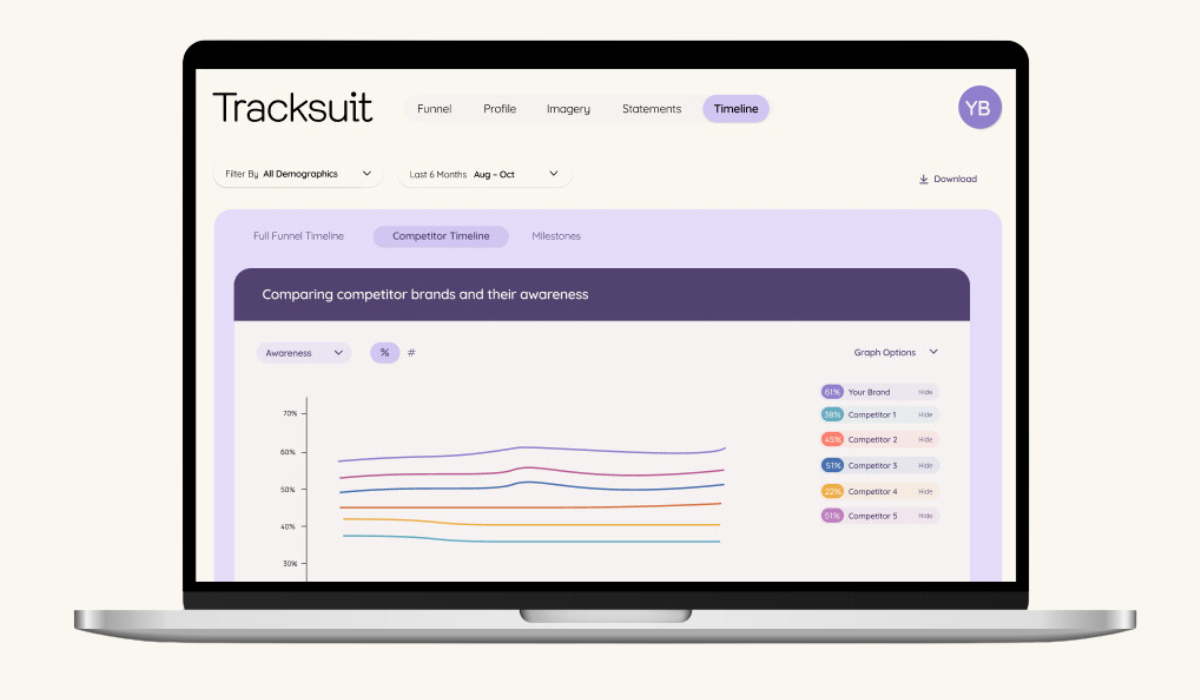
Tracksuit’s always-on dashboard comes in handy for this. It has continuous and real-time brand tracking to consistently monitor consumer perceptions, measure marketing actions, and make data-driven adjustments.
Don’t let your hard work go unnoticed. Report your brand ROI’s cumulative effect to secure continued support and investment.
3. Educate executives about the significance of brand loyalty and customer lifetime value (LTV)
The executives at your business are masters of strategic decision-making, financial management and operational efficiency.
However, they’re not always experts in brand loyalty and customer lifetime value. Educate executives on why these key metrics matter to prevent short-term thinking. Highlight that brand loyalty is when customers consistently choose your brand over competitors. Meanwhile, customer lifetime value (CLV) represents the revenue each customer generates for the business throughout the relationship.
Consider presenting case studies and success stories from your previous campaigns or from other firms in your industry. Here’s an example of a case study from BePure, a vitamin and supplements business.
They recently underwent a rebrand and measured the success of a campaign debuting its new look and feel on Tracksuit. Their team monitored whether top-of-funnel brand metrics were growing, if specific demographics of consumers were underserved by the brand and whether consumer sentiment was changing.
“In terms of Tracksuit, something that was really exciting to see was the direct impact of our campaign going live (including billboards which was a first for us). We were sitting at 17.6% brand awareness in April, jumping to 20.2% in June and the goal is obviously to maintain this level of brand awareness from here on out,” BePure Brand Marketing Manager Emily Parks says.
Since then, Tracksuit’s data shows that BePure has successfully maintained this brand awareness. Thanks to these brand ROI metrics, their executive team can now see how good branding investment drives long-term growth.
The importance of ongoing brand tracking
It takes more than a one-off pitch to persuade executives to invest in long-term branding strategies. And even with consistent efforts, there are macro fluctuations happening to your wider category that you can’t control (like if you’re in fintech and an economic downturn happens, it means people are less likely to invest).
Because of this, ongoing brand tracking becomes critical to achieve the ROI of branding. Here’s how it can help you achieve more investment:
Continuous progress evaluation and monitoring
Research shows that 68% of businesses credit brand consistency for 10% to 20% (or more) of their revenue growth. With ongoing tracking, you can fine-tune all your campaigns and projects and align them to your brand’s objective. It also helps to identify any shortcomings and make necessary improvements for ongoing revenue.
Understanding consumer perceptions and sentiments
Did you know that 66% of consumers will discard a brand if their experience isn’t personalised? Conduct ongoing surveys and feedback gathering to understand their preferences, pain points and aspirations. Using this data, tailor your brand messaging and efforts to hit the mark every time.
New growth opportunities through iterative improvement
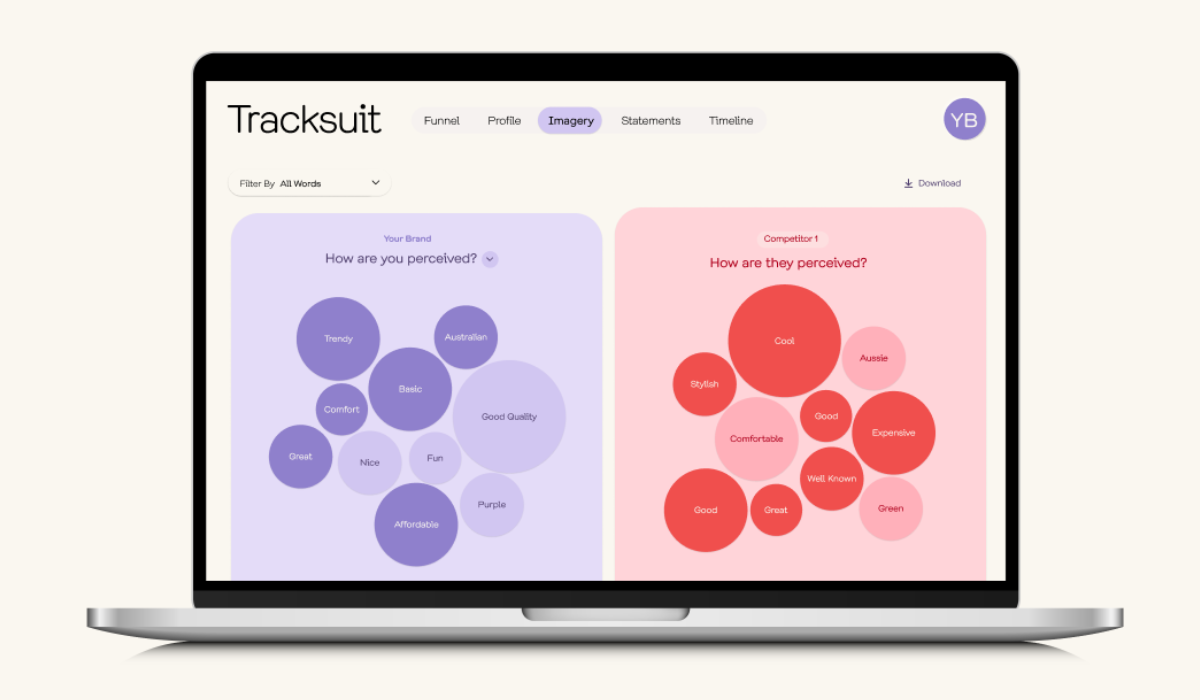
The majority of companies conduct brand tracking and report an average 7x ROI. You can achieve similar success by implementing well-defined feedback loops. This methodology seeks feedback from active consumers in your category, analyses their perceptions and uses that data to optimize branding strategies.
For instance, if consumers prioritise trust when it comes to your product category, consider highlighting this aspect of your brand in your marketing campaigns. Satisfied shoppers become instant brand advocates who can attract referrals and amplify your reach.
Tracksuit: A tool to help drive more brand ROI
Airbnb boasts an impressive 82% brand awareness among 149.7 million people and counting. Meanwhile, Apple’s name and logo alone are worth over $408 billion, surpassing Microsoft and Google’s total brand values.
These impressive brand awareness and valuation figures are the results of extensive and ongoing brand building (and tracking) 🔥
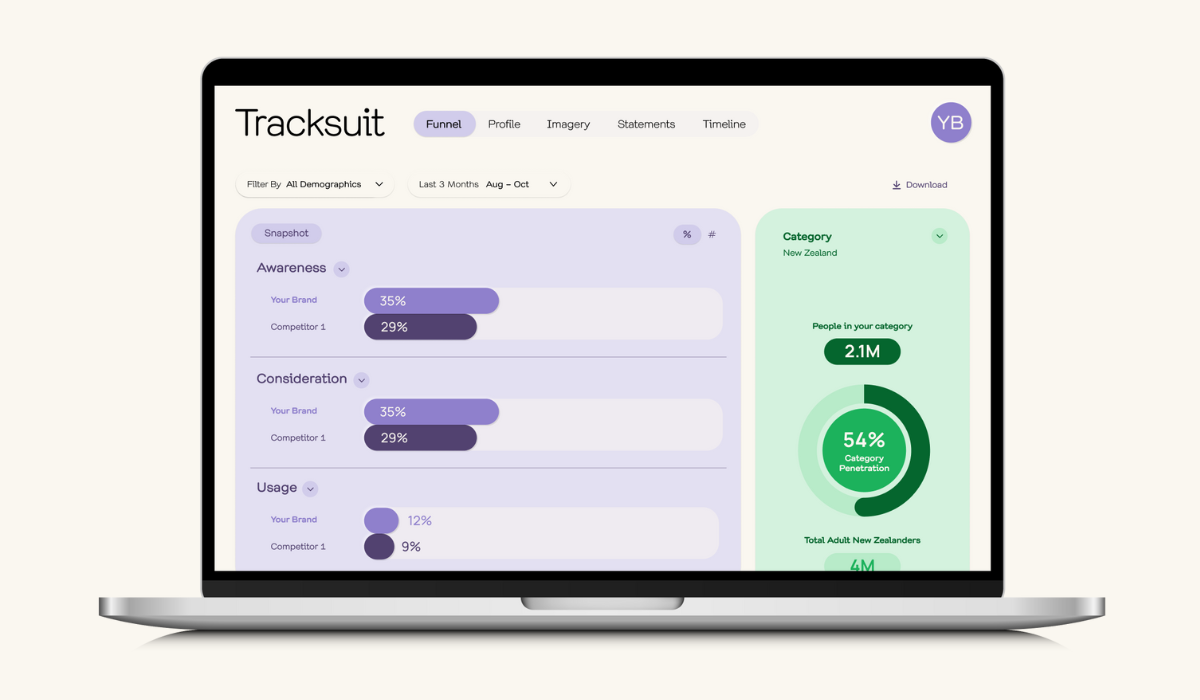
Here at Tracksuit, we are known for our real-time tracking tools, advanced analytics and stakeholder-friendly dashboards. From the top of the funnel marketing perspective — awareness, consideration and preference, our smart tool handles all the branding assessments and reports for you.
Tracksuit sends weekly surveys to a nationally representative panel of consumers. Our real-time data ensures a vast, unbiased sample that accurately represents your target audience’s sentiments. So, you won’t have to settle with limited data and subjective assessments from traditional consultancy firms.
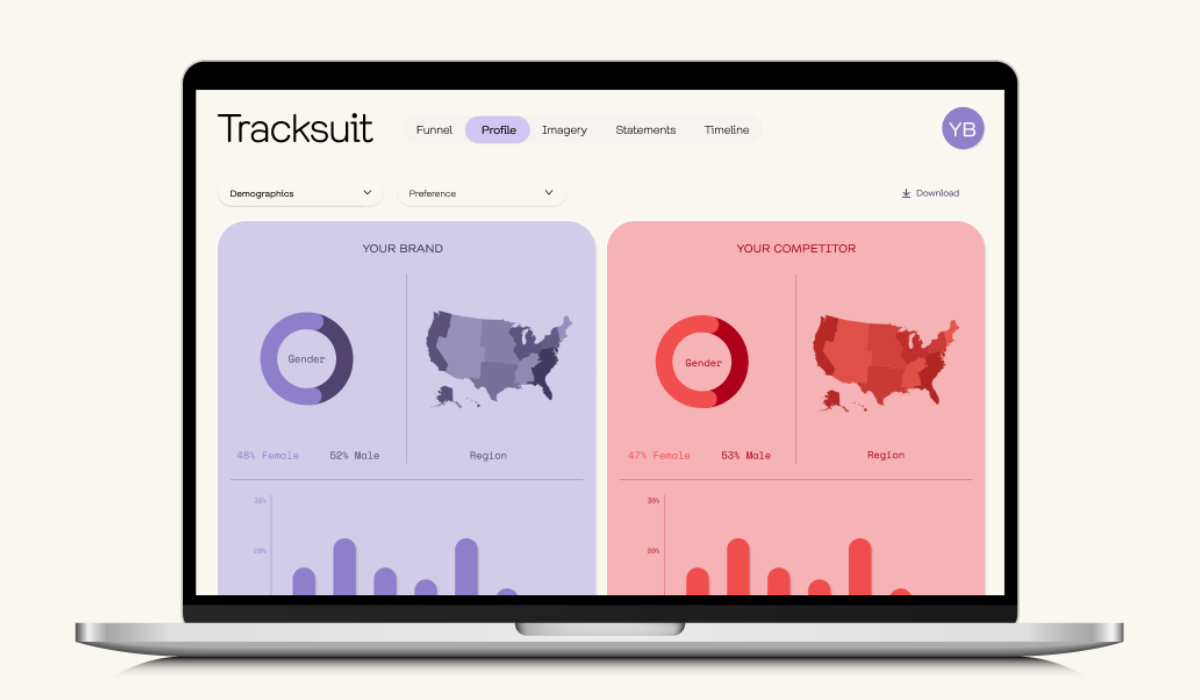
💡 Top tip: Tracksuit customers often overlay their sales or investment data with data from their brand tracking to identify correlations and maximise marketing results.
Build a strong brand that not only resonates with thousands, but also translates into substantial brand ROI.
Get executives bought in with Tracksuit
Securing executive buy-in for marketing investments requires a strategic approach that emphasises the value of marketing ROI. Some of the best practices to keep in mind: a compelling business case, well-aligned marketing goals, industry benchmarks, open communication and visualisations.
Achieve brand ROI with us — start your journey here