

For this evidence-based agency, brand data isn't a reporting add-on - it's the starting point for every media decision.
"Tracksuit is another layer of data that is independent and verified, that supports, proves or disproves whatever we try to do."
Audience Group, opens in new tab is a Brisbane-based media and communications strategy agency founded in 2015. Starting as a creative shop before shifting to media strategy, the agency works with a tight roster of mid-market clients across categories including legal services, FMCG, tourism, and consumer brands - relationships that typically run five to seven years or longer.
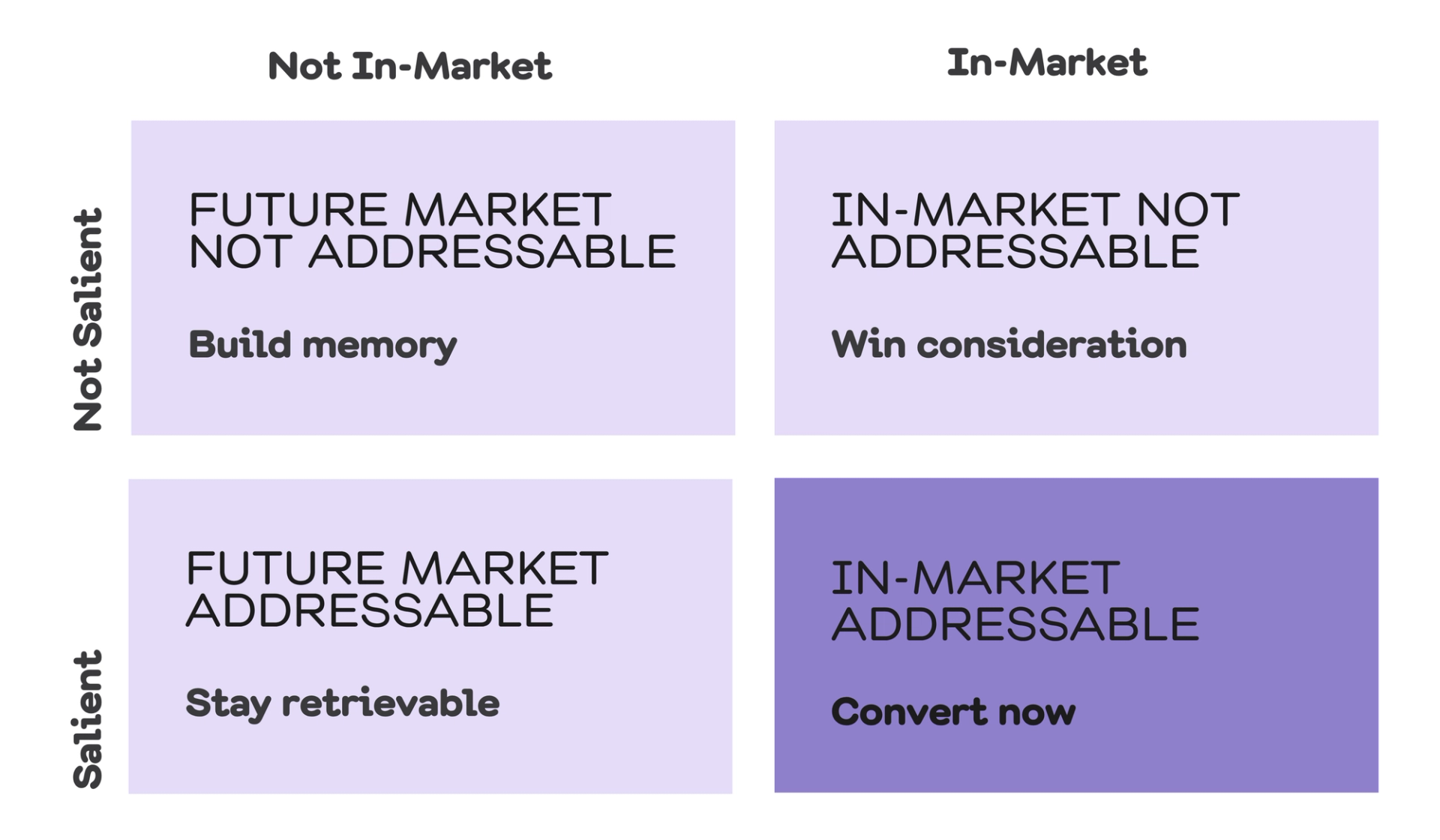
The agency's philosophy is clear: "Stop making media owners rich and buy your audience, not media." For James McDonald, Managing Director at Audience Group, that means every dollar needs to do a specific job. His planning model divides every audience into four boxes - in market or not in market, salient or not salient - each demanding different channels, different creative, and different levels of investment. Tracksuit is what quantifies each box.
The data flows through the whole team. Media planners use it to shape channel recommendations. Strategists pair it with media-mix models, search data, and competitive intelligence. And when the CEO of a client business calls to talk about whether media investment is working, it gives the agency something concrete to point to.
Diagnosing the problem
Before Tracksuit, identifying what was actually wrong meant relying on proxies: search volume, website traffic, auction data, market share. None showed the full progression from awareness to consideration to preference. Annual brand studies - when clients had them at all - were expensive, infrequent, and often poorly sampled.
The agency watches the data monthly, reports on it monthly, and uses it to catch demographic shifts, creative fatigue, and messaging problems early enough to act - rather than relying on annual brand studies that arrive too late to course-correct within a campaign cycle.
"I'm more interested in using it as a planning input and a measurement output." James says.
The sharpest example came from a national brand that was number one in every Australian state except Queensland. The assumption was low awareness. Tracksuit showed something different.
"Through Tracksuit, we found that it was really pretty healthy - not as healthy as in other markets, but still healthy. The real problem was the consideration to preference, and that's where we were underperforming in Queensland."
That single insight reframed the entire media brief for the state. The agency had been running an out-of-home-heavy strategy suited to markets where the brand was already dominant - reminding people who already knew. In Queensland, the problem wasn't recall. It was giving people a reason to choose.
Sizing the audience
Tracksuit replaced the proxies with a continuous view of brand health - broken down by competitor, geography, and demographic. "It fills it out perfectly for us. We treat Tracksuit as almost a pre-media mix model."
For James, the value is knowing how many people sit in each of his four boxes - and what each box costs to move. The "build fame" box is the most expensive: an unfamiliar brand chasing people who aren't yet in market needs broad, high-cost formats like TV, cinema and radio to cut through. Knowing exactly how many people sit in that box is what tells him how much to spend there, instead of guessing.
What, where and how much to spend
Once the diagnosis is clear, Tracksuit data shapes the execution. Take the Queensland example from the section above: the fix wasn't more media - it was different media.
"Just that one insight from Tracksuit actually changed the media mix in that state. It changed our in-channel executional aspects - it certainly changed our screen strategy to be into more areas of heightened emotional state."
Here’s the thinking behind it.
"Because it wasn't an awareness thing, we needed to choose environments where we could spend a bit of time talking to customers. We needed to find environments where we could gain enough attention to get a more complex message across."
The media mix shifted. Out-of-home moved from fewer large placements to smaller, more numerous ones. Screen strategy moved into subscription TV and connected TV at peak, targeting environments with heightened emotional engagement. TV spots moved from 15-second to 30-second formats to give the message more room.
The client grew market share in Queensland. Qualified leads increased. Search acquisition costs rose less than in other states.
Defending and proving it
James treats Tracksuit as one of several independent lines of evidence rather than a single source of truth: paired with econometric modelling, it gives the agency two separate ways to reach the same conclusion, not one.
"If I can show them Tracksuit data as well, then I've got two independent data sources." The result? "It's made it less subjective, which I love."
The freedom to test, fail, and adjust without guessing is what changes the conversation with leadership. When the CEO calls to discuss whether the media plan is working, the answer isn't a gut feel or a proxy metric.
"It's the uncertainty of not knowing that creates doubt, and Tracksuit removes an element of doubt for us," says James. "The first thing Tracksuit does is give us a continuous ability to look in and go: how are we going?".
Key Takeaways
Diagnose before you plan. Audience Group used Tracksuit to discover that a state-level problem wasn't awareness but consideration-to-preference - reframing the entire media brief.
Quantify your audience, not just your reach. Tracksuit fills out the agency's four-box planning model, showing how many people are in market, how many find the brand salient, and where investment should go.
Watch it monthly, not annually. Continuous tracking catches demographic shifts, creative fatigue, and messaging problems early enough to adjust spend and tactics before it’s too late - including, for one client, recommending a significant brand budget cut when investment efficiency has flattened.
Two independent data sources beat one. Pairing Tracksuit with media-mix modelling gives the agency confidence to challenge assumptions, defend recommendations, and reduce subjectivity in client conversations.
Ready to make brand data the starting point for smarter media decisions?
Talk to Tracksuit.


