
Black Friday is new to Japan. It only really arrived in 2016, when a handful of retailers tried it on, and it has had to find room in a calendar already crowded with year-end bonuses, New Year sales and the mid-year summer sale.
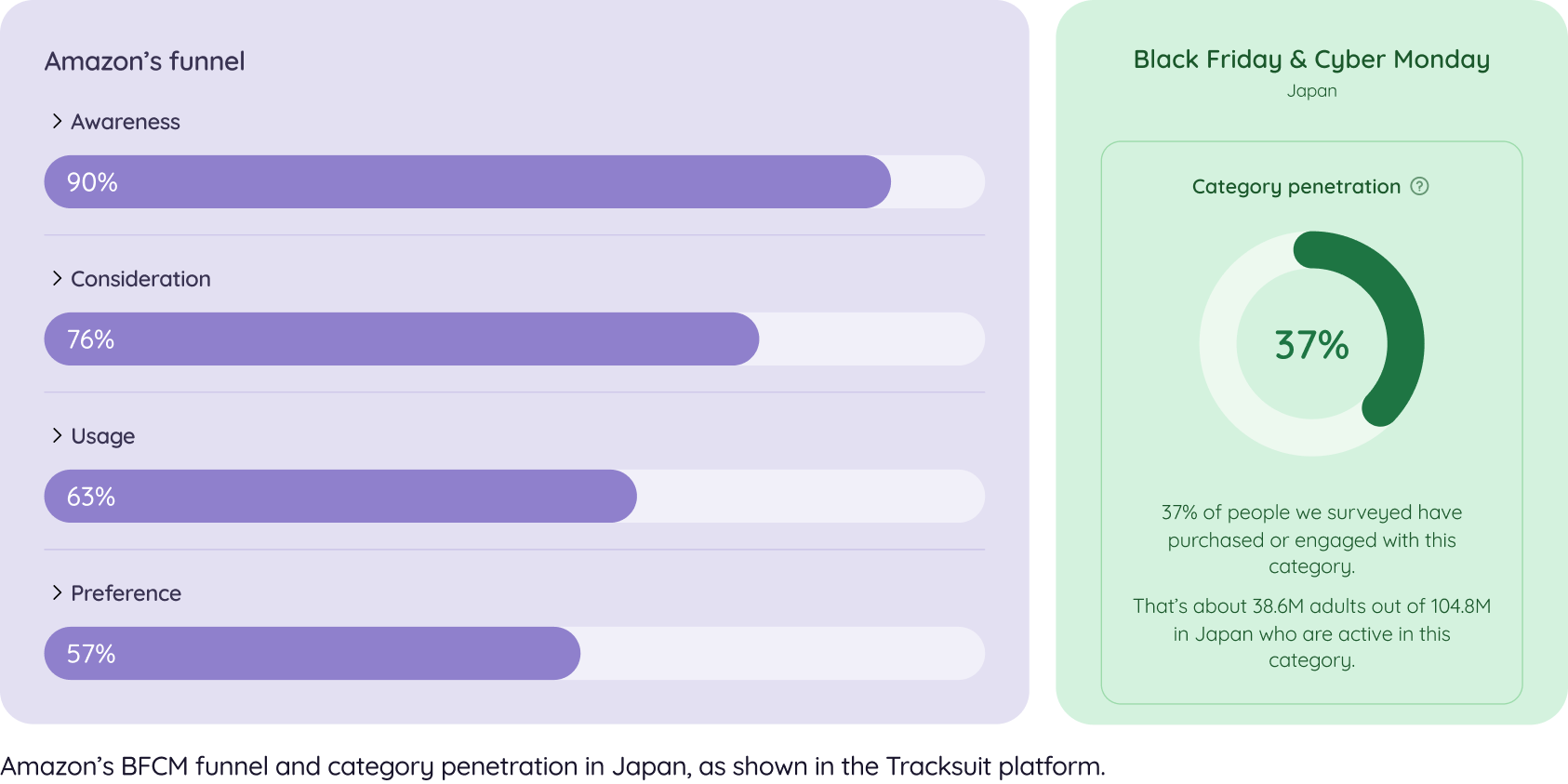
So we asked how far it has got. When Tracksuit surveyed 1,863 Japanese adults in October 2026, only 37% said they’d bought in a Black Friday or Cyber Monday (BFCM) sale in the past year or were open to doing so, the second-lowest engagement rate in our eight-country study, just above New Zealand. But Japan is a big country. Scaled up to the adult population, that 37% equates to about 39 million people, the third-largest Black Friday audience we measured, behind only the US and Germany and ahead of the UK.
The 690 who qualified rated 15 major retailers: the global marketplaces (Amazon, Costco, Temu, Shein, AliExpress and Qoo10) and nine Japanese names (Rakuten, Yahoo! Shopping, ZOZOTOWN, Don Quijote, Matsumoto Kiyoshi, Yodobashi Camera, BIC Camera, Yamada Denki and K’s Denki).
One idea runs through this whole series, and it’s the easiest way to read what follows: the shortlist is long, but the basket is short. Shoppers will happily consider a handful of retailers and then buy from one or two. Japan takes that to its limit: the narrowest baskets in the study and the clearest two-horse race. The retailers that win are the ones that turn “I’d consider it” into “I bought it”, and then into “I’ll be back next year”. Remember what we’re reading here: this is shoppers’ state of mind going into Black Friday 2026, not what happens during it. We’ll follow up in January with three months of data and the full story. Here’s what we found.
Amazon leads, Rakuten follows, nobody else is close
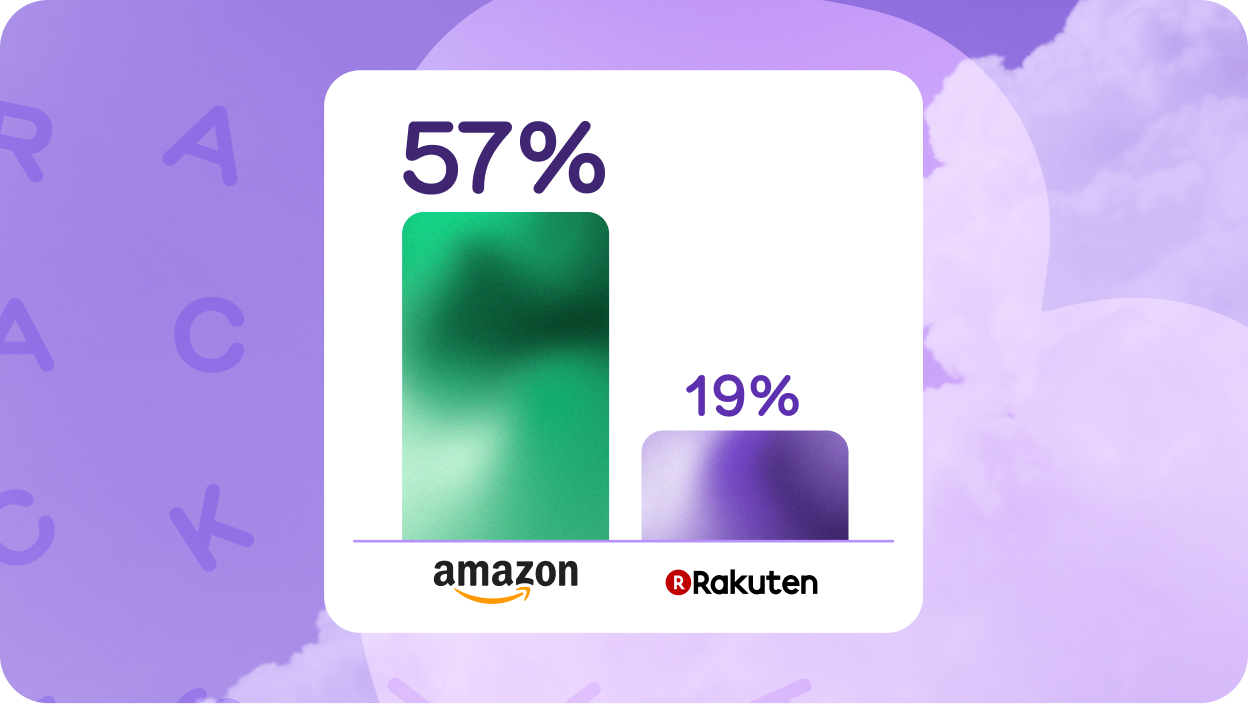
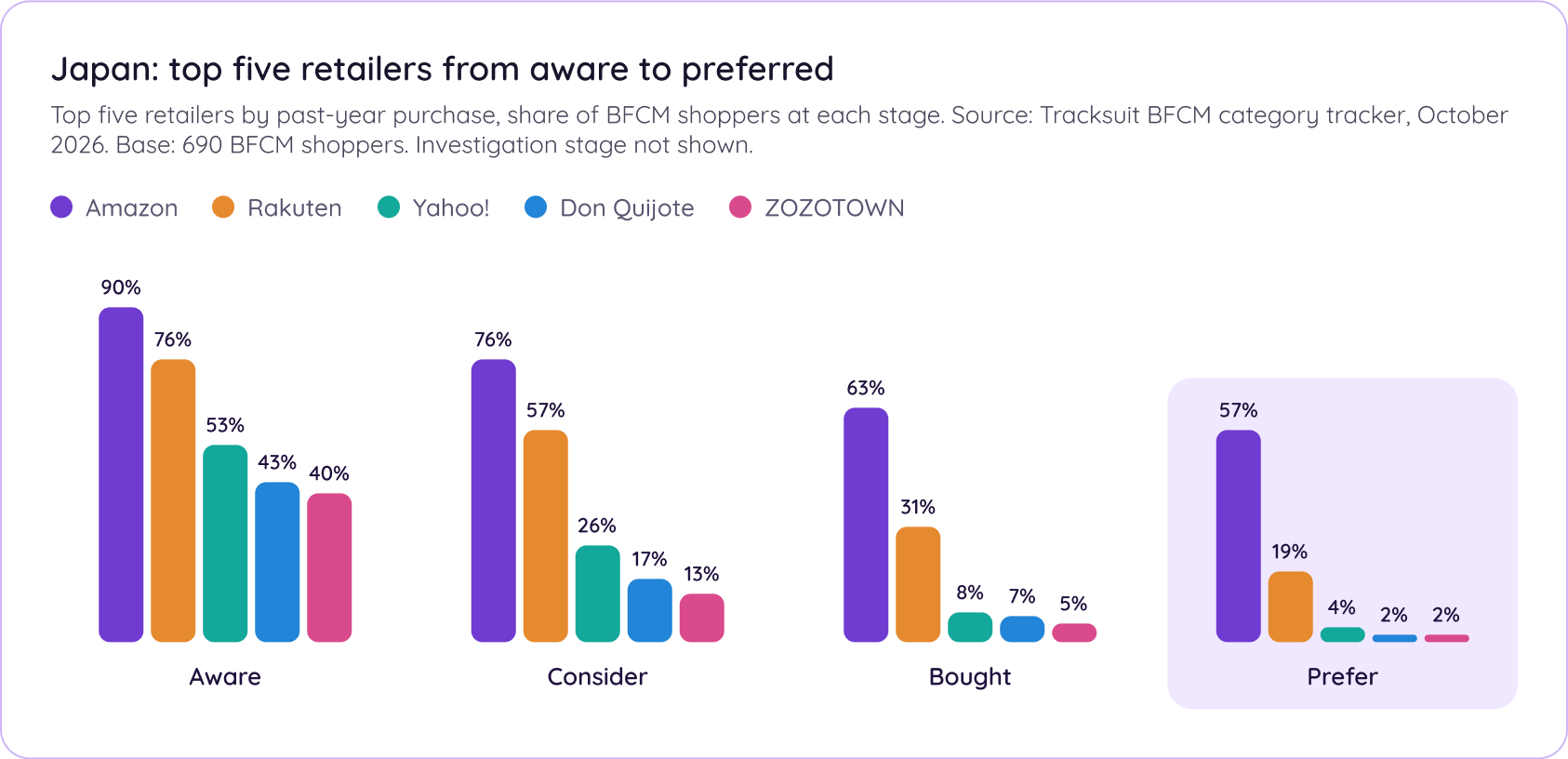
Ask Japanese BFCM shoppers which retailer they’d prefer to buy from, one answer only, and 57% say Amazon. Nearly everyone knows it: 90% of shoppers have heard of it, 76% would consider buying from it and 63% bought from it last Black Friday or Cyber Monday. That’s a share of preference only Germany beats.
Rakuten is the one local brand with a real answer. It’s recognized by 76% of shoppers, considered by 57%, was bought from by 31% last year and is preferred by 19%. That 19% is the strongest second-place position of any local retailer in our study. Yahoo! Shopping is third at 4%. Nothing else reaches 3%. Purchase and preference are counted differently, which is why the gap between them is so telling: shoppers could name as many retailers as they liked when we asked what they’d bought, so purchase rates can add up to well over 100%, while preference is one pick each and can’t.
The two-horse race splits by gender. Among Japanese women, Amazon is the preferred Black Friday retailer for 51% and Rakuten for 24%; among men it’s 63% and 15%. That’s the widest gender gap for Amazon in any market we surveyed. If Rakuten wants to grow, the men are the gap; if Amazon does, it’s the women.
Sign up for Shorts
For fortnightly brand insights, stories and goodness that’ll help you win (we promise).
The narrowest sale in the study
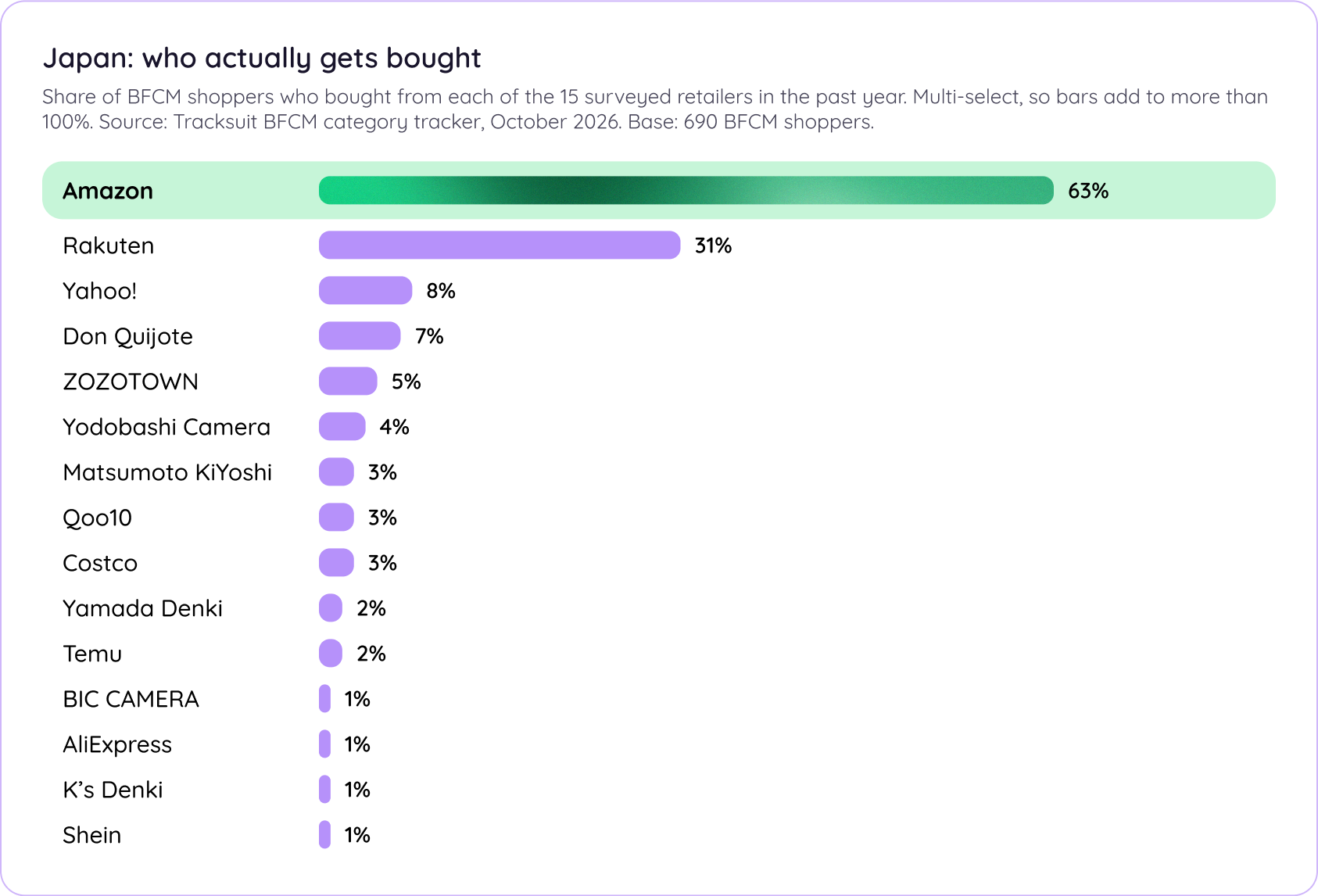
Japanese shoppers bought from 1.4 of the 15 major retailers we surveyed, the fewest of the eight markets, and Amazon accounts for 46% of all the purchases reported across them (63% of shoppers bought from it). Rakuten is the only other retailer above 10%: bought by 31%, with Yahoo! Shopping (8%) and Don Quijote (7%) a long way back. Rakuten is also the only local brand with a real funnel: considered by 57%, bought by 31% and preferred by 19%.
A small audience with settled repeat BFCM purchasing habits
Only 37% of Japanese adults are in the sale or open to it, the lowest of the large markets, but that’s still roughly 39 million people, and most have settled on a favourite. 57% prefer Amazon and 19% Rakuten, so three in four name one of those two. The average shopper bought from 1.4 of the 15 major retailers we surveyed, the fewest in the study.
We also read shoppers short statements, like “is where I shop every Black Friday”, and asked which retailers each one describes, counting only people who already know the brand. For the average retailer we tracked, repeat BFCM purchasing habit is modest at 9%, but Amazon’s score is 33% and Rakuten’s is 22%. The sale has two routines, and only two.
The chart shows how concentrated the baskets are. Amazon is bought by 63% and Rakuten by 31%. The next best, Yahoo!, is on 8%.
Everyone knows the electronics chains. Nobody picks them
Yodobashi Camera, BIC Camera and Yamada Denki are recognized by 36 to 42% of Black Friday shoppers each, and they’re the most trusted brands in the market: 40% of people who know BIC Camera call it a brand they trust, 38% for Yodobashi, 34% for Yamada. Amazon manages 30%.
And yet none of them is preferred by more than 1.3% of shoppers. The pattern repeats with Don Quijote (43% awareness, 2.4% preferred) and ZOZOTOWN (40% and 1.8%). Japanese shoppers trust their specialists more than they trust Amazon; they just don’t think of them as where Black Friday happens.
Value belongs to Don Quijote. Deals are a dead heat
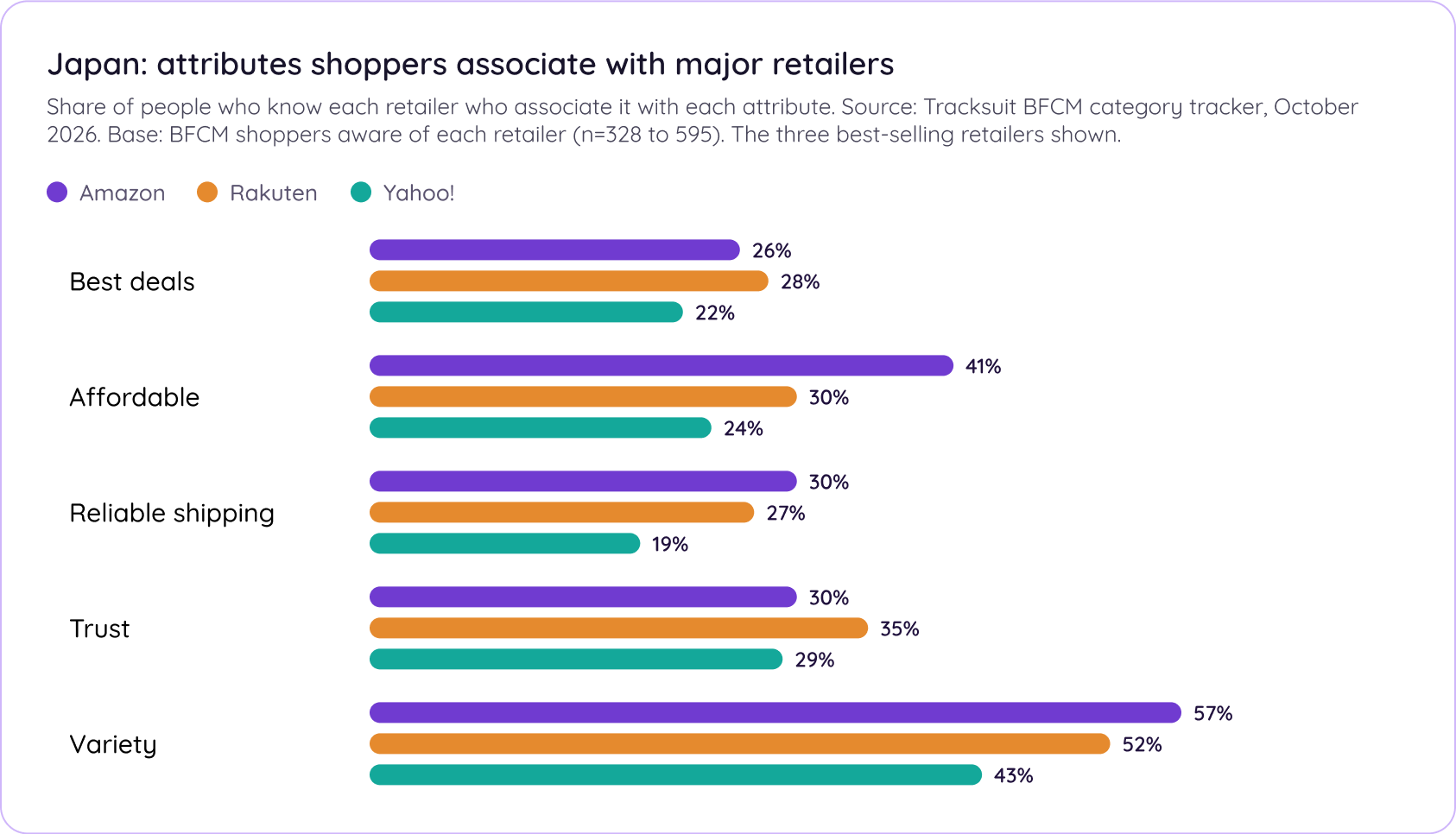
The brand statements split the market neatly. Among people who know each brand, Don Quijote is the affordability champion at 57%, with Shein (47%) and AliExpress (45%) next and Amazon back at 41%. On “has the best deals”, Rakuten (28%) edges Amazon (26%); Japan and Australia are the only markets with a local Amazon store where it doesn’t lead that statement. Amazon’s edge is where it always is: 49% of people who know it credit it with fast shipping, against 26% for Yodobashi, the best local.
The chart shows how the two horses differ. Amazon wins on fast shipping (49% against 18%) and “affordable” (41% against 30%), but Rakuten has the edge on trust (35% against 30%) and “best deals” (28% against 26%). Those are small leads, but they’re the ones a challenger can build on.
The Chinese marketplaces haven’t landed
Japan is the weakest market in our study for Temu, Shein and AliExpress. Temu is recognized by 30% of shoppers but considered by under 5%, bought from by 2% and preferred by 0.3%. Shein is at 27% awareness and 0.4% preferred; AliExpress at 14% and 1%. Together they hold under 2% of first preferences. Their trust scores are in single digits, and Japan’s own marketplaces already cover the ground they’d normally take.
Japan has two routines
What Japan does have is repeat BFCM purchasing habit. Among people who know Amazon, 33% say they shop there every Black Friday; for Rakuten it’s 22%. The sale is young, but for the people who’ve adopted it, it’s already routine.
Where Japanese shoppers are two weeks out
Japan is a smaller, quieter and more settled sale. 37% of adults are in the sale or open to it, which is still about 39 million people, but this is an audience with firm repeat BFCM purchasing habits: 57% prefer Amazon and 19% Rakuten, so three in four name one of those two.
The basket is a very short one. Shoppers bought from 1.4 of the 15 major retailers we surveyed, the fewest in the study.
Repeat BFCM purchasing habit comes down to two routines, Amazon (33%) and Rakuten (22%), against 9% for the average retailer. Picture a shopper who knows exactly which two sites they’ll open, and has little reason to try a third.
What this means if you’re competing with Amazon
The race for second place is settled, so the useful question is how to take a slice of a sale with only two routines. Four moves:
- Take the second-seat route, then build on it. Rakuten has done the hard work: 76% awareness, 57% consideration, 31% bought and 19% preferred. It already beats Amazon on trust (35% against 30%) and “has the best deals” (28% against 26%). Small leads, but ones a challenger can build on.
- Get on the shortlist first. Don Quijote owns “affordable” (57% against Amazon’s 41%), but only 43% of shoppers know it and 7% bought from it. Yodobashi Camera and BIC Camera are known by about 40% and preferred by about 1%. You can’t be chosen if you aren’t on the shortlist.
- Give trust a reason to visit. The electronics chains are the most trusted brands (BIC Camera 40% against Amazon’s 30%). The job isn’t convincing people to trust them. It’s convincing them that Black Friday is a reason to go.
- Promise delivery that rivals Amazon’s. Amazon is credited with fast shipping by 49% of the people who know it, against 26% for Yodobashi, the best local, and 18% for Rakuten.
After the sale, think about repeat BFCM purchasing habit, because it is how a second-place retailer becomes first choice over time.
Methodology
Part of Tracksuit’s eight-country Black Friday 2026 study. Read the global view here: [Link: global post]. Methodology: 1,863 Japanese adults surveyed in October 2026, of whom 690 qualified as BFCM shoppers; brand statements are asked of people aware of each brand; gender differences are quoted only where they pass a 95% significance test and the sample is large enough for Tracksuit to report without an indicative or insufficient flag; bases for AliExpress and Qoo10 are under 100. Retailers per shopper adds each market’s purchase rates across the 15 major retailers surveyed. Retailer groups: the 15 major retailers are grouped as global marketplaces headquartered in the US (Amazon and Qoo10); marketplaces headquartered in Asia (Temu, AliExpress and Shein); local marketplaces (Rakuten and Yahoo!); fashion (ZOZOTOWN); beauty (Matsumoto KiYoshi); electronics and appliances (Yodobashi Camera, Yamada Denki, BIC CAMERA and K's Denki); general merchandise (Don Quijote); warehouse clubs (US-headquartered Costco). Unless marked, brands are headquartered in Japan. Population equivalents apply each market’s engagement rate to the UN World Population Prospects 2024 (medium variant) estimate of the population aged 18 and over at 1 July 2026. We’ll publish a follow-up in January, using a full three months of data, on how the sale actually played out. AI was used to support ideation and iteration of this analysis. All data points and observations have been refined and validated by Tracksuit’s Marketing Science team.