What is brand tracking? The story lives between the stages
Written by


Ozempic is approved in the US for type 2 diabetes. Zepbound is the one approved for chronic weight management. But ask a room of people which one they would take to lose weight and the name they say first would usually be Ozempic, which is exactly the gap brand tracking exists to find.
Knowing a brand and choosing a brand are two different measurements, and most dashboard slides only get seen once a year. Always-on brand tracking fixes that in two ways: it gives you a monthly read on your brand’s performance instead of an annual dip, and it gives you consistent conversion rates between funnel stages so you can learn how to perform better in your next campaign.
What is brand tracking?
Brand tracking is the repeated measurement of how a category's buyers know, consider and choose your brand alongside the competitors they weigh it against. Ideally, it runs the same survey with the same category-qualified people at a set cadence (monthly rather than annually).
Most importantly, it reads the movement between funnel stages, either positive or negative, that you can use to inform next quarter’s strategy.
The funnel we measure runs in a linear order:
- Awareness (both aided and unaided)
- Consideration
- Investigation
- Usage
- Preference
If you want the mechanics of the first stage, we've written up this article on aided and unaided awareness separately, which would be worth a read if you’re not clear on the difference just yet.
The use of brand tracking has risen sharply in recent times. 62% of CMOs were tracking brand awareness metrics in 2025, up from 42% in 2024 (source: Censuswide downloadable report, opens in new tab). That’s a 20-point jump in a year, which means more marketers than ever are tracking their brand in some form or fashion.
The problem is that many teams are getting annual reports about their brand’s health, which means they see a score this year and can only track progress on a 6-to-12 month basis. But with a self-serve, always-on tracking approach, teams can follow movement across their funnel month after month in near real-time.
Sign up to Shorts
A fortnightly newsletter with exclusive brand insights, useful marketing tips, and a round-up of all the stories you should know about.
Individual funnel stages are pieces of a larger pie
When brand tracking is done once per year, it tends to force attention on a single stage of the funnel at a time. You’ll get an understanding of how much awareness increased compared to last year, or how fewer people are considering your brand compared to competitors.
But when you see the whole picture, on a consistent basis, you get a better sense of your wins and losses at a more granular level.
Clinique in UK premium skincare is one of our favorite examples of this. Over the 12-month period we tracked, their top-of-funnel stage was broadly flat. If you read the awareness line alone, the year looks like nothing much happened:
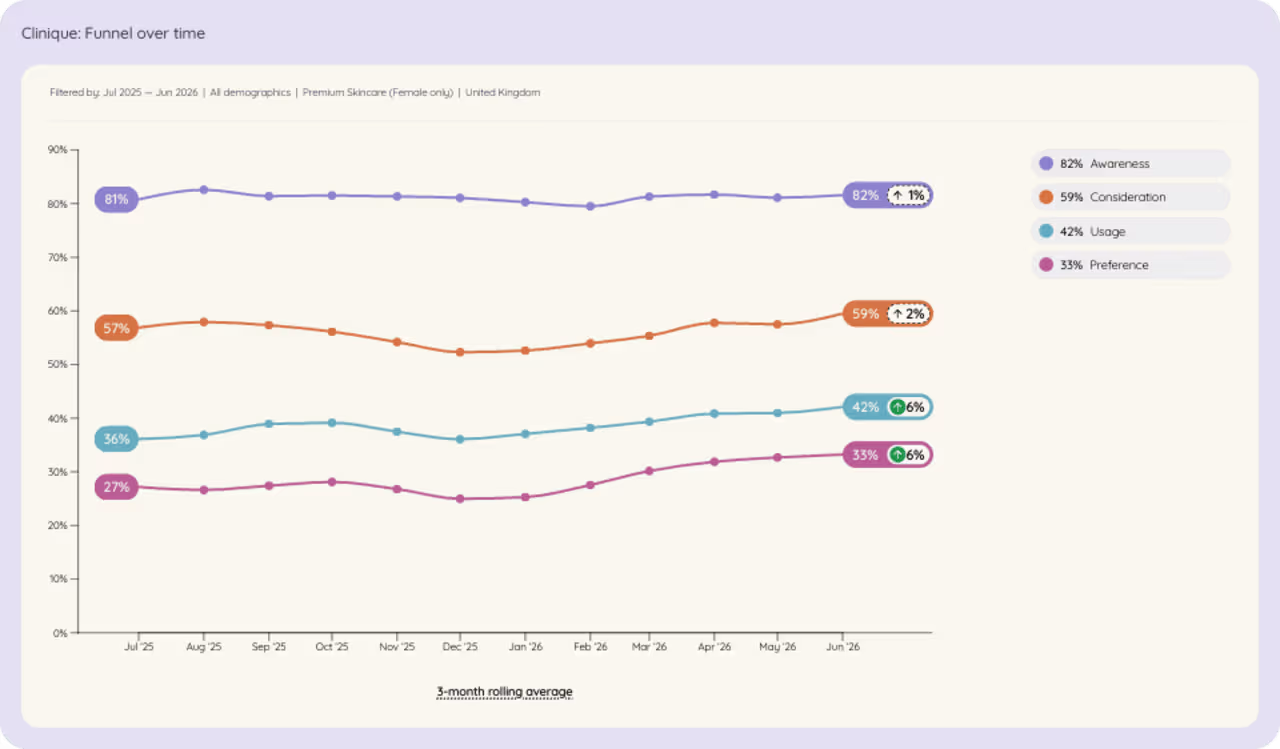
Underneath it, preference climbed from 27% to 33% overall, and from 30% to 39% among women aged 35 to 54. That’s a six-point jump in Preference for a category where Preference is what lets you hold price at the counter.
And if you look more closely at the dates, you can see the largest jump occurs between January 2026 and June 2026, something that an annual report may not have been as clear about.
While each phase in your funnel is valuable in and of itself, seeing the consistent trends in your brand health metrics over shorter periods of time can be more informative when your team is trying to figure out the best next move.
The importance of conversion ratios between stages, month-over-month
Let’s break it down with a concrete (albeit hypothetical) example to make the point clear: imagine you survey 1,000 category buyers. 340 give you aided awareness (34%), 96 name you unaided (9.6%), and 140 of those 340 aware people would consider buying you.
That's an awareness-to-consideration conversion of 140/340, or 41%, against a 50% category average.
What does this likely tell you? Nine points of conversion below category average is a persuasion problem, not necessarily a reach problem. It means two hundred people know your brand’s name and still choose someone else.
This type of finding matters because different ratios are what inform your strategy, but the diagnosis lives quietly between the stages themselves. And the only way to get a clear view of those ratios with enough time to act is to get that data back more frequently than every 12 months. That way, you can consistently keep your finger on the pulse of your market, rather than making a long-term strategy from a snapshot taken once per year.
Here’s a breakdown of each funnel step, the conversion rate you’re looking for, and how that specific ratio can guide your next strategy decision.
Unaided to aided awareness
- What it measures: How many who recognize your brand can recall it unprompted
- Below category average usually means: Weak distinctive assets; you're recognized, not remembered
- Where the next dollar goes: Consistent codes, colors and characters across all media
Awareness to consideration
- What it measures: How many aware buyers would actually buy your brand
- Below category average usually means: A persuasion gap; the proposition isn't landing
- Where the next dollar goes: Positioning and message, before any reach increase
Consideration to investigation
- What it measures: How many considerers go looking for detail on your brand
- Below category average usually means: Not enough reason to research; you're a safe second choice
- Where the next dollar goes: Proof, range clarity and search-visible content
Investigation to usage
- What it measures: How many researchers convert into buyers
- Below category average usually means: Friction at price, availability or retail presence
- Where the next dollar goes: Distribution, pack, pricing architecture and retail media
Usage to preference
- What it measures: How many buyers name your brand as their favorite
- Below category average usually means: Product or experience isn't converting trial into loyalty
- Where the next dollar goes: Experience, community and post-purchase brand work
Set expectations on preference.
Preference is the funnel's most stubborn stage (think quarters, not weeks). Getting Awareness to Consideration moving is faster work, so don’t be discouraged if preference feels like it’s moving slowly or lagging behind more established competition.
What to do with conversion ratios in brand tracking
Take your five funnel stages, calculate the conversion between each adjacent pair, and put the category average next to every one.
Then, find the widest gap.
That's where the next dollar goes, and it settles the reach-versus-positioning argument in about four minutes, which is roughly three months faster than a study that lands after the budget is locked.
One caveat before you carry the ratio into the room: people don't always say what they think or do what they say. Read every ratio as a very useful signal that keeps strategy on the right track rather than a binary answer from a single wave (each repeat of a survey).
Mark Ritson's point about measuring progress is worth keeping in mind. Nobody can tell you how long it takes to get from A to B, so you track whether you're moving at all in the first place. The awareness number tells you how many people say your name, but the conversion rate tells you how many people actually buy it.
And only one of those pays for next quarter’s plan.
Read your number against the category counterfactual
Another issue teams run into is when they measure their brand in isolation. By that, we mean they don’t take any counterfactual (i.e. what happened to everyone else over the same window) into account.
Consider Zepbound, where awareness went from 29% to 46% in a year among US adults aged 55 and over, with every funnel stage moving in concert rather than one lonely spike at the top:
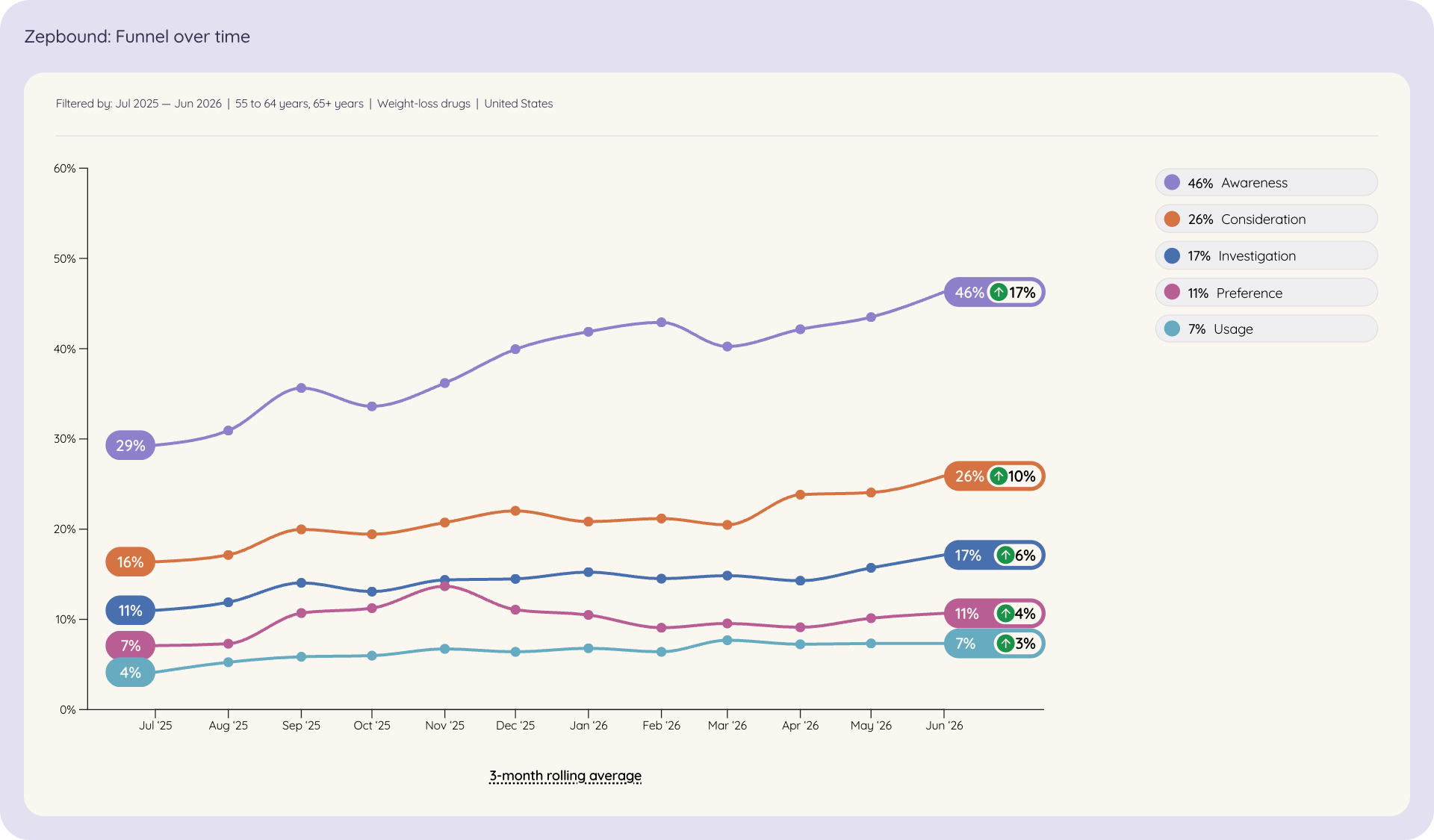
That’s great news for any brand, but gets even better when you learn that over the same window and with the same demographic, Ozempic sat flat.
Two brands, one category, one year, and only one of them moving.
There were nameable public events in that window (price cuts, a Super Bowl spot, and Medicare coverage landing from July 1). So to be totally fair, we're reporting two readings and a calendar, not a causal chain, and we'd never claim one brand's rise pushed the other's line down.
But this does emphasize an important point: a number without the category counterfactual is a fact about your specific survey, not a reading of your market, which is also why brand-led repositioning stories only make sense in context (see Airbnb's brand-led shift).
When to start brand tracking
Start tracking each phase of the funnel long before it’s time to make a decision about your strategy, never after a campaign has already happened. Brand tracking can be valuable to audit the results of a campaign, but is even more valuable in helping you plan next steps like committing next year's plan and targets, entering a new market or category, or repositioning the brand.
In other words, begin tracking with your next campaign in mind so you never have to feel like you’ve missed that window again.
And remember, a monthly read beats an annual dip
We’re often asked about cadence, i.e. how often should you track your brand?
The answer is simple, though not always easy without the right tool: you should use continuous sampling with a rolling read, because an always-on approach gives you better, faster, and more reliable insights than an annual study ever could.
And for the CFOs out there reading this, we know what you’re thinking, “That sounds expensive.”
But usually, continuous brand tracking is priced as subscription software with sampling running underneath it, scaled by how many markets, categories and competitors you measure, instead of being quoted per commissioned study.
That means always-on brand tracking isn’t only better, faster, and more reliable, but it can be a more flexible option for budgets than a traditional adhoc approach.
Two habits for feeling the pulse of your brand
If you take nothing else away from this article, remember this: healthy brand tracking comes down to two habits.
The first is measuring continuously: a monthly read of the same funnel, with the same category-qualified people, so the conversion ratios between stages become visible while you can still do something about them.
An annual dip hands you a position, but a monthly read hands you a direction, and direction is the part a plan can actually use.
The second is never reading your own line alone.
Every number earns its meaning from the brand sitting next to it: Zepbound's seventeen-point climb only became a story about the market because Ozempic sat flat in the same demographic over the same window, and your 41% conversion is only a diagnosis because the category sits at 50%.
Remove the counterfactual and the whole story goes quiet.
Let’s circle back to the example this article opened with: ask people which drug they'd take to lose weight, and the first name out is usually Ozempic, even though Zepbound is the one actually approved for it. Somewhere in your category, buyers are reaching for the more familiar name at the exact moment your brand should be the one that comes to mind.
A monthly read of the full funnel (held against the competitors they're choosing between) is how you find out where that's happening, and what it's costing you. Measuring each phase of the funnel once per year might tell you how you’re currently performing, but only the consistent change in ratios between those phases will give you insight into how to perform better.
Frequently asked questions
What is brand tracking in simple terms?
Brand tracking is the repeated measurement of how the people in your category know, consider and choose your brand versus your competitors. Instead of a single opinion poll, it follows the same questions over time so you can see movement instead of a simple snapshot. The version worth having is always-on: monthly reads instead of one annual study that lands months after the decisions it should have informed.
What is the difference between brand tracking and brand monitoring?
Brand monitoring tends to colloquially mean social listening: mentions, sentiment, share of voice in the press and online chatter. Brand tracking is structured survey data, run against a representative sample of category buyers, that measures where people sit on awareness, consideration, investigation, usage and preference for your brand and named competitors. Monitoring tells you what people are saying, whereas tracking tells you what they'd actually do.
What metrics does brand tracking measure?
The core read is the five-stage funnel: unaided awareness (what comes to mind unprompted), aided awareness (recognition when shown your brand among a list of logos), consideration, investigation, usage, and preference.
How often should you run brand tracking?
Monthly is the standard for always-on brand tracking, because conversion rates between funnel stages shift gradually and you need enough reads to tell a real trend from noise. An annual study only gives you a position, but it doesn’t provide a direction. You can't tell if you're moving one way or another until you have at least two or three points to compare.
What is a good awareness-to-consideration conversion rate?
There's no universal number; it depends on your category average, which is why brand tracking always measures your competitor set alongside you. In our hypothetical example, a brand converting 41% of its aware audience into considerers against a 50% category average has a persuasion problem, not an awareness problem, and more media spend won't fix it (see the table in the article above to learn about conversion ratios and how they inform your upcoming strategy).
How much does brand tracking cost?
Always-on brand tracking runs as subscription software with continuous sampling, which is why it can be priced and delivered monthly instead of as a one-off commissioned study. That model is what makes frequent reads viable at all; a bespoke annual study can't be cut into twelve pieces and still work.
Do you need to track competitors as well as your own brand?
Yes. Your own number means very little without the category counterfactual: Zepbound's awareness among US adults 55+ climbed from 29% to 46% in a year, while Ozempic, same demographic, same window, sat flat. Reading your funnel against the same measures for your competitors is the method, not an add-on.
When should a brand start tracking, and how long before the numbers move?
Start before the decision that needs the answer, not after: a launch, a repositioning, a new market entry. While healthy brand tracking can shed light on what worked (or didn’t work) for a previous campaign, it’s biggest value is in giving your team the data it needs to set up their next campaign for success.