
Canada didn’t have to import Black Friday. It leaked across the border, first in the boot of the car on cross-border shopping trips, then with the American retailers themselves. Today the sale is firmly part of the Canadian calendar. The question is whose sale it is.
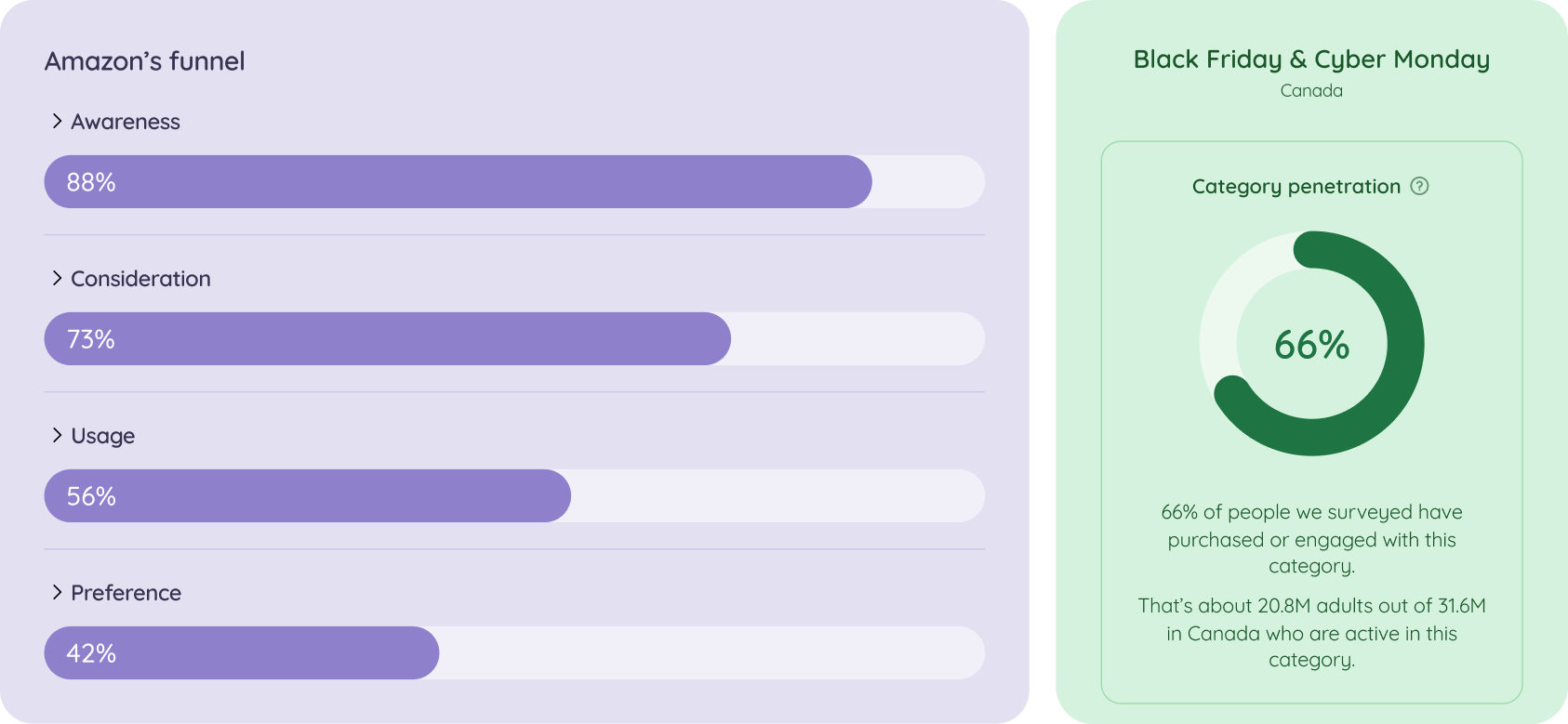
So we asked. In October 2026, Tracksuit surveyed 1,595 Canadian adults about Black Friday and Cyber Monday (BFCM), and 66% said they’d bought in a BFCM sale in the past year or were open to it, the second-highest rate of the eight countries in our study. Scaled up to the adult population, that equates to roughly 22 million people.
The 1,042 who qualified rated 15 major retailers, and the list itself is the first finding. Twelve of the fifteen are headquartered somewhere else, mostly the US: Amazon, eBay, Walmart, Best Buy, Costco, Home Depot, Staples, Wayfair, Sephora, Temu, Shein and AliExpress. Only three are Canadian-owned: Canadian Tire, Visions and Bouclair. Canada’s Black Friday is a sale run from across the border.
One idea runs through this whole series, and it’s the easiest way to read what follows: the shortlist is long, but the basket is short. Shoppers will happily consider a handful of retailers and then buy from one or two. In Canada the long shortlist is full of American names, and the basket is shared between Amazon and a clear second tier. The retailers that win are the ones that turn “I’d consider it” into “I bought it”, and then into “I’ll be back next year”. Remember what we’re reading here: this is shoppers’ state of mind going into Black Friday 2026, not what happens during it. We’ll follow up in January with three months of data and the full story. Here’s what we found.
Amazon first, then a strong American second tier
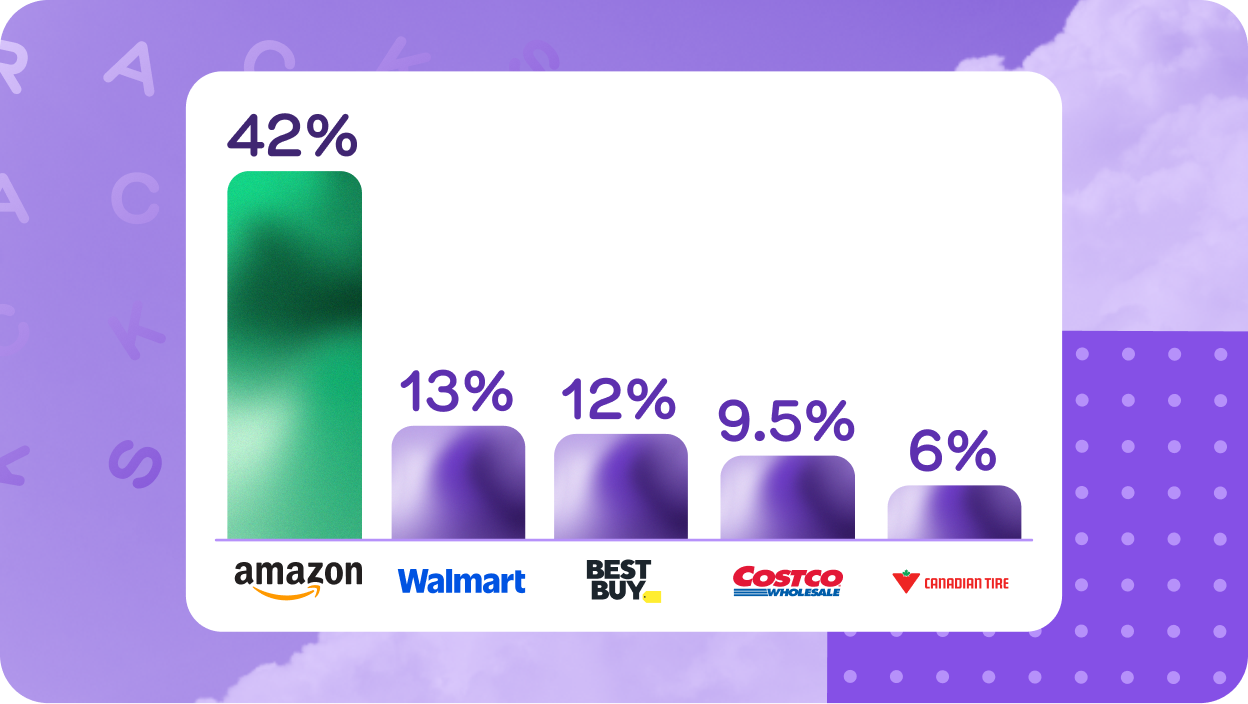
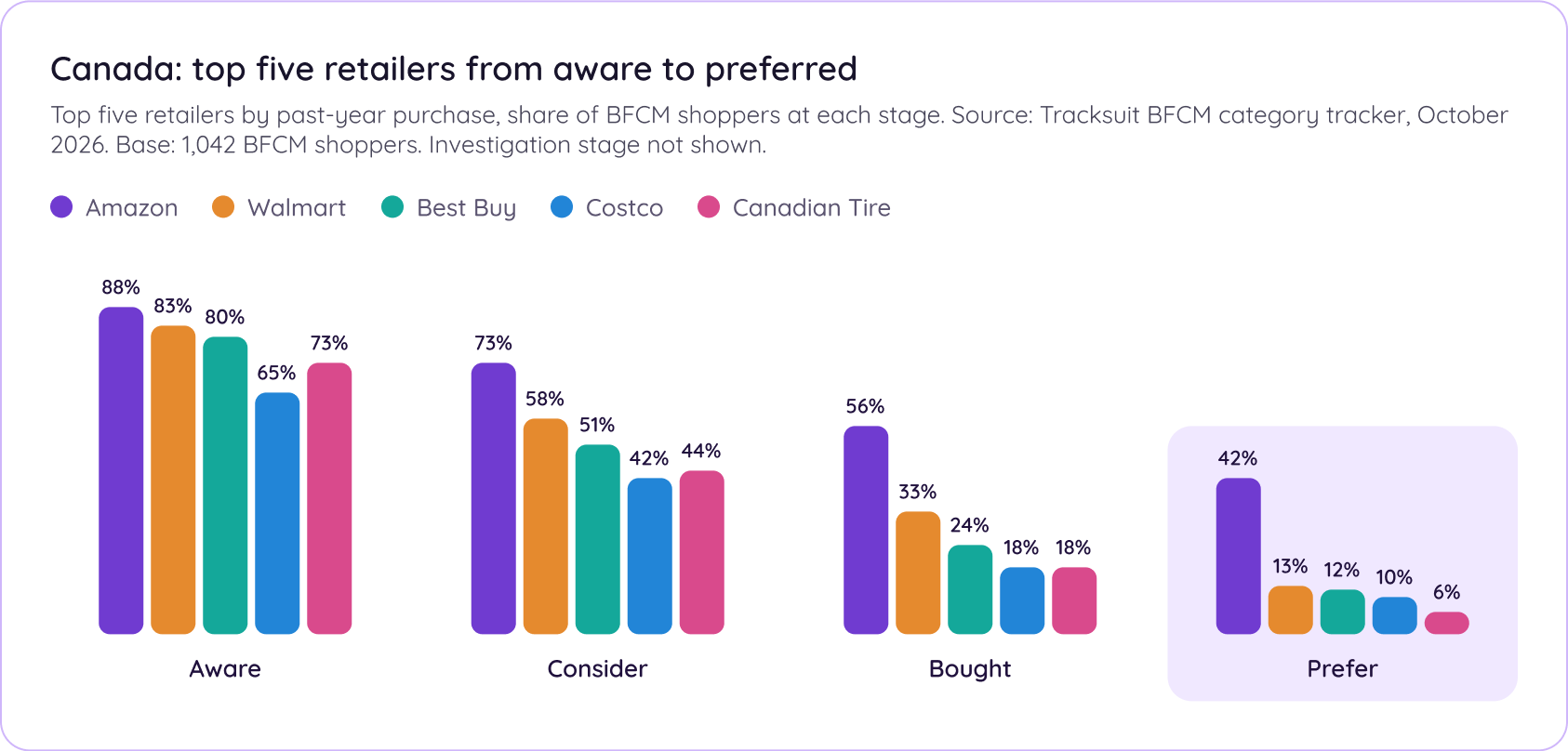
Ask Canadians which one retailer they’d most like to buy from during BFCM and 42% say Amazon. Nearly everyone knows it: 88% of shoppers have heard of it, 73% would consider buying from it and 56% bought from it last Black Friday or Cyber Monday. We also read shoppers short statements, like “is where I shop every Black Friday” and “is a brand I trust”, and asked which retailers each one describes, counting only people who already know the brand. Among people who know it, 41% say they shop there every Black Friday.
But Canada has a second tier that most countries lack. Walmart (13% preferred, 33% bought last year), Best Buy (12% and 24%) and Costco (9.5%) together hold about a third of first preferences, and all three are considered by more than four in ten shoppers. Purchase and preference are counted differently, which is why the gap between them is so telling: shoppers could name as many retailers as they liked when we asked what they’d bought, so purchase rates can add up to well over 100%, while preference is one pick each and can’t.
Sign up for Shorts
For fortnightly brand insights, stories and goodness that’ll help you win (we promise).
The second tier shows up at the checkout too
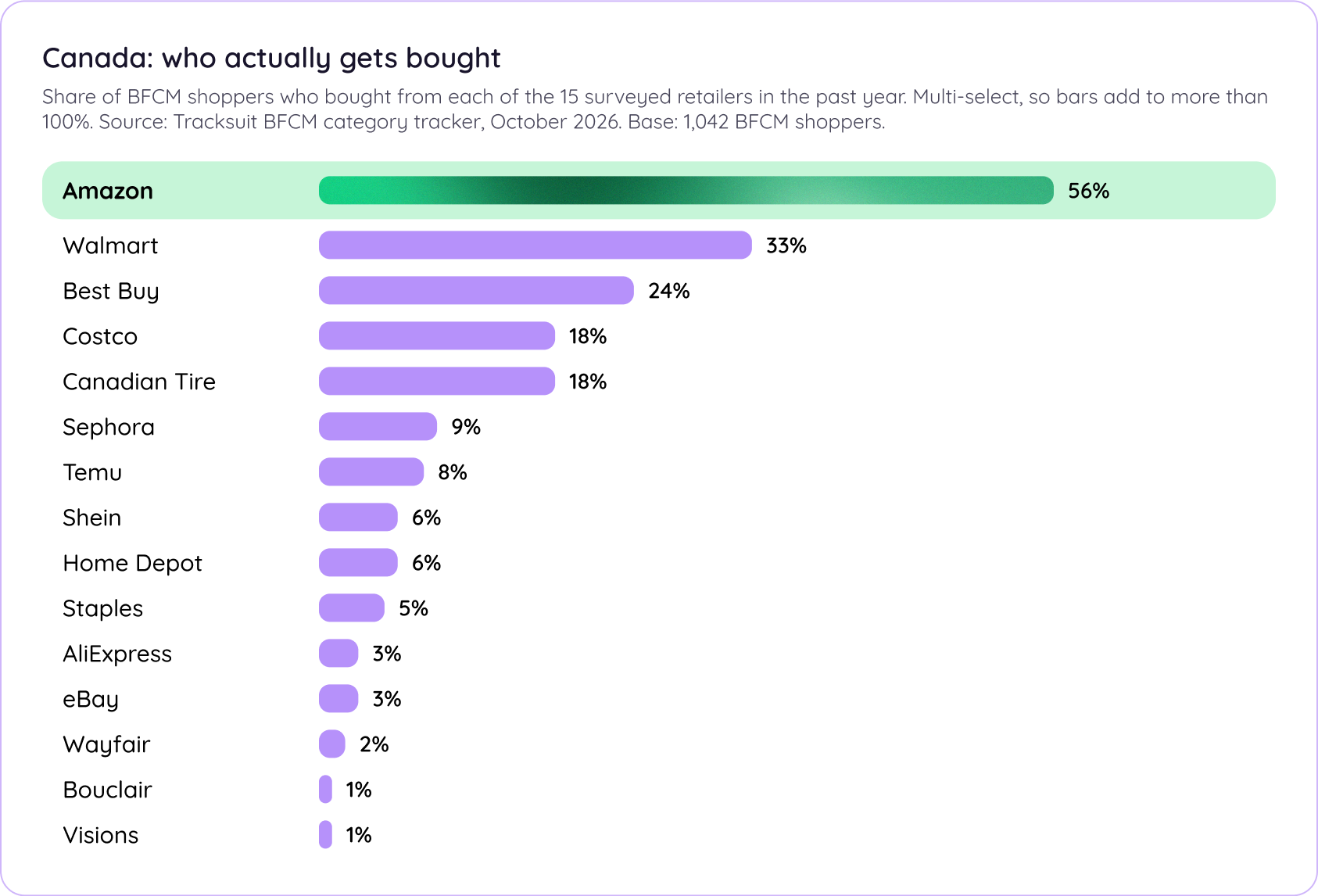
Walmart is bought by 33% of BFCM shoppers and Best Buy by 24%, behind Amazon’s 56%. Costco and Canadian Tire follow at 18% each. The average Canadian shopper bought from 1.9 of the 15 major retailers we surveyed, and Amazon accounts for 29% of all the purchases reported across them. The shortlist-to-checkout drop is steepest for the store chains: Canadian Tire is considered by 44% and bought by 18%, Costco by 42% and 18%, Walmart by 58% and 33%.
Canadians come with repeat BFCM purchasing habits
Two-thirds of Canadian adults (66%) are in the sale or open to it, and the ones who are come with repeat BFCM purchasing habits. For the average retailer we tracked, 16% of people who know it say they shop there every Black Friday, the highest of the eight markets. Amazon’s score is 41%, but Walmart (25%), Costco (24%) and Best Buy (23%) all have a real every-year following.
The average shopper also bought from 1.9 of the 15 major retailers we surveyed. Amazon takes 42% of first preferences and nobody else gets above 13%.
The chart shows who gets the baskets. After Amazon (56%) comes the American second tier: Walmart (33%), Best Buy (24%), then Costco and Canadian Tire on 18% each.
Canadian Tire holds the flag
Canadian Tire is the only Canadian-owned brand with real scale in the sale: 73% recognise it as a BFCM retailer, 44% would consider it, 18% bought from it last year and 6% prefer it. It also has the second-highest trust score in the market (49%), behind only Costco (52%).
Trust is the interesting one. The two most trusted BFCM brands in Canada are both store chains, and neither is a top-two preference. There’s a gap between what Canadians believe about these brands and where they say they’ll shop, and gaps like that are where campaigns live.
Walmart owns cheap, Amazon owns fast
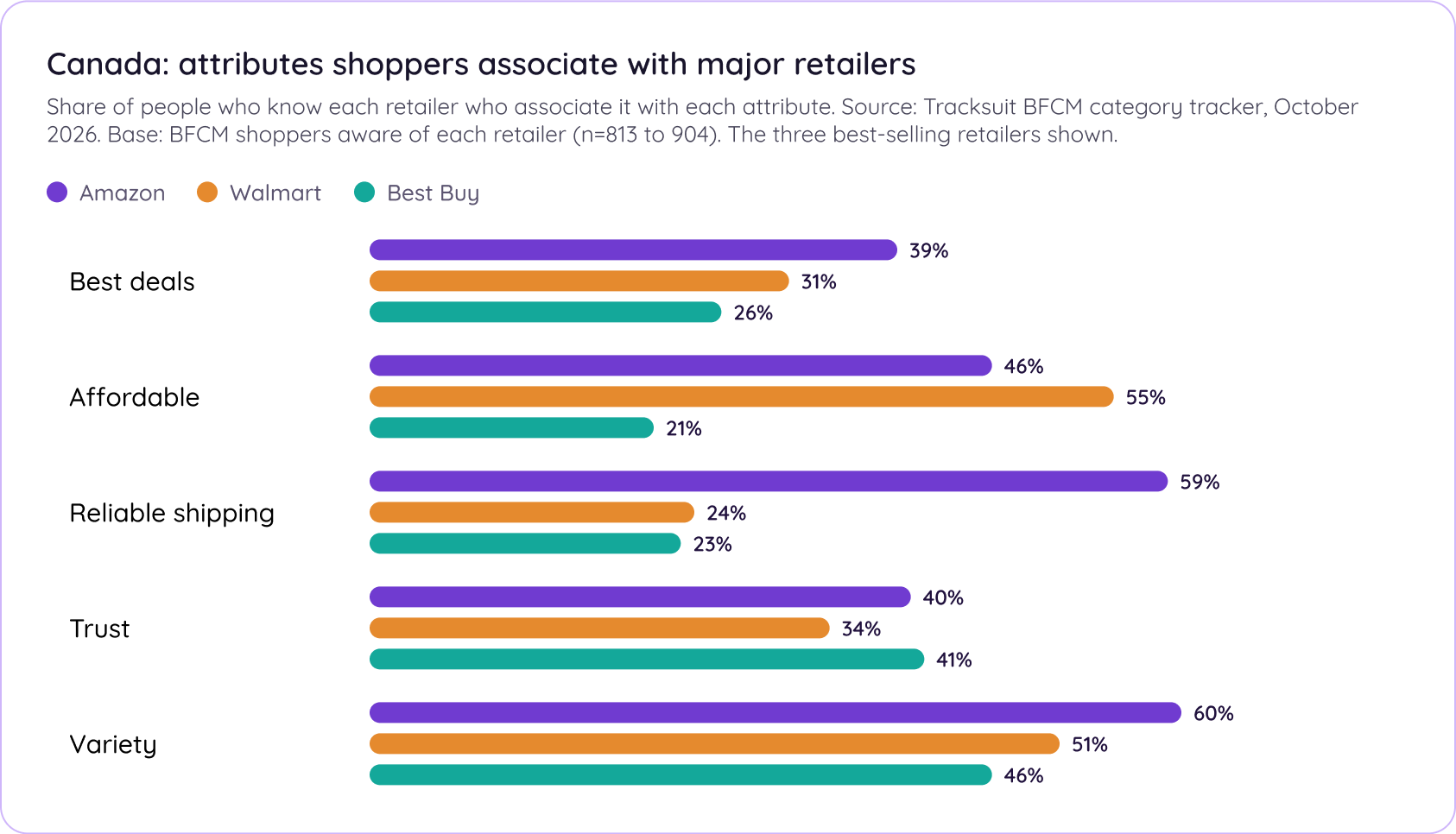
Among people who know each brand, Walmart leads “affordable” at 55%, with Temu and Amazon level behind at 46%. Amazon leads everything to do with delivery: 64% fast shipping (Walmart 23%), 59% reliable shipping, and 39% “has the best deals” (Costco 36%, Walmart 31%).
The chart makes the division of labour clear. Walmart wins on “affordable” (55% against 46% for Amazon), while Amazon wins on reliable shipping (59% against 24% for Walmart and 23% for Best Buy). Best Buy is level with Amazon on trust (41% against 40%), which is an asset that hasn’t yet turned into preference.
Temu is the best of the Asian marketplaces here
Temu has had a better run in Canada than in the US. It’s recognized by 45% of BFCM shoppers, considered by 14%, was bought from by 8% last year and is preferred by 2.3%. Together with Shein and AliExpress it holds 4.5% of first preferences.
Their calling card is the same as everywhere: affordable. Their weakness is too: 14% of Canadians who know Temu call it a brand they trust, and Canada is the market where the trust gap between the Asian marketplaces and the North American ones is widest.
Best Buy and the sale habit
Best Buy’s numbers show a brand bound to the sale: among people who know it, 23% shop there every Black Friday. The problem, as with electronics chains everywhere, is how few of them there are.
Where Canadians are two weeks out
Canadians come into the sale with repeat BFCM purchasing habits. Two in three adults (66%) are in the sale or open to it, and for the average retailer 16% of the people who know it say they shop there every Black Friday, the highest of the eight markets. This isn’t a market of one-off bargain hunters. It’s a market with traditions.
Amazon sits at the centre of them: 56% of BFCM shoppers bought from it, 42% would pick it first and nobody else is above 13% (Walmart 13%, Best Buy 12%, Costco 10%). But Amazon isn’t the only routine. 41% of people who know it shop there every Black Friday, and Walmart (25%), Costco (24%) and Best Buy (23%) each have an every-year following of their own.
Baskets are modest, at 1.9 of the 15 major retailers on average. So the Canadian shopper two weeks out is loyal to a short list, and the question for everyone else is whether they’re on it.
What this means if you’re competing with Amazon
Canada is contested in a way most markets aren’t, because the second tier already has repeat BFCM purchasing habits to build on. Four moves for the two weeks left:
- Turn repeat BFCM purchasing habit into first choice. Walmart, Best Buy and Costco each have roughly one in four known-brand shoppers who come every Black Friday, but Walmart is bought by 33% and preferred by 13%. Ask your regulars to start with you, with early access, members’ offers or a clear reason to look at you before the others.
- Put delivery certainty next to price. Amazon’s lead on reliable shipping is 35 points over Walmart (59% against 24%), and on fast shipping it is 64% against 23%. A clear delivery promise is the cheapest way to narrow that.
- Say “trusted and good value”, not “cheapest”. Costco (52%) and Canadian Tire (49%) are the most trusted brands, and Canadian Tire out-trusts Amazon (40%), but it is bought by 18% and preferred by 6%. Walmart already owns “affordable” (55%), so the gap nobody has filled is value you can trust.
- Use trust against the marketplaces. Only 14% of Canadians who know Temu call it a brand they trust, and Canada is the market where the trust gap between the Asian and North American marketplaces is widest. Make reliability part of your Black Friday message.
After the sale, the shoppers who say they come every year are the ones most open to being asked to start with you.
Methodology
Part of Tracksuit’s eight-country Black Friday 2026 study. Read the global view here: [Link: global post]. Methodology: 1,595 Canadian adults surveyed in October 2026, of whom 1,042 qualified as BFCM shoppers; brand statements are asked of people aware of each brand; gender differences are quoted only where they pass a 95% significance test and the sample is large enough for Tracksuit to report without an indicative or insufficient flag. Retailers per shopper adds each market’s purchase rates across the 15 major retailers surveyed. Retailer groups: the 15 major retailers are grouped as global marketplaces headquartered in the US (Amazon and eBay); marketplaces headquartered in Asia (Temu, AliExpress and Shein); beauty (French-headquartered Sephora); electronics and appliances (Visions, plus US-headquartered Best Buy); general merchandise (Canadian Tire, plus US-headquartered Walmart); home improvement (US-headquartered Home Depot); home and furniture (Bouclair, plus US-headquartered Wayfair); warehouse clubs (US-headquartered Costco); office and tech (US-headquartered Staples). Unless marked, brands are headquartered in Canada. Population equivalents apply each market’s engagement rate to the UN World Population Prospects 2024 (medium variant) estimate of the population aged 18 and over at 1 July 2026. We’ll publish a follow-up in January, using a full three months of data, on how the sale actually played out. AI was used to support ideation and iteration of this analysis. All data points and observations have been refined and validated by Tracksuit’s Marketing Science team.