
Black Friday arrived in Britain about a decade ago as an American import, and like most imports it has been thoroughly adopted. It now runs across two weeks rather than a Friday, every retailer from Argos to Harrods has a plan for it, and the question shoppers ask has quietly shifted from “is this a real sale?” to “where do I go first?”
So before this year’s sale landed, we asked. In October 2026, Tracksuit surveyed 593 UK adults about Black Friday and Cyber Monday (BFCM). Two-thirds of them (68%) had either bought in last year’s BFCM sales or were open to doing so, the highest engagement rate of the seven countries in our study. Scaled up to the adult population, that equates to roughly 38 million people.
The 68% of respondents who qualified as BFCM shoppers then told us what they think of 15 major retailers: the global marketplaces (Amazon, eBay, Temu, Shein and AliExpress) and ten British names across electronics, grocery, fashion and department stores (Argos, Currys, Tesco, M&S, John Lewis, Very, ASOS, Debenhams, Harrods and AO). It’s a strong home side. The results say it isn’t a fair fight.
Black Friday has a reputation as a free-for-all of bigger discounts, earlier deals and increasingly louder attempts to get shoppers to hit ‘buy now’. It’s an easy conclusion to reach when discounts dominate the conversation. What British shoppers told us goes deeper. The retailers they prefer are strong on two things at once. They have mental availability, meaning shoppers know them and would consider them, and physical availability, meaning shoppers can find and acquire items easily. So while discount culture may feel like a race to the bottom, people are racing to the strongest brand, and in Britain one brand is a long way in front.
We’ll kick this analysis off with who is winning on purchase and preference, then how mental and physical availability line up behind the brand that wins, and the wider brand picture behind it. The retailers that win are the ones that turn “I’d consider it” into “I bought it”, and then into “I’ll be back next year”.
Remember what we’re reading here: this is shoppers’ state of mind going into Black Friday 2026, not what happens during it. We’ll follow up in January with three months of data and the full story. Here’s what we found so far.
Amazon leads the race to the brand
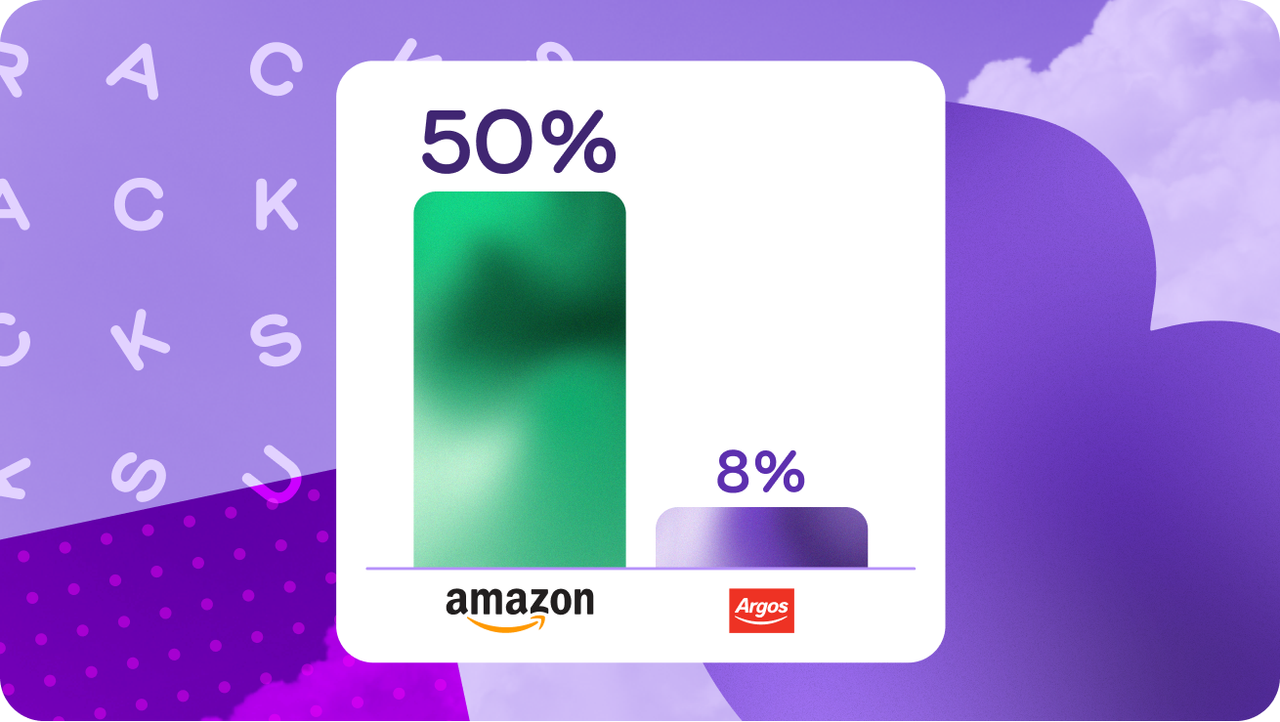
Ask UK shoppers which retailer they’d prefer to buy from during BFCM, one choice only, and 50% say Amazon. The next name is Argos at 8%. That’s a 42-point gap, and no other brand reaches 10%.
Amazon didn’t get there on awareness alone. 89% of shoppers recognise it as a BFCM retailer, 71% would consider it, and 55% bought from it in last year’s BFCM. Among people who know it, 35% say it’s where they shop every single Black Friday; the next-highest brand on that measure is John Lewis at 14%.
Sign up for Shorts
For fortnightly brand insights, stories and goodness that’ll help you win (we promise).
From shortlist to checkout: where UK retailers lose the sale
The shortlist isn’t where the sale leaks. The till is. Amazon goes from 71% consideration to 55% bought. Argos goes from 53% to 21%, Currys from 49% to 16% and Tesco from 45% to 20%. Across the 15 major retailers we surveyed, the average BFCM shopper bought from 1.9 of them, and Amazon accounts for 29% of all the purchases British shoppers reported across those 15.
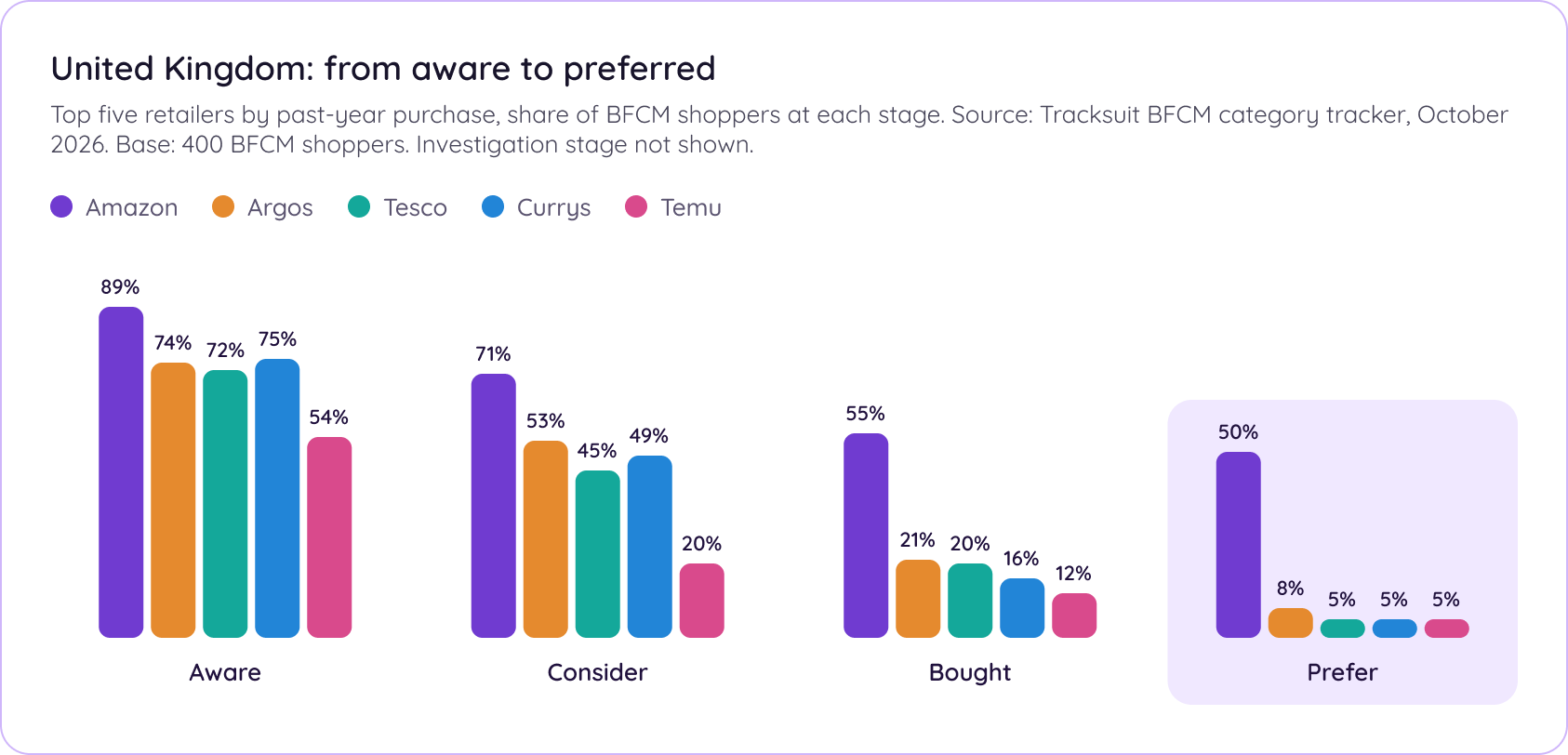
Awareness and consideration are how we read mental availability, and Amazon keeps more shoppers moving through every stage than Argos, the next best-selling British retailer. 80% of the people who know Amazon for BFCM consider it (Argos 71%), 77% of those who consider it bought from it (Argos 40%), and 90% of those who bought from it prefer it (Argos 37%).
Shoppers arrive with a default, not an open mind
What’s already in UK shoppers’ heads? Quite a lot, and it points one way. Half of the BFCM shoppers we surveyed name Amazon as the one retailer they’d prefer to buy from this year, and nobody else reaches one in ten. They aren’t arriving with an open mind. They’re arriving with a default.
We also gave BFCM shoppers short statements, like “is where I shop every Black Friday”, and asked which ones they associate with each major retailer, counting only people who already know the brand for BFCM. For the average retailer we tracked, 11% of people who know it for BFCM say it’s where they shop every Black Friday. Repeat BFCM purchasing habit is the telling number, because it’s the share who go back without needing a reason. Amazon’s is 35%. For most British names it’s a fraction of that, which means a lot of loyalty is still there to be earned.
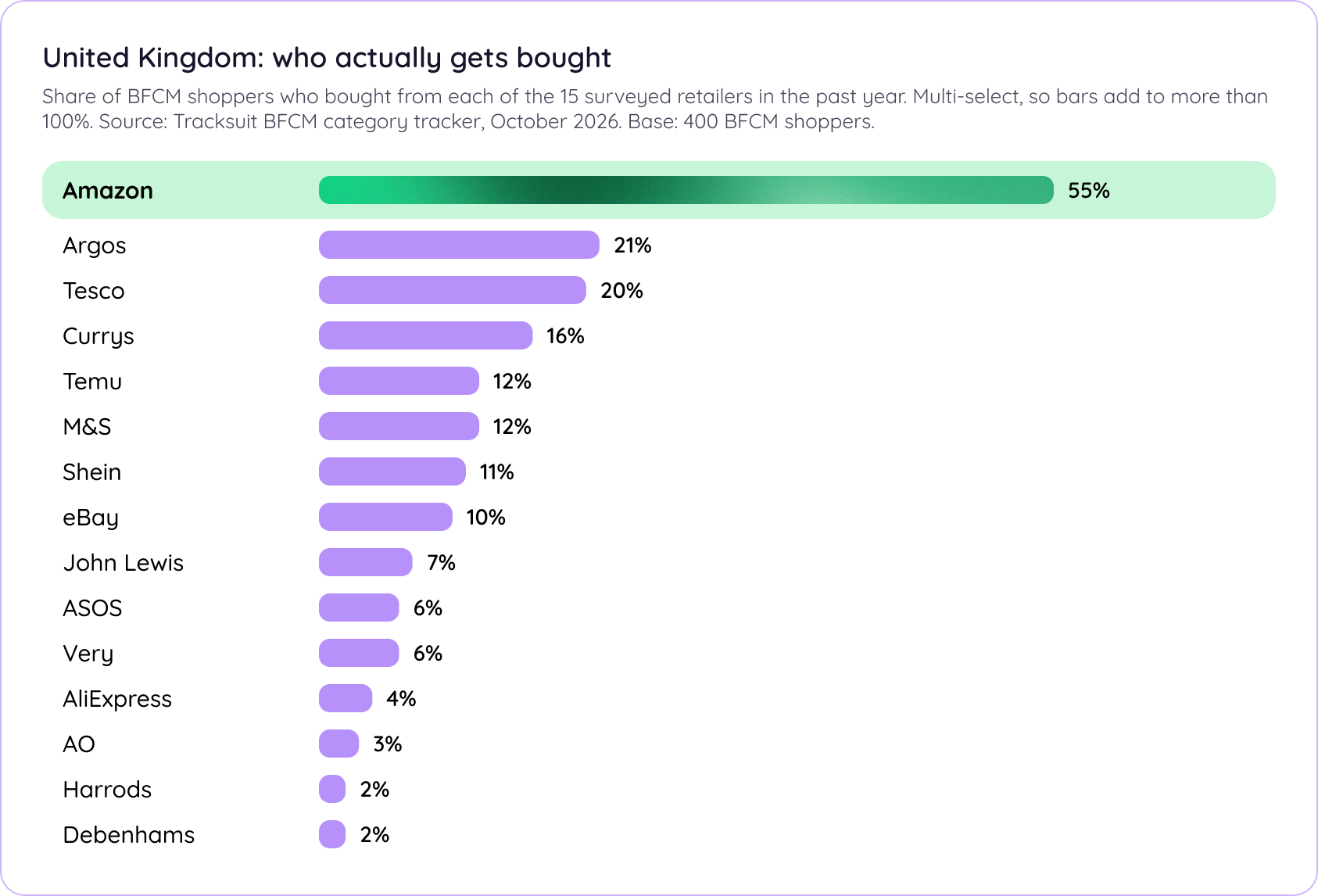
The chart shows what that looks like at the checkout. Amazon was bought from by 55% of shoppers last year. A cluster of British names follows on 16 to 21% (Argos, Tesco and Currys), and then Temu and Shein sit level with M&S.
The physical availability machine behind Amazon’s lead
We asked Black Friday shoppers which of 13 qualities they associate with each retailer, from reliable shipping and ease of use to trust and value, counting only people who already know the brand. Two things to keep in mind. Shoppers could pick more than one statement for each retailer, so “has the best deals” isn’t a preference, but it’s a strong sign of where shoppers see value. And the charts weight each score by how many BFCM shoppers know the retailer, which makes retailers with different reach more comparable. Four qualities stood out as most closely linked to retailer preference across our seven markets, and in the UK Amazon leads all four.
Among people who know it for BFCM, 61% call Amazon easy to use (Argos is next at 51%), 58% associate it with a wide range of deals (Argos 43%), 36% say it has the best deals (Tesco 27%, Argos 26%) and 52% say its shipping is reliable, where no UK retailer gets above John Lewis’s 31%.
UK retailers hold their own on trust, the quality where the gap with Amazon is slimmest. Among people who know each retailer for BFCM, M&S (60%) and John Lewis (54%) are more trusted than Amazon (53%), with Tesco at 51% and Argos at 47%. Weighted by how many shoppers know each brand for BFCM, Amazon is ahead, though only just: 47% of all BFCM shoppers both know Amazon and trust it, against 41% for M&S, 37% for Tesco, 35% for Argos and 32% for John Lewis, because more shoppers know Amazon for BFCM. It’s still the closest Amazon gets to the locals on any quality. Trust is shaped by many things beyond Black Friday, so this isn’t a BFCM-only read.
Yet BFCM preference for all four major local retailers sits between 5% and 8%, against 50% for Amazon, even though Argos is considered by 53% of BFCM shoppers, Currys by 49%, Tesco by 45% and M&S by 43%. The shortlist is strong. What shoppers associate with Amazon, and not yet with the locals, is the machine: the ease, the range of deals and the certainty that the parcel turns up.
Put the brand attributes side by side and the gap that matters is reliable shipping: 52% for Amazon, 26% for Argos and 22% for Tesco. The one thing challengers can’t yet claim is certainty that it will arrive.
The chart below weights each score by how many shoppers know the retailer, so the total responses per retailer are comparable. That is why its figures read lower than the ones above, which are among people who know each brand.
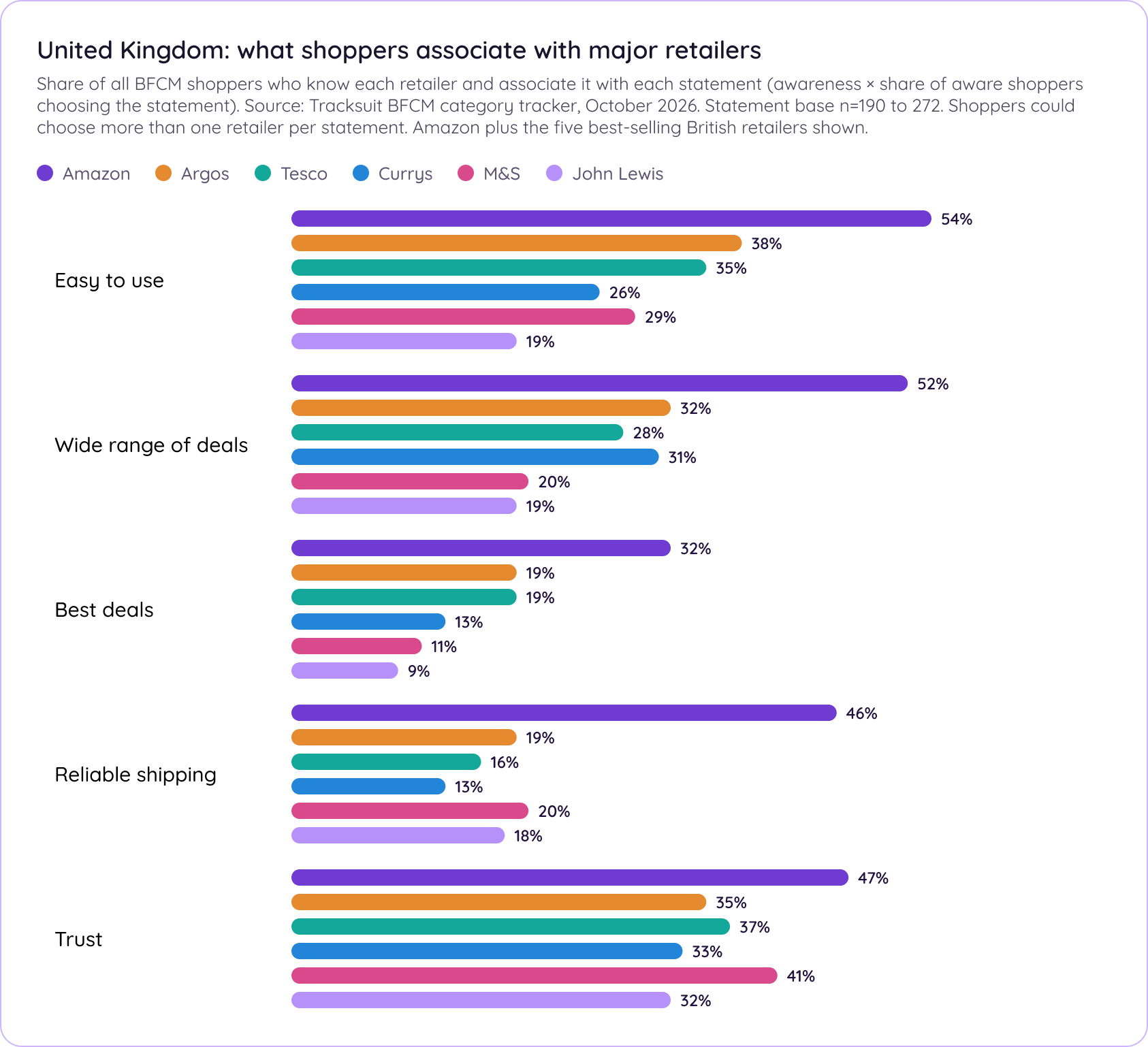
Can a UK retailer compete with Amazon? The data suggests they can, but few have all the right ingredients. Argos is the closest on ease of use and range of deals, John Lewis is the closest on reliable shipping, and M&S and John Lewis lead on trust.
The takeaway? The second basket goes to whoever assembles the most of the machine first.
Temu and Shein have attention, not brand
Last BFCM, Temu was bought by 12.5% of UK BFCM shoppers, effectively level with M&S (12.3%) and ahead of John Lewis (6.7%) and ASOS (6.4%). Shein, at 10.9%, also beat ASOS, the only British fashion brand in our set.
They did it from a small shortlist. Both are known by around half of BFCM shoppers, but only just over a third of the people who know them would consider them, against 63% for M&S. Once shoppers do consider them, six in ten buy. Preference is still low (Temu 4.7%, Shein 3.1%), trust sits at 13% and 15%, and on “has reliable shipping” they score 19% and 21% against Amazon’s 52%. They’ve bought attention, some of the baskets, but there’s more mental availability to be built.
The chart below sets Temu and Shein beside Amazon and the average of the ten British retailers at each stage, from awareness through to preference.
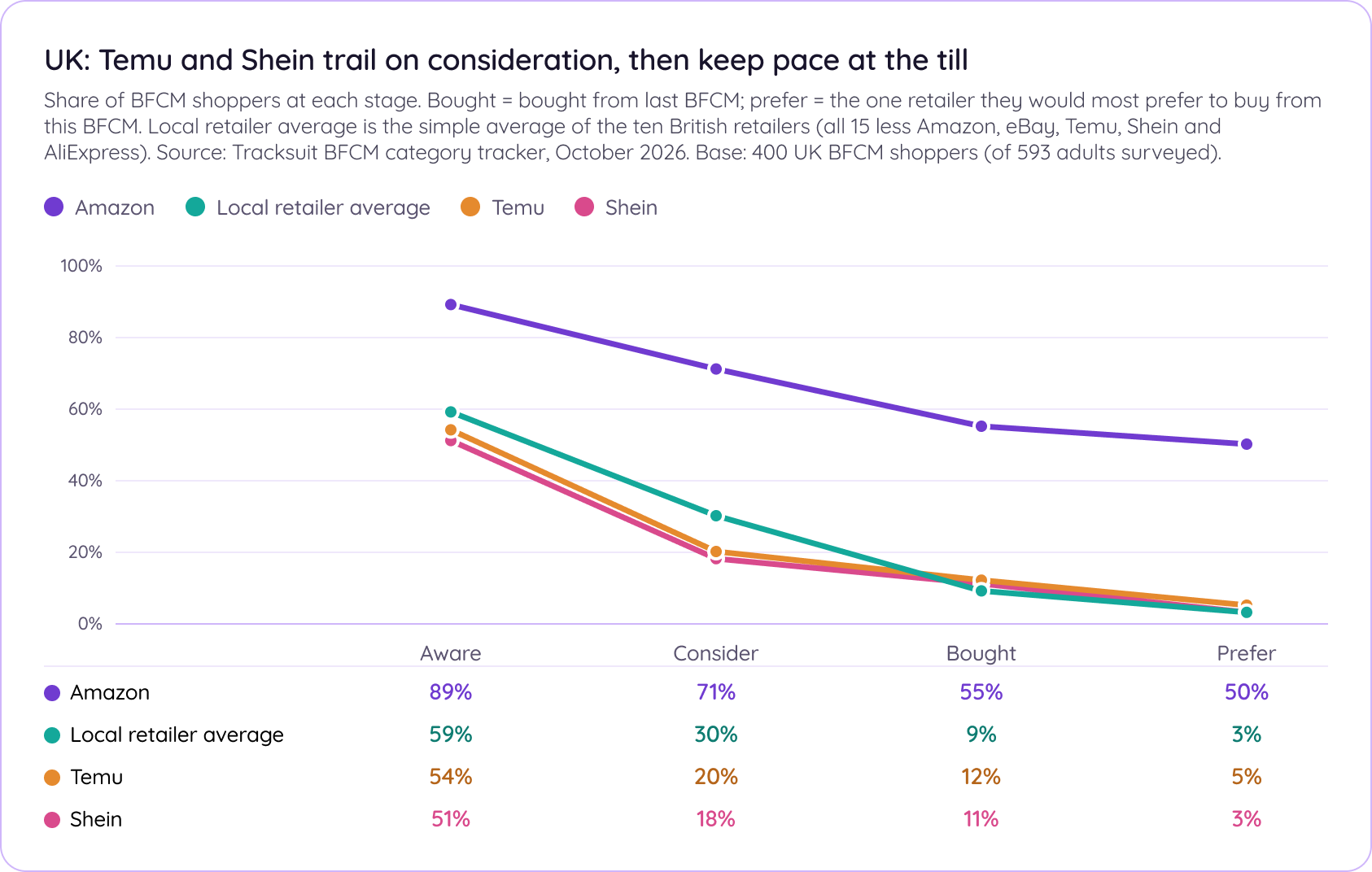
Against the ten UK retailers on our list, Temu and Shein are known for affordability and deals. Among people who know them, 41% call Temu affordable and 44% call Shein affordable, against 27% for the average UK retailer, and 23% and 22% say they have the best deals, against 16%.
Temu and Shein are also falling behind on awareness, consideration and trust.
Temu is known by 54% of BFCM shoppers and Shein by 51%, against 59% for the average British retailer. Just 20% and 18% consider them, against 30%. And among people who know them, only 13% and 15% associate them with trust, against 39%.
The takeaway? Getting attention is one thing. Turning it into trust, consideration and purchases is another.
How UK shoppers are heading into the sale
Imagine a British shopper two weeks out and the first thing you notice is that most of the decision has already been made. Half of BFCM shoppers (50%) would pick Amazon first, and nobody else gets to one in ten (Argos is next, on 8%). It isn’t that the alternatives are unknown or distrusted: Argos is considered by 53% of shoppers, and M&S (60%) and John Lewis (54%) are more trusted than Amazon. They’re just not the first name that comes to mind.
This shopper isn’t browsing widely, either. The average Brit bought from 1.9 of the 15 major retailers we surveyed, which is a first stop and perhaps one more.
Repeat BFCM purchasing habit is where the gap is widest. 35% of people who know Amazon say they shop there every Black Friday, against 11% for the average retailer in the set. So the picture is of someone who has done this before, knows where they’re going and mostly wants confirmation that the deal is good enough. For everyone else, the job is to be the browser tab they open second.
What separates the names is that Amazon is strong on both fronts: more shoppers know and consider it (89% and 71%), and it leads on ease of use, range of deals, best deals and reliable shipping. The British names have won a place on the shortlist (Argos is considered by 53%) and on trust, but not yet on the physical side. Two weeks out, this looks like a race to the brand: the shopper arrives with a favourite, and the rest of the field is competing for second place.
What this means if you’re racing against Amazon
Mental and physical availability win the sale together. Amazon isn’t magic: 89% know it, 71% would consider it, 55% bought from it and 50% would pick it first, and it leads on the physical side too. UK challengers lose the shopper later in the funnel. There might not be time to overhaul your entire strategy before the peak, but four small moves can still go a long way:
- Where possible, close the gap on delivery. Amazon leads UK retailers on ease of use (61% against Argos’s 51%), range of deals (58% against Argos’s 43%) and best deals (36% against Tesco’s 27%), but the widest gap is delivery: no British retailer gets above 31% on reliable shipping against Amazon’s 52%. Make delivery promises where practical, and put stock availability and clear returns next to the discount.
- Be the second browser tab. The average shopper bought from 1.9 of the 15 major retailers we surveyed shoppers about, so there’s always a second basket. Argos is considered by 53% and bought by 21%; Currys goes from 49% to 16%. “The one I check after Amazon” is a position you can claim in two weeks.
- Spend your trust lead. British retailers lead Temu and Shein on trust by 20 points or more, and M&S (60%) and John Lewis (54%) are more trusted than Amazon. A discount alone won’t hold that line, but “the deal you can trust” might.
- Start building next year’s repeat BFCM purchasing habit now. Email, loyalty offers and a reason to come back in 2027 are how this year’s buyers become the 35% Amazon enjoys.
Two weeks out, Britain is a race to the brand, and Amazon is a long way in front. It’s the retailer that pairs being known and considered with being easy to use, strong on deals and reliable on delivery, and that’s the bar the British names have to clear. Argos, M&S and John Lewis already hold pieces of it, on the shortlist and on trust, so the retailer that adds the physical side first has the best chance of winning the second basket. The part of this that outlasts the sale is repeat BFCM purchasing habit, and it’s the number we’ll be watching when we circle back in January with three months of data.
Methodology
Part of Tracksuit’s seven-country Before Black Friday 2026 study. Read the global view here: [Link: global post].
In October 2026 Tracksuit surveyed 593 UK adults. Respondents qualified as BFCM shoppers if they said they had bought in a Black Friday or Cyber Monday sale in the past 12 months or were open to buying in this year’s sale; 400 did. Unless stated, results are shares of the 400 BFCM shoppers in the UK, rounded to whole numbers, so totals and differences may not add exactly.
BFCM shoppers rated 15 major retailers in their market on four measures: awareness (recognising the retailer as a BFCM retailer), consideration (would consider buying from it), bought (bought from it in last year’s BFCM, with as many choices as they liked) and preference (the one retailer they would most prefer to buy from this BFCM). Conversion between stages, such as “80% of the people who know Amazon for BFCM consider it”, divides one stage by the one before, using each stage’s share of all BFCM shoppers.
Retailers per shopper adds each market’s purchase rates across the 15 retailers, and a retailer’s share of purchases is its purchase rate divided by that total.
Brand perception statements are asked of people aware of each brand: they chose which of 13 short statements fit each retailer, and could choose more than one statement for each retailer, so statement scores are shares of aware shoppers and are not a preference measure. Where we weight statements by awareness, we multiply the share of aware shoppers choosing a statement by the share of BFCM shoppers who know the retailer, and show the result as a share of all BFCM shoppers, so that the share of the population who hold each view is more evident. Statement results are used only for retailers with at least 100 aware respondents.
Brand statements and preference: we used Spearman’s rank correlation to identify the strongest connection points between the brand statements and the funnel metrics, across the 101 retailer-and-market pairs with at least 100 aware respondents in the seven-market analysis.
The Temu and Shein comparison sets each against the average of the ten British retailers (the 15 less Amazon, eBay, Temu, Shein and AliExpress), using statements only where at least 100 people were aware of the brand.
Each retailer appears once per market and the pairs aren’t fully independent, so the figures describe the pattern rather than test for cause.
Retailer groups: the 15 major retailers are grouped as global marketplaces headquartered in the US (Amazon and eBay); marketplaces headquartered in Asia (Temu, AliExpress and Shein); fashion (ASOS); electronics and appliances (Currys and AO); general merchandise (Argos and Very); grocery (Tesco); department stores (M&S, John Lewis, Debenhams and Harrods). Unless marked, brands are headquartered in the UK.
Population equivalents apply each market’s rounded engagement rate to the UN World Population Prospects 2024 (medium variant) estimate of the population aged 18 and over at 1 July 2026.
We’ll publish a follow-up in January, using a full three months of data, on how the sale actually played out.
AI was used to support ideation and iteration of this analysis. All data points and observations have been refined and validated by Tracksuit’s Marketing Science team.